

The Ultimate Ladakh Bike Trip: A Complete Rider's Guide
A Ladakh bike trip is the ride every rider dreams of. An in-depth guide to the routes, permits, passes, fuel, altitude and gear, down to the last detail.
 RydrLoop··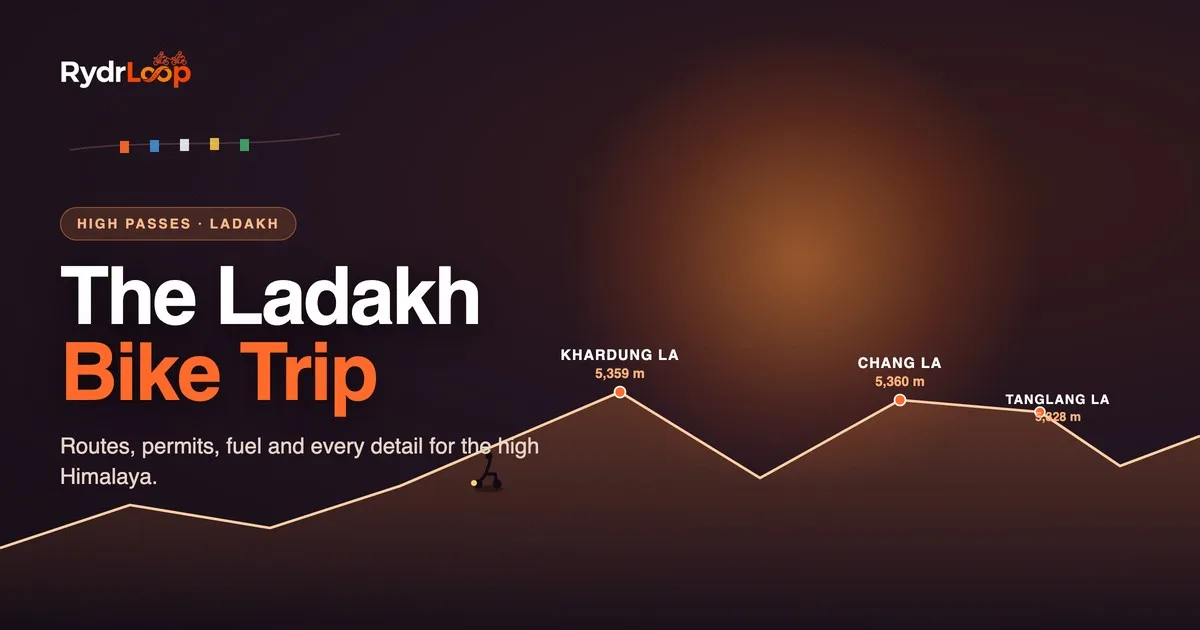
Ask any rider in India about the one trip they want to do before they hang up their helmet, and the answer is almost always the same: a Ladakh bike trip. The high passes, the impossible blue of Pangong, the empty moonscapes, the sheer scale of it all. Ladakh is the ride that other rides prepare you for. It is also a place that punishes the unprepared, not with difficulty alone but with altitude, distance and remoteness.
This guide is deliberately long and detailed, because a Ladakh bike trip has a hundred small things that matter: which way to ride in, where the last fuel pump is, which SIM works, when to cross a water crossing, how to keep altitude sickness from ending your trip on day three. Read all of it, plan properly, and Ladakh gives you the ride of your life.
When to go
Ladakh is a summer destination for riders. The high passes that connect it to the rest of the country are buried in snow for most of the year and open only in the warmer months.
- Mid-June to mid-September is the season. This is when both the Manali-Leh and Srinagar-Leh roads are reliably open.
- June gives you snow walls on the passes and fewer crowds, but some stretches have only just opened and can be rough.
- July and August are peak season and the busiest, but this is also monsoon time in the rest of the country, so the approach roads from Manali and Srinagar can see landslides and delays. Ladakh itself stays mostly dry (it sits in a rain shadow), but getting there can be slow.
- September is many riders' favourite: clear skies, golden light, thinner crowds, and cold but stable weather. Nights are properly cold by now.
- From October onwards the passes begin to close and Ladakh becomes a winter expedition of a completely different kind.
The two ways in, and the loop that works best
There are two classic road routes for a Ladakh bike trip, and how you use them matters for your safety.
- Srinagar to Leh (about 420 km): via Sonamarg, the Zoji La pass, Drass (one of the coldest inhabited places in India), Kargil, and the surreal moonland of Lamayuru. This route climbs more gently, which makes it far better for acclimatization.
- Manali to Leh (about 470 km): via the Atal Tunnel, Keylong, Jispa, the high Baralacha La, Sarchu, the famous Gata Loops, Nakee La, Lachulung La, the vast More Plains, and Tanglang La. This route is higher, harsher, and gains altitude fast, with Sarchu sitting at a brutal 4,290 metres.
The smartest way to do a full Ladakh bike trip is to ride up via Srinagar and come down via Manali. You gain altitude gradually on the way in, acclimatize properly in Leh, and only tackle the higher, faster Manali route on the way out once your body is adjusted. Doing it the other way around, hammering up from Manali to Sarchu on day two, is the single most common way riders get altitude sick.
If you are short on time, many riders fly into Leh instead and rent a bike there. That works, but you must then spend your first two days doing nothing strenuous while your body adjusts to 3,500 metres.
A sensible itinerary
Give a Ladakh bike trip at least twelve to fourteen days end to end. Here is a route that balances riding with the acclimatization your body needs:
- Srinagar to Kargil. Ease in over Zoji La. Overnight at Kargil or Drass.
- Kargil to Leh via Lamayuru and the monasteries of Alchi and Likir. Reach Leh.
- Leh, rest and acclimatize. Do not ride high today. Explore Leh town, Shanti Stupa, the Hall of Fame, Magnetic Hill, the Gurudwara Pathar Sahib and the Indus-Zanskar confluence at Sangam.
- Leh to Nubra Valley over Khardung La (around 5,359 metres). Stay at Hunder or Diskit.
- Nubra to Turtuk and back, the last village before the border, with its unique Balti culture, then return to Leh or stay in Nubra.
- Leh to Pangong Tso over Chang La (around 5,360 metres). Camp near Spangmik or Man.
- Pangong to Leh, or push on towards Tso Moriri via Chushul and Loma if you have the permits and the days.
- Tso Moriri (Korzok) and, for the truly committed, remote Hanle with its dark-sky observatory.
- Return to Leh, top up on rest and fuel.
- Leh to Manali over two days, overnighting at Sarchu or Jispa, crossing Tanglang La, Pang and the high passes on the way down.
Build in spare days. Weather, landslides and your own body can all cost you a day, and a rigid schedule in Ladakh is a broken schedule.
The places that make a Ladakh bike trip
- Leh. Your base, at around 3,500 metres. A lively little town of monasteries, markets, cafes and bike shops, ringed by mountains. This is where you rest, refuel, arrange permits and plan.
- Khardung La and Nubra Valley. Khardung La is the pass every rider wants the photo at, and the descent drops you into Nubra, where sand dunes and double-humped Bactrian camels sit against snow peaks at Hunder. Diskit's giant Maitreya Buddha watches over the valley.
- Turtuk. Beyond Nubra, close to the border, Turtuk only opened to travellers in 2010. Its apricot orchards, stone houses and Balti hospitality feel like a different country.
- Pangong Tso. The lake that everyone comes for, changing colour through the day and stretching away into Tibet. Reaching it over Chang La and waking up beside that blue is a core memory of any Ladakh bike trip.
- Tso Moriri. Higher, quieter and more remote than Pangong, ringed by mountains at Korzok village. The ride there, past the Chumathang hot springs, is half the reward.
- Hanle and Umling La. For the hardcore. Hanle is one of the darkest night skies in the country. Nearby, Umling La has become the world's highest motorable road at around 5,883 metres, a bucket-list pass for serious riders with the acclimatization to attempt it.
- Lamayuru, Alchi and the monasteries. The lunar landscape of Lamayuru and the ancient art of Alchi are the cultural soul of the ride, easy to fold into the Srinagar-Leh leg.
Permits: sort these before you ride anywhere
This is the part first-timers underestimate. Large parts of a Ladakh bike trip, including Nubra, Pangong, Tso Moriri, Hanle, Turtuk and the Dah-Hanu villages, lie in protected and border areas and need a permit.
- Indian citizens need an Inner Line Permit (ILP). You can apply online through the official Leh administration portal, or get it done through your hotel or an agent in Leh. It is quick and cheap, and includes a small environmental and Red Cross fee.
- Foreign nationals need a Protected Area Permit (PAP), which must be arranged through a registered travel agent and usually requires a group of two or more.
- Carry many photocopies. Checkposts keep a copy each, so print at least four or five sets and keep the original safe. Keep them dry.
Sort your permits in Leh on your acclimatization day, so you are not scrambling the morning you want to leave for Pangong.
Choosing, prepping, or renting your bike
You do not need a specialised machine, but you need a sorted one. A reliable, torquey motorcycle with good ground clearance is worth more than raw power on a Ladakh bike trip.
- Bringing your own from the plains means a full service first: fresh oil, healthy battery, good tyres, a clean chain, and a check of brakes and bearings. Carbureted bikes can run rich and lose power at altitude, so get the tuning looked at. Modern fuel-injected bikes adjust themselves.
- Renting in Leh is common and easy. Choose a well-maintained bike from a reputable shop, check the tyres, brakes, chain and clutch yourself before you sign, and clarify what happens in a breakdown far from town.
- Either way, carry spares: clutch and accelerator cables, spare tubes, a puncture kit, a tyre lever, basic tools, a length of rope, and cable ties. A metal fuel canister is close to essential (more on fuel below).
Run a full pre-ride checklist before every high-altitude day. Small problems become big ones fast when the nearest mechanic is a pass and a hundred kilometres away.
Riding gear for Ladakh
The weather in Ladakh can swing from blazing sun to sleet in an hour, and the passes are freezing even in summer. Dress in layers.
- Base and mid layers: thermals and a fleece, because mornings on the passes are cold no matter the month.
- Outer layer: a proper armoured, windproof and waterproof riding jacket and pants. You will meet rain, wind and the occasional snow flurry at altitude.
- Extremities: warm waterproof gloves, sturdy riding boots, a balaclava or neck tube, and thick socks.
- Eyes and sun: the high-altitude sun is fierce and the glare off snow and water is blinding. Carry a good visor or sunglasses, strong sunscreen and lip balm.
If you are still building your kit, start with the essentials every rider needs and add the warm and waterproof layers Ladakh demands.
Altitude sickness is the real danger
More Ladakh bike trips are ruined by altitude than by anything else. Leh sits at 3,500 metres and you will cross passes above 5,300. Take this seriously.
- Acclimatize. Spend at least two nights in Leh doing very little before you ride high. Gain altitude gradually, and always try to sleep lower than the highest point you reached that day.
- Know the signs. Headache, nausea, dizziness, breathlessness and sleeplessness are your body warning you. Mild symptoms mean stop and rest, not push on.
- Respond correctly. If symptoms get worse, or you see confusion, a bad cough or loss of coordination in yourself or a friend, descend immediately. Altitude sickness kills people who ignore it. The only reliable cure is to go down.
- Help your body. Drink far more water than usual, skip alcohol entirely for the first few days, eat light, and do not linger at the very top of the highest passes. Some riders use Diamox, but only after talking to a doctor before the trip.
Fuel, cash, SIM and facilities
The details that keep you moving and safe.
- Fuel. Leh has petrol pumps, and there are pumps at Kargil and along the Srinagar side. The dangerous gap is on the Manali route: the last reliable pump is at Tandi, near Keylong, and from there it is roughly 365 kilometres to the next dependable fuel near Leh (at Karu). Fill up completely at Tandi and carry extra fuel in a canister. On the Ladakh loops there is no fuel at Pangong and very little towards Tso Moriri and Hanle, so always fill up in Leh or Karu and carry a spare five to ten litres. Altitude and cold worsen mileage, so plan a generous buffer.
- Cash. Leh has ATMs, but they can run empty in peak season, and beyond Leh there are almost none. Carry enough cash for the whole trip.
- SIM cards. This one catches everyone out: only postpaid connections work in Ladakh. Prepaid SIMs do not work here at all. Postpaid BSNL, Jio and Airtel have coverage in Leh and along the main roads, but Pangong, Tso Moriri, Hanle, Nubra's far corners and Turtuk have little or no signal. Download offline maps and tell someone your plan.
- Mechanics and medical. Leh has mechanics and a hospital. Out on the loops you are largely on your own, which is why you carry spares, a medical kit, and ride in a group.
Water crossings and road hazards
Ladakh has its own rules of the road that can catch out even experienced riders.
- Cross water crossings early. Glacier-fed streams (nallahs) that trickle across the road in the cool morning become deep, fast torrents by afternoon as the ice melts. Plan your riding so you hit the known water crossings in the morning, walk them first to judge depth and the firmest line, and never ride blindly into moving water.
- Watch the surface. Expect sand, loose gravel, slush, and long broken stretches. Keep your weight balanced, look ahead, and stay smooth on the throttle and brakes.
- Respect the passes. The air is thin, the drops are big, and there is often two-way traffic on narrow ledges. Give trucks room, use your horn on blind corners, and never overtake into one.
- Approaches can slide. The Manali and Srinagar sides can see landslides and washouts, especially in monsoon. Ride the mountain sections early in the day and do not gamble on a marginal patch.
Where you will sleep and eat
Leh is full of hotels, guesthouses and homestays for every budget. Out on the loops, plan ahead:
- Nubra (Hunder and Diskit) has guesthouses and camps.
- Pangong (Spangmik, Lukung, Man, Merak) is mostly tented camps and homestays that fill up fast in peak season, so book ahead.
- Tso Moriri (Korzok) has basic homestays and camps.
- Hanle is remote homestays only.
Food is simple and hearty: dal, rice, thukpa, momos, maggi at every pass-top dhaba, and endless tea. Carry your own snacks, dry fruits and energy bars for the long empty stretches, and a way to purify water, since single-use plastic bottles are discouraged and increasingly banned across Ladakh.
Pack this, and ride responsibly
A Ladakh packing list should include a good medical kit, a headlamp, a power bank, a reusable water bottle with a purifier, strong sunscreen and lip balm, warm gloves, a dust mask or buff, and copies of all your documents and permits in a waterproof pouch.
And ride like a guest. Ladakh is a high, fragile, deeply Buddhist land. Carry every scrap of your trash out, especially around Pangong and the lakes. Respect the single-use plastic ban. Follow the army's rules near the border, including where photography is not allowed. Ride slowly through villages, ask before photographing people, and leave the wildlife and the silence exactly as you found them.
Plan your Ladakh bike trip with the right riders
The best decision you can make for a Ladakh bike trip is who you ride it with. A group that acclimatizes together, carries shared spares and fuel, and looks out for each other is safer and far more fun than going it alone. That is exactly what RydrLoop is built for: finding experienced riders heading to Ladakh in your window, planning the route and permits together, and making sure someone always knows where the group is.
Ladakh will test your riding, your planning and your patience, and then it will reward all three like nowhere else. Prepare for the small things, respect the altitude and the land, ride within your limits, and you will come home with the trip you have been dreaming about for years.
Comments (0)
Join the conversation. Your thoughts matter!
Be the first to share your thoughts.