

How to Increase Bike Mileage: What Works and What Is a Myth
The showroom said 60. Your bike gives 45. How to measure mileage properly, the habits and faults that waste petrol, and the popular tricks that do nothing.
 RydrLoop··
Every rider has had this conversation at a chai stall. Someone asks about your bike mileage, you say 45, and the other person says his gives 58 on the same model. Then the advice starts. Fill nitrogen. Use power petrol. Fill up early in the morning when the fuel is cold. Coast downhill in neutral.
Most of that advice does nothing. Some of it is unsafe. And the few things that really do change your bike mileage are boring: how you use the throttle, how fast you cruise, whether your tyres have the right air in them, and whether the bike is dragging something it should not be.
This guide goes through all of it in the order that matters. First, how to measure bike mileage so you know what you are working with. Then the riding habits, then the bike, then the myths.
Measure your bike mileage the right way first
The number on your dashboard is an estimate. The number you calculated from one ₹200 top-up is a guess. Before you change anything, get a real figure.
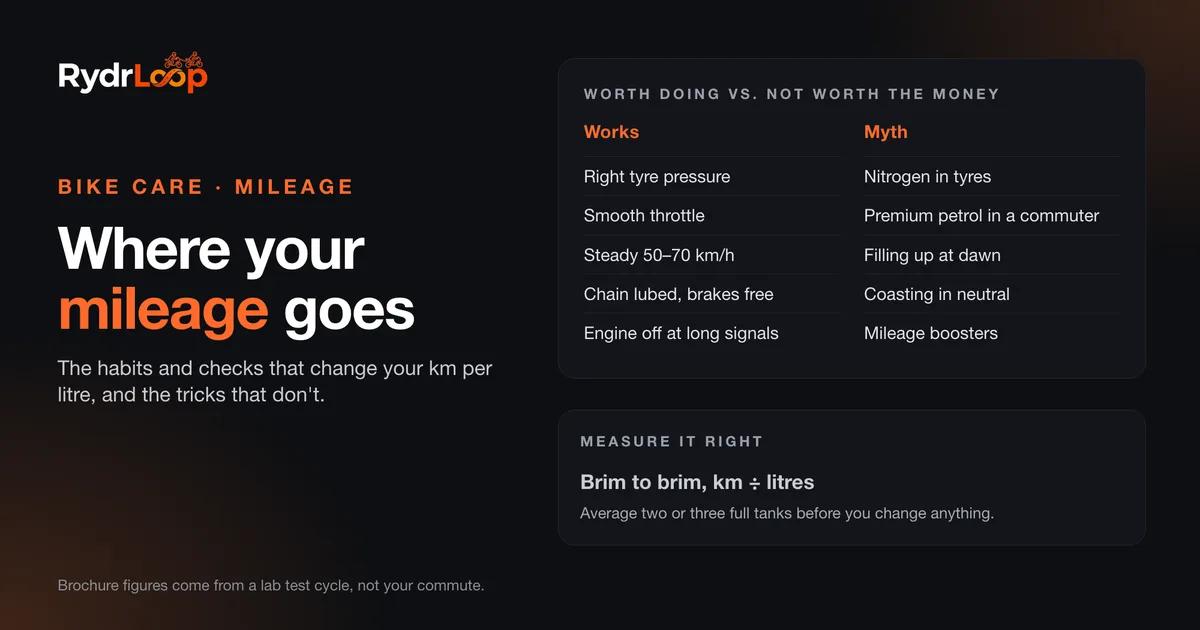
- Fill the tank to the brim at a pump you trust. Ask the attendant to stop at the neck of the tank, not at the first click, and note the odometer reading.
- Ride normally until the tank is down to about a quarter. Do not change your habits for the test.
- Go back to the same pump, ideally the same nozzle, and fill to the same level. Note the litres that went in and the new odometer reading.
- Divide the kilometres by the litres. That is your bike mileage for that tank.
Do this for two or three tanks and take the average. One tank can be thrown off by a weekend ride or a week of traffic jams. Keep the figures in your phone notes so you can see whether a change you make later actually helps.
Why you get less than the brochure
The figure in the brochure comes from a lab. The bike runs on a roller at set speeds, with set gear changes, a light rider, no wind, no traffic, and no speed breakers. It is useful for comparing one bike with another. It was never meant to be what you get on the road.
Expect real-world bike mileage to sit somewhere below the claimed figure. On a commuter that claims 65 km/l, getting low 50s in city use is normal. If you are getting a lot less than other owners of the same bike in the same city, that is worth looking into. The causes are almost always in the next two sections.
The riding habits that waste the most petrol
Cruising too fast
Air resistance grows quickly with speed, and a motorcycle with a rider sitting upright is not a slippery shape. On a small commuter bike, the jump in fuel use between a steady 55 and a steady 85 is large. On a 350 cc or bigger bike the curve starts later, but it is there.
You do not have to crawl. Find the speed where your bike is relaxed in top gear, usually somewhere between 50 and 70 km/h on a commuter, and hold it on open roads. That one habit does more than any gadget sold at a petrol pump.
Grabbing the throttle and braking hard
Every time you open the throttle hard and then brake hard at the next signal, you are turning petrol into heat in your brake pads. Smooth riders get better mileage on the same bike, and most of that comes from looking further ahead.
If the signal in front is already red, roll off early and let the bike slow on its own. If the traffic ahead is bunching up, ease off instead of riding up to the bumper of the car in front. You will brake less and use less fuel getting back up to speed.
The wrong gear
Riding in third at 50 km/h when the bike is happy in fifth keeps the engine spinning fast for no reason. Shift up as soon as the engine pulls cleanly in the next gear.
The opposite is also bad. If you are in top gear at 25 km/h and the engine is knocking or shuddering, that is lugging. It strains the engine and does not save fuel. Drop a gear.
Riding the clutch
Some riders keep two fingers on the clutch lever all the time, half pulling it without noticing. Every bit of slip is power lost as heat, and you make up for it with more throttle. Keep your fingers off the lever unless you are using it. In stop-and-go traffic this habit costs more than you would guess.
Idling for long
A bike sitting at a two-minute signal or a closed railway gate burns fuel to go nowhere. If you know you are going to wait more than a minute, switch off. Fuel-injected bikes restart easily and use very little petrol to do it.
If your bike has an idle stop system, such as Hero's i3S, leave it switched on in town. That is exactly what it is for.
Leaving the choke on
This one is only for older carburettor bikes. The choke richens the mixture so a cold engine starts. Leave it on for ten minutes of riding and you are pouring petrol through the engine. Push it back in as soon as the bike idles smoothly.
The bike checks that make a real difference
Tyre pressure, every two weeks
This is the single easiest fix. A soft tyre squashes more as it rolls, which means more drag and a bike that feels heavy to steer. Most riders who check their pressure for the first time in months find both tyres low.
- Check pressure when the tyres are cold, before you have ridden more than a couple of kilometres.
- Use the pressures printed in your owner's manual or on the sticker near the chain, not what the pump attendant thinks is right.
- Use the rider-plus-pillion figure when you carry a passenger or luggage.
- Buy a cheap pencil or digital gauge. Pump gauges are often off by a few psi.
Our motorcycle tyre guide covers pressures, tread and tyre age in detail.
A chain that is dry, rusty or too tight
A dry or rusty chain fights itself on every link. A chain adjusted too tight pulls against the gearbox and the rear wheel bearings. Both cost power, and power costs petrol.
Clean and lube the chain every 500 to 700 km, and again whenever it has been soaked in a downpour. Measure the slack on the side stand and compare it with the figure in your manual. The motorcycle maintenance guide shows how.
Brakes that drag
Put the bike on its main stand, or have a friend lift the front, and spin each wheel by hand. It should spin freely for a few turns. If it stops quickly, or you can hear the pads rubbing, a brake is dragging.
On drum brakes this is often a rear brake adjusted too tight. On disc brakes it can be a sticky caliper piston, which a mechanic can clean. A dragging brake can cost you several km/l and you will never feel it while riding.
The air filter and spark plug
On older carburettor bikes, a choked air filter makes the mixture too rich, and the bike burns more petrol. On fuel-injected bikes the engine computer makes up for it, so a dirty filter mostly costs power, which you then make up for with more throttle. Either way, a filter that has done twice its service interval is costing you something.
A worn spark plug misfires now and then, especially when starting. Change it at the interval in your manual. It is a cheap part.
Engine oil of the right grade
Use the oil grade your manual lists. Thicker oil than specified adds friction inside the engine. And oil that is long overdue for a change has broken down and does not protect or flow the way it should.
Regular service
A bike that misses services drifts out of tune slowly, so you never notice bike mileage slipping. Valve clearances, throttle body cleaning, the idle setting and the brake adjustments all add up. A full service often brings a tired bike back to the numbers it gave when new.
What you carry and how you sit
Weight matters less than people think on a bike, because the rider is a big share of the total anyway. A pillion makes a clear difference. An empty top box bolted on for months adds weight and wind drag every day.
How the bike meets the air matters more. A rider sitting bolt upright in a flapping jacket, with a tall bag strapped to the seat, is a parachute at 80 km/h. Zip up, keep luggage low and tight, and take off the top box when you do not need it.
The bike mileage myths, one by one
Nitrogen in the tyres
Nitrogen leaks out of a tyre a little more slowly than normal air, so pressure stays right for longer. That is the whole benefit. Normal air at the right pressure gives exactly the same mileage. If you check your pressure every two weeks, nitrogen adds nothing.
Premium petrol
Higher-octane petrol is for engines built to use it, usually high-compression performance bikes whose manual asks for it. In a commuter or a regular 350 cc engine designed for normal petrol, premium fuel does not add mileage you can measure. It does cost several rupees more per litre.
Filling up early in the morning
The idea is that cold fuel is denser, so you get more for your money. Pump fuel sits in big underground tanks where the temperature barely changes between morning and afternoon. The difference is too small to measure.
Coasting downhill in neutral
This one is a safety problem as well as a myth. In neutral you have no engine braking and less control, which is the last thing you want on a ghat road.
It also saves nothing on a modern bike. Every BS6 motorcycle is fuel-injected, and when you close the throttle in gear, the injection system cuts fuel almost completely. In neutral, the engine has to idle, which needs fuel. So coasting in gear actually uses less.
Mileage boosters, magnets and additives
Fuel-line magnets, pills in the tank and bottles sold as bike mileage boosters have never shown a real gain in proper testing. Save the money for a tyre gauge and a can of chain lube.
E20 petrol and bike mileage
Most pumps in India now sell E20, which is petrol with 20 per cent ethanol mixed in. Ethanol carries less energy per litre than petrol, so a litre of E20 takes you slightly less far than a litre of the old fuel did.
Bikes built and tuned for E20 lose very little. Older bikes not designed for it can lose a few per cent more. If your bike mileage dropped a little over the last year and nothing else changed, the fuel is a likely reason, and none of the tips above can fully undo it.
A quick mileage checklist
- Tyre pressure checked cold, at the manual's figure
- Chain cleaned, lubed and at the right slack
- Both wheels spin freely with no brake drag
- Air filter and spark plug within their service interval
- Engine oil of the right grade and not overdue
- Top box off when not needed
- Engine off at long signals and railway gates
- Fingers off the clutch lever while riding
Common questions
What mileage should a 150 cc bike give?
It depends a lot on the bike, the rider and the roads. Most 150 to 160 cc bikes give somewhere between the mid-40s and low 50s in mixed city use, a bit more on the highway at steady speeds. Compare your figure with owners of the same model in your city, not with the brochure.
Does bike mileage drop in winter?
A little, mostly because the engine takes longer to warm up and runs richer while it does. Short trips in cold weather show it most.
Does a new bike give lower mileage at first?
Often, yes. The engine loosens up over the first couple of thousand kilometres, and mileage usually improves slightly after the first service or two.
Ride further on every tank
Better bike mileage mostly comes from a calmer right hand and a bike that is looked after. Check your tyres this weekend, measure two tanks properly, and see what changes. If you want a record of where all those kilometres go, Record Route in the RydrLoop app saves every ride with its distance and the road you took, and you can find riders near you who ride the same roads at the same easy pace.


Comments (0)
Join the conversation. Your thoughts matter!
Be the first to share your thoughts.