

The Motorcycle Tyre Guide: Pressure, Tread, Age and When to Replace
Two palm-sized patches of rubber hold you to the road. How to set pressure, read the sidewall, judge wear and age, and know when a tyre is finished.
 RydrLoop··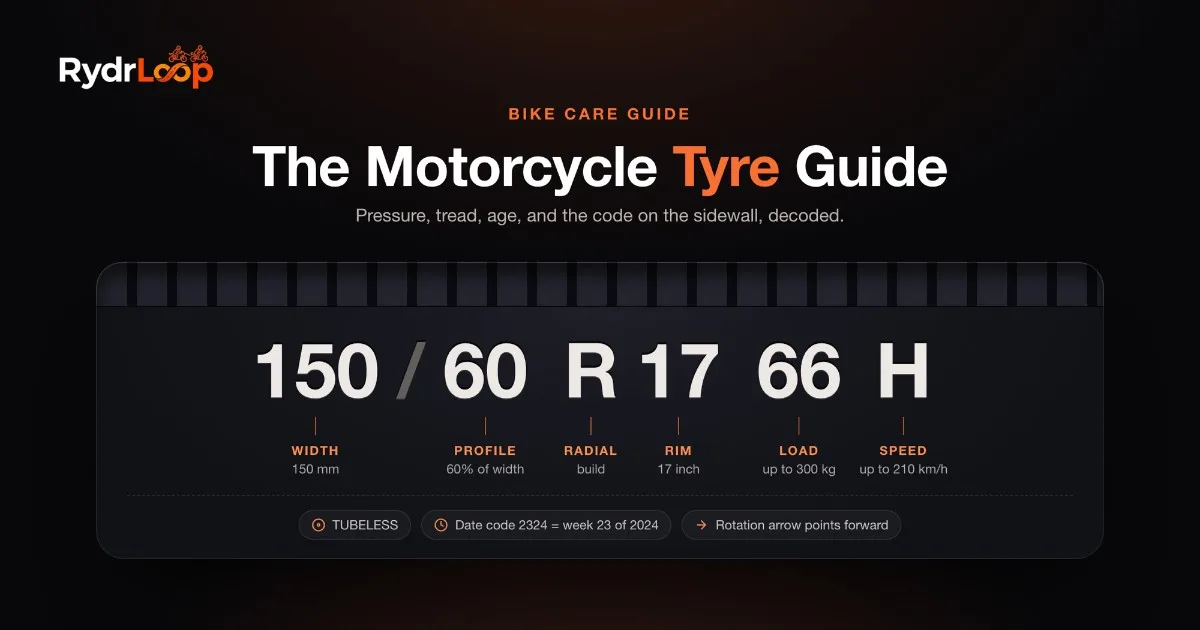
Everything your motorcycle does, braking, leaning, accelerating out of a corner, happens through two patches of rubber roughly the size of your palm. That is the whole connection between you and the road. And yet the motorcycle tyre is the part most riders in India check least, usually when a mechanic points at it during a service or when it goes flat on a highway.
Most tyre problems are slow and silent. Pressure drops a couple of PSI a week. Tread wears flat in the centre over thousands of kilometres of highway. Rubber hardens in the sun for years while the tread still looks fine. None of it announces itself until the bike feels vague in a wet corner or a tyre gives up at speed.
This guide covers what actually matters: setting pressure properly, reading wear, decoding the sidewall, understanding tyre age, and knowing the moment a tyre has to go. None of it needs tools beyond a gauge and a torch.
Tyre pressure: the check that matters most
If you do one thing after reading this, buy a decent pressure gauge and use it every week. Correct pressure affects grip, braking distance, steering, tyre life and fuel economy all at once, and it is the single most neglected check on Indian bikes.
Where to find the right number. Look for a sticker on the swingarm or chain guard, or check the owner's manual. Many bikes list two rear values, one for solo riding and a higher one for riding with a pillion or luggage. The large number moulded into the sidewall is the maximum the tyre can hold, not the pressure you should run.
Check it cold. Pressure rises as a tyre warms up, often by a few PSI after twenty minutes of riding. Check before you ride or after the bike has been parked for a few hours. Never let air out of a hot tyre to match the cold figure, or it will be underinflated once it cools.
Use your own gauge. The gauges on petrol pump air machines are knocked around daily and can be several PSI off. A small dial or digital gauge costs a few hundred rupees and removes the guesswork.
What wrong pressure does
- Too low: heavy, slow steering, a tyre that runs hot, worn shoulders, more flex in the sidewall, and on tube tyres a much higher chance of a pinch puncture over a pothole.
- Too high: a smaller contact patch, less grip on wet roads, a harsh ride over broken tarmac, and wear concentrated in the centre.
A tubeless motorcycle tyre with a nail in it can lose pressure so slowly that it takes a week to feel. A weekly gauge check catches it days before it strands you.
Reading the tread
Every motorcycle tyre has tread wear indicators, small raised bars sitting inside the grooves. Their positions are usually marked on the shoulder of the tyre with a small triangle or the letters TWI. When the surrounding tread wears down level with those bars, the tyre is finished, whatever else it looks like.
Do not wait for that point in the monsoon. Tread grooves exist to push water out from under the contact patch, and a tyre that is legal in March can aquaplane on a flooded highway in July. For rain-heavy riding, replace earlier.
Wear patterns and what they mean
- Squared-off rear tyre. A flat band worn across the centre from long, straight highway riding. The bike will feel like it drops suddenly into corners instead of rolling smoothly onto its side. It is one of the most common reasons a motorcycle tyre stops feeling right long before the tread is gone.
- Cupping or scalloping on the front. A saw-tooth pattern you can feel with your palm across the tread blocks. Usually a sign of underinflation or tired suspension, and often noticeable as a hum at speed.
- One shoulder worn more than the other. Often just the camber of Indian roads and the way we ride on the left, but large differences deserve a look at wheel alignment.
- Uneven wear with a wobble. Check for a bent rim or a wheel that needs balancing.
Decoding the sidewall
The markings on the sidewall tell you almost everything about a tyre. Take a common radial rear size, 150/60 R17 66H:
- 150 is the tyre's width in millimetres.
- 60 is the profile, the sidewall height as a percentage of the width. Here it is 60 percent of 150 mm.
- R means radial construction. A dash in its place, as in 110/80-17, means bias-ply, which is still common on commuter and many mid-size bikes.
- 17 is the rim diameter in inches.
- 66 is the load index. 66 means the tyre can carry up to 300 kg, and 57 on a smaller tyre means 230 kg.
- H is the speed rating, the maximum sustained speed. H is 210 km/h, P is 150 km/h and S is 180 km/h.
You will also see the word TUBELESS, or a TT for tube type, arrows showing the direction of rotation, and a four-digit date code.
Rotation arrows matter. A motorcycle tyre fitted backwards wears badly and loses grip in the wet. Check the arrow every time a tyre is fitted, especially at roadside puncture shops.
Tyre age: the check nobody does
Rubber ages whether you ride or not. Sun, heat and ozone harden the compound and dry out the sidewalls, and an old tyre with plenty of tread can have a fraction of the grip it had new.
Find the four-digit code on the sidewall. The first two digits are the week and the last two are the year, so 2324 means the 23rd week of 2024.
- Look for fine cracks in the sidewall and between the tread blocks. Surface crazing is a warning sign, and deep cracks mean replace.
- Most tyre makers recommend having tyres inspected once they are around five years old and replaced by ten at the absolute latest. On a motorcycle, where two small contact patches do everything, plenty of experienced riders replace at five or six years regardless of tread.
- Check the date when you buy. A tyre that sat in a warehouse for two years is not really new. Ask to see the code before it is fitted, and prefer one made within the last year.
Tubeless or tube type
Most bikes on alloy wheels now run tubeless tyres, and it is one of the best safety improvements on modern motorcycles.
- Tubeless: a puncture usually loses air slowly, giving you time to stop safely. A small tread puncture can be plugged at the roadside and you can ride on.
- Tube type: a puncture can deflate the tyre fast, and fixing it means removing the wheel. Most spoked rims need tubes because air escapes through the spoke holes, though some adventure bikes now come with sealed tubeless spoked wheels.
Never fit a tubeless tyre on a rim that is not designed for tubeless use and run it without a tube. And if a tubeless motorcycle tyre is ever run with an emergency tube inside, treat it as a get-home fix and ride gently.
Punctures and repairs
- Plugs are for the tread only. A string plug in the centre of the tread is a sound temporary repair. Get it checked, and ideally replaced with a patch-plug fitted from inside, at a proper tyre shop.
- Never repair the sidewall or the shoulder. Those areas flex constantly and no repair holds there safely.
- Big holes mean a new tyre. Most tyre makers treat damage larger than around 6 mm as unrepairable.
- One repaired tyre is fine. A patchwork is not. A tyre with several repairs close together is due for replacement.
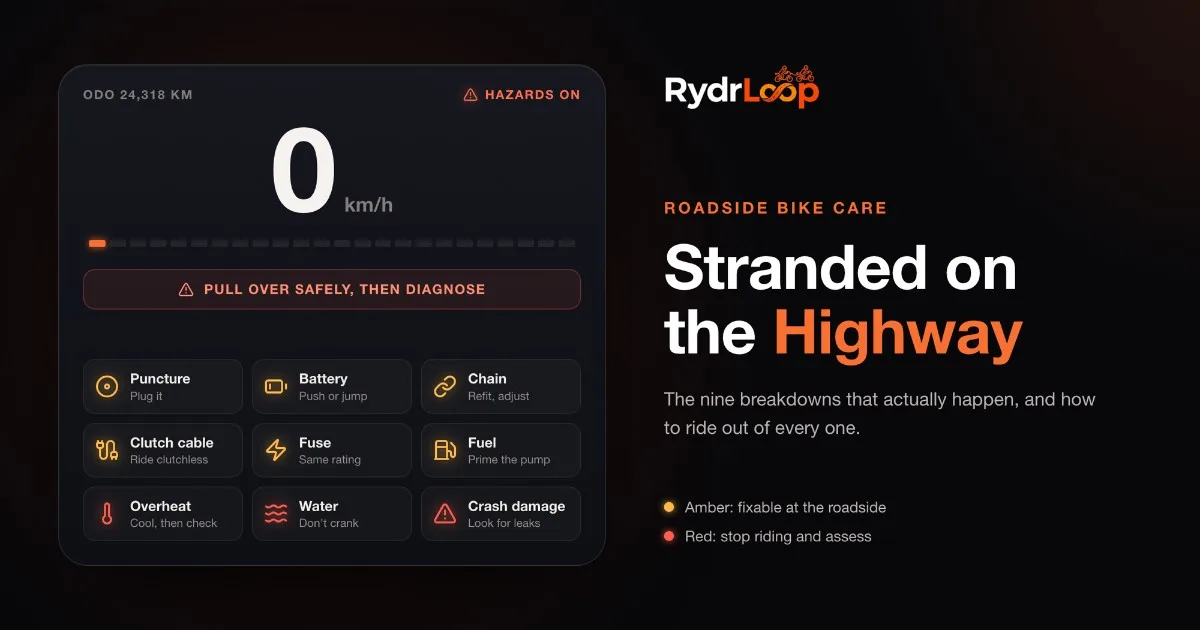
The roadside side of this, what to carry and how to plug a tyre properly, is covered in the motorcycle breakdown guide.
When to replace a motorcycle tyre
Replace it when any of these is true, whichever comes first:
- The tread is level with the wear indicators.
- The rear has squared off enough to change how the bike turns.
- There are deep cracks, a bulge, a cut into the carcass, or exposed cords.
- It has a sidewall or shoulder puncture, or a hole larger than a plug can handle.
- It is past five or six years old and the rubber has hardened or cracked.
- It has been run flat for any distance, which can damage the inside even when the outside looks fine.
You do not always need to replace both tyres together. Rear tyres usually wear out well before fronts. What does matter is keeping the same construction type and a size the manufacturer approves, because mixing a radial and a bias-ply tyre, or fitting a much wider rear for looks, can make the handling unpredictable.
Choosing the replacement
- Stick to the sizes in your manual. A wider rear motorcycle tyre can slow the steering, rub against the chain or swingarm, and confuse ABS on some bikes.
- Match the tyre to your riding. Road tyres grip best on tarmac. Dual-purpose tyres with bigger blocks cope better with gravel and broken roads but give up some grip and last differently on the highway.
- Softer compounds grip more and wear faster. For long touring distances, a harder touring compound often makes more sense than a sport tyre.
- Ask for balancing and a new valve. Every new tubeless fitment deserves a fresh rubber valve and a balanced wheel.
Riding on new tyres
A brand new motorcycle tyre is slippery. The surface carries a release agent from the moulding process, and it needs roughly the first 100 to 150 km of gradually increasing lean and gentle braking to wear it off. Treat the first ride after a tyre change the way you would treat a wet road, especially in corners.
Pre-trip motorcycle tyre checklist
Run through this the evening before any long ride, with the bike cold:
- Pressure set cold to the manual's figure, including the higher rear value if carrying a pillion or luggage
- Tread clear of the wear indicators on both tyres
- No squared-off rear profile or cupped front
- No cracks, bulges, cuts or embedded stones, nails or glass
- Date code checked, and neither tyre older than about five or six years
- Valve caps fitted and valves not cracked
- Rotation arrows pointing forward on both wheels
- Plug kit and a pressure gauge or small compressor packed
The rest of the bike deserves the same attention, and the pre-ride checklist covers everything else in one pass. For the regular weekly routine, the motorcycle maintenance guide is the next place to go.
The short version
Check pressure every week with your own gauge. Look at the tread and the sidewall every time you wash the bike. Know how old your tyres are. And when a motorcycle tyre is done, replace it with the right size and type instead of squeezing another monsoon out of it.
Riding is a lot more fun when you trust the two patches of rubber holding you up. If you are looking for people to put those tyres to good use with, RydrLoop helps you find riders nearby and join rides that match your pace.

Comments (0)
Join the conversation. Your thoughts matter!
Be the first to share your thoughts.