

Motorcycle Maintenance: The Simple Checks Every Rider Can Do
You do not need to be a mechanic to look after your bike. The simple checks any rider can do themselves: tyres, chain, brakes, oil and a roadside kit.
 RydrLoop··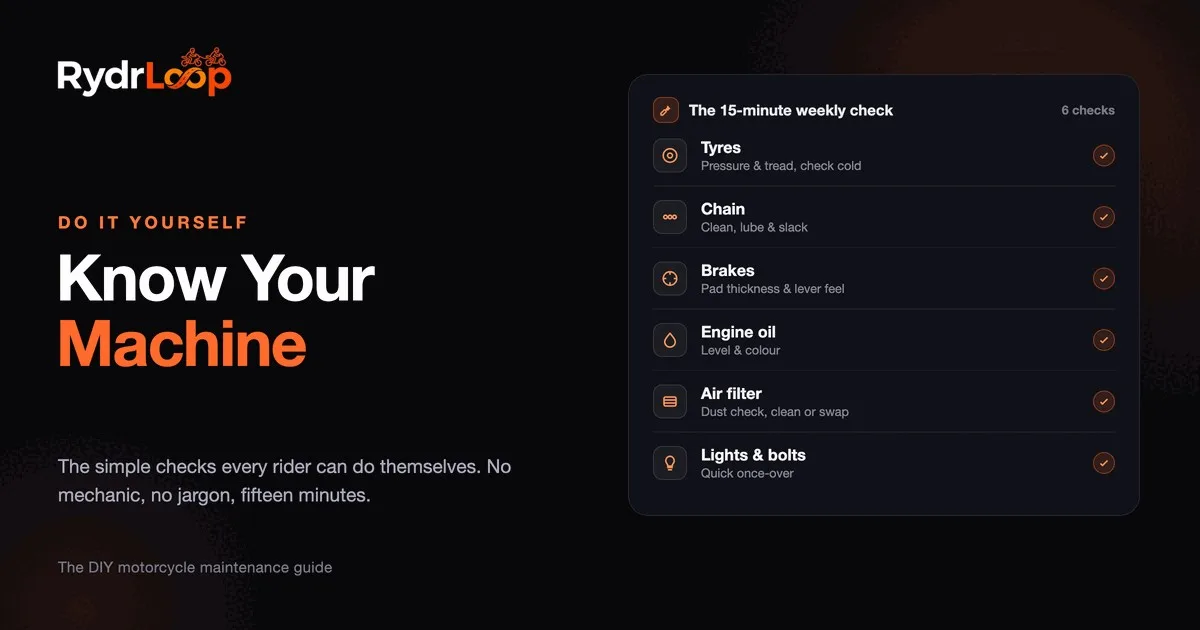
Most riders treat their motorcycle like an appliance. You use it until something feels wrong, then you hand it to the mechanic, pay whatever the bill says, and ride off without ever really knowing what happened. It works, until the day the chain snaps or the tyre goes soft two hundred kilometres from the nearest town, and the mechanic is not there, and you realise you have no idea how your own machine actually works. A little motorcycle maintenance done by your own hands is what stands between you and that moment.
Here is the thing nobody tells you. You do not need to be a mechanic to look after a motorcycle. The vast majority of basic motorcycle maintenance is simple, takes minutes, needs almost no tools, and is the difference between a bike that runs sweetly for years and one that leaves you stranded. The riders who never seem to break down are rarely luckier than you. They just spend fifteen quiet minutes a week getting to know their machine, and it pays them back every single ride.
This is a practical guide to the maintenance any rider can and should do themselves, written for Indian roads, Indian dust, and Indian monsoons, where bikes take a harder beating than the manual ever imagined. None of it is hard. All of it saves you money, keeps you safer, and slowly turns your motorcycle from a mystery into something you actually understand.
Why bother doing it yourself
Three good reasons, before we get into the how.
The first is safety. A loose chain, a bald tyre, worn brake pads or a soft tyre are not abstract problems, they are the things that put riders in hospital. When you check them yourself, regularly, you catch them long before they become dangerous. A mechanic sees your bike once every few months. You see it every day.
The second is money and honesty. When you understand basic motorcycle maintenance, you stop being at the mercy of a workshop that may or may not be straight with you. You know when something genuinely needs replacing and when you are being upsold, and you handle the small stuff yourself for the price of a bottle of chain lube instead of a labour charge every time.
The third is the quiet one that sneaks up on you. Learning to look after your own machine changes your relationship with it. You start to hear it, to notice the small changes, to feel when something is a little off before it becomes a real fault. That awareness makes you a better, safer rider, and honestly it is one of the more satisfying parts of owning a motorcycle.
The basic kit you actually need
You do not need a workshop. A modest set of tools, most of which fit in a small bag, covers almost everything in this guide, and getting into motorcycle maintenance costs less than a single big workshop bill.
A basic tool roll with the spanner sizes, allen keys and screwdrivers your bike uses. Check the sizes against your machine, since most bikes use just a handful. A tyre pressure gauge, a proper one, because the machine at the fuel pump is often wildly inaccurate. Chain lube and a stiff brush for cleaning. A can of contact or chain cleaner, or plain kerosene, for degreasing. A puncture repair kit with plugs, and a small hand pump or a CO2 inflator, so a flat does not end your day. A torch, a pair of gloves, some rag, zip ties and insulation tape, because those three fix a surprising number of roadside problems.
And the single most underused tool of all, your owner's manual. Almost nobody reads it, and it contains the exact tyre pressures, the chain slack, the oil type and quantity, and the service intervals for your specific bike. Everything in this guide should be cross-checked against your manual, because the numbers vary from machine to machine.
Tyres: the two patches that matter most
Start here, because your tyres are the only thing connecting you to the road. Two small contact patches, each about the size of your palm, carry your entire life at speed. No other part of motorcycle maintenance matters more, and none is ignored more often.
Pressure is the big one. Check it at least once a week, and always when the tyres are cold, because a warm tyre reads high and gives you a false number. Use your own gauge, not the pump attendant's, and set it to the pressure your manual or the sticker on the swingarm specifies, not a number someone guessed. Underinflated tyres feel vague, run hot, wear out fast and kill your mileage. Overinflated ones give you less grip and a harsh ride. Correct pressure is free, takes two minutes, and improves how your bike handles, brakes and lasts more than almost anything else you can do.
Then look at the tyre itself. Check the tread depth and watch the wear pattern, because it tells a story. Wear in the centre means a lot of straight highway riding. Wear at the edges means you enjoy your corners. Uneven or scalloped wear can point to pressure problems or worn suspension. Run your eye and hand over the rubber for cuts, embedded nails or glass, and bulges, and check the sidewalls for the fine cracks that come with age and Indian heat, because a tyre can time out before it wears out. When the tread is near the wear markers, replace it. This is not the place to save money.
The chain: the part that strands people
If tyres are the most important thing, the chain is the most neglected, and a neglected chain is the classic reason riders end up stuck by the roadside. In our dust and rain, a chain needs more love here than almost anywhere else in the world, and it is the one piece of motorcycle maintenance you truly cannot skip.
Two jobs keep it alive: cleaning and lubing, and adjusting the slack.
Cleaning and lubing is a fifteen minute job you should do every 500 to 800 kilometres, and always after riding in rain, because water strips the lube and rust sets in fast. Put the bike on its centre stand or a paddock stand so the wheel spins freely. Brush the grime off the chain with your cleaner or a little kerosene and a stiff brush, working around the whole loop as you rotate the wheel. Wipe it dry, then apply chain lube evenly to the inner face of the chain while you turn the wheel, so it flings into the links rather than off them. Let it soak in for a few minutes before you ride. A clean, lubed chain runs quieter, saves fuel, and lasts far longer.
Slack is the second job. A chain that is too tight strains the gearbox and can snap, while one too loose can jump the sprocket, and both are dangerous. Find your bike's correct free play in the manual, usually a couple of centimetres of up and down movement at the middle of the lower run, and check it. If it needs adjusting, loosen the rear axle, turn the adjusters on each side by equal amounts, using the alignment marks so the wheel stays straight, then retighten the axle to spec. While you are there, look at the sprocket teeth. If they have gone thin and hooked like little waves, the sprockets and chain are worn out and need replacing as a set. Never fit a new chain to old sprockets.
Brakes: check them before you need them
Your brakes are your best safety feature, and brake checks are the motorcycle maintenance that most directly keeps you alive. The good news is that brakes give plenty of warning before they fail, if you bother to look.
Check the brake pads for thickness. Most pads have a wear groove or a minimum line, and when the friction material gets thin, they need replacing. A squealing noise is often an early warning, and a harsh grinding sound means metal on metal, which is an emergency and will destroy your disc. Look at the disc too, for deep scoring or a lip at the edge.
Feel the levers. The brake should bite firmly and predictably, not feel spongy or travel all the way to the bar. Spongy brakes usually mean air in the line or old fluid. Check the brake fluid level in the reservoir, and look at its colour, because fresh fluid is light and clear, while old fluid goes dark and absorbs water, which reduces braking power. Most manuals want the fluid changed every couple of years regardless of mileage. And do not forget the rear brake, which riders neglect constantly. It does real work, especially in slow traffic and on loose surfaces, so keep it adjusted and working.
Engine oil: the lifeblood
If there is one piece of motorcycle maintenance that pays for a whole engine, it is this. Oil is what stands between your engine and a very expensive silence. Running an engine low on oil, or on oil that is years past its change, is one of the few maintenance mistakes that can kill a motor outright.
Checking the level is basic and you should do it often. With the bike upright and the engine warm but off, read the level through the sight glass or on the dipstick, and keep it between the marks. Top up with the correct grade if it is low. While you are at it, notice the oil's colour and feel, because clean oil is amber and slippery, while oil that has gone black, gritty or smells burnt is overdue for a change.
Changing the oil yourself is well within reach if you want to, and many riders do. You warm the engine, drain the old oil out of the sump plug, replace or clean the oil filter, refit the plug, and refill with exactly the grade and quantity your manual specifies, then check the level. If you would rather leave the actual change to a workshop, that is completely fine, but at least check the level yourself between services, and know your change interval. Follow the manual on intervals and on whether your bike wants mineral, semi synthetic or full synthetic oil, because using the wrong type or stretching the interval to save a few hundred rupees is a false economy that can cost you an engine.
The air filter: your engine's lungs
This one matters far more in India than the manual assumes, because our air is dusty and our filters clog fast. A choked air filter starves the engine of air, which costs you power, roughens the running and quietly drinks your fuel.
Find the airbox, usually under the seat or the tank, and take a look at the filter at the interval your bike suggests, sooner if you ride a lot of dusty or unpaved roads. A paper filter that has gone dark and clogged gets replaced. A foam or cotton filter can often be cleaned and re-oiled and reused. It is one of the cheapest, easiest jobs in all of motorcycle maintenance, and riders are always surprised how much smoother and more economical the bike feels afterwards.
Battery, cables and the small stuff
A few smaller checks round out the picture, and these are the bits of motorcycle maintenance that prevent the annoying, avoidable failures.
The battery on most modern bikes is sealed and maintenance free, but the terminals still matter. Keep them clean and tight, and watch for the white or greenish powder of corrosion, which you can clean off. If your bike sits unused for weeks, especially through a cold spell, the battery drains and sulphates, so a cheap trickle charger or simply starting and riding it regularly keeps it healthy.
Your control cables, the clutch and throttle, need a little free play and a little lubrication, and they should move smoothly without catching. A dry, fraying cable is a breakdown waiting to happen, and cables are cheap. Check your lights, indicators, brake light and horn every so often, because a blown bulb is invisible to you until someone fails to see you, and carry a spare fuse or two since a blown fuse can otherwise strand a perfectly healthy bike.
Finally, vibration. A motorcycle shakes its own fasteners loose over time, so every now and then run a spanner and your fingers over the obvious ones, the axle nuts, the handlebar and mirror mounts, the footpegs, the number plate and any luggage racks. Catching a loose bolt in your driveway is a non event. Discovering it at speed is not.
A simple motorcycle maintenance rhythm
You do not need to do all of this at once. Good motorcycle maintenance is really just a set of small habits on different clocks.
Before every ride, a thirty second glance. Tyres look properly inflated, no puddle of oil under the bike, lights and brakes working, chain not bone dry. Our pre-ride checklist covers this quick once over in detail, and it takes less time than putting your helmet on.
Every week or so, the deeper checks. Tyre pressures with a proper gauge, a proper look at the chain, oil level, brakes, and a glance over the tyres for damage.
Every few hundred kilometres, clean and lube the chain, and do it again after any wet ride.
And at the intervals in your manual, the service items, oil and filter changes, air filter, brake fluid, and the jobs best left to a workshop.
Build these into your routine and they stop feeling like chores. A clean and lubed chain on a Sunday morning, coffee in hand, is a genuinely nice way to spend fifteen minutes, and your bike will thank you on every ride that week.
Know where to stop
Doing your own maintenance does not mean doing everything yourself, and a big part of being sensible is knowing your limits. The jobs in this guide are safe, simple and hard to get badly wrong. Deeper work is a different matter.
Leave the engine internals, the valve clearances, the fuel injection and ECU work, wheel bearings, suspension internals and any serious electrical fault to a proper mechanic with the right tools and knowledge. There is no shame in it, and trying to force one of those jobs with the wrong tools and a video you half watched is exactly how a small problem becomes an expensive one. Good motorcycle maintenance is as much about knowing what you should not touch as what you should. Do the basics brilliantly, and hand over the specialist work to someone who does it every day. Never bodge a safety critical repair to save time or money, because on a motorcycle the bill for that comes due at the worst possible moment.
What to carry on the road
Everything above is home maintenance, but a little of it travels with you, because problems do not wait for you to get back to the garage.
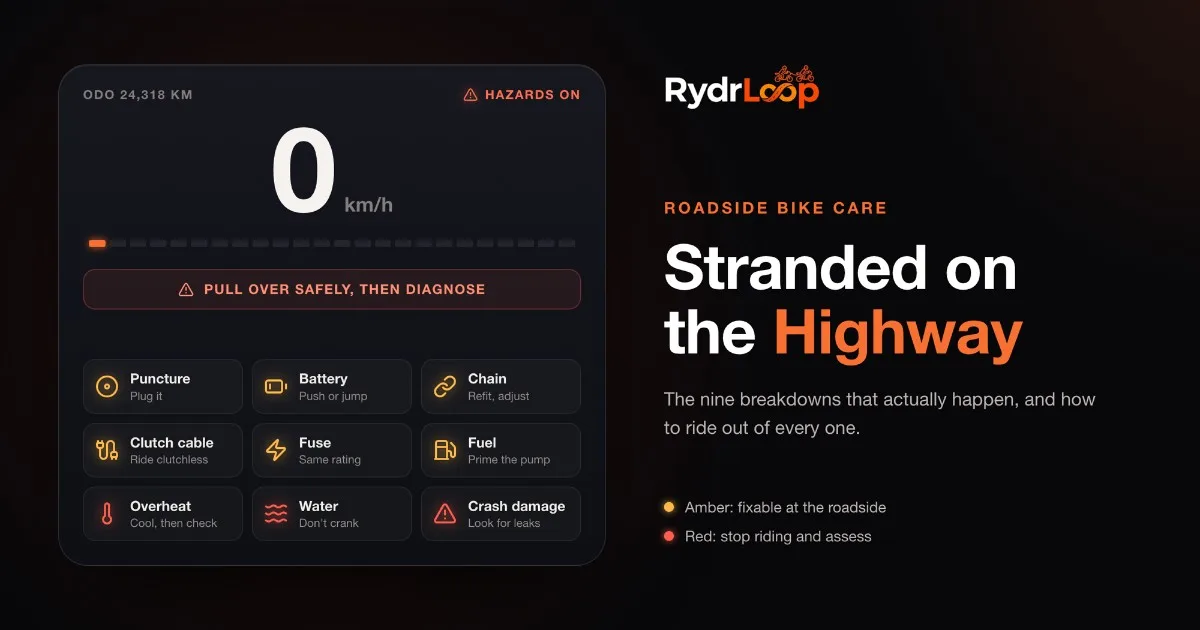
For any ride beyond your city, carry a small kit: your basic tools, a puncture repair plug kit and a way to inflate the tyre, a small bottle of chain lube for long tours, a few zip ties and some tape, a torch and a spare fuse or bulb. With those and the knowledge from this guide, you can handle the common roadside issues yourself, a puncture, a dry chain, a loose bolt, a blown fuse, rather than standing helpless waiting for help that may be hours away. This matters even more on big trips, where a breakdown far from any workshop is a real risk, which is why bike prep is such a large part of our guide to long distance riding.
The payoff
None of this is complicated, and that is the whole point. Basic motorcycle maintenance is not a dark art reserved for mechanics. It is a handful of simple, repeatable checks that any rider can learn in a weekend and carry for the rest of their riding life. Treat motorcycle maintenance as a habit, not an emergency, and it quietly disappears into your routine.
Do them, and your bike runs better, lasts longer, costs less and strands you far less often. But the real reward is quieter than all of that. A rider who looks after their own machine rides with a confidence that shows, because they know their motorcycle is ready, they know they can handle what the road throws at them, and they have a connection to the bike that you simply cannot buy at a service counter. Start this weekend, with a rag and a bottle of chain lube, and build from there. Your future self, somewhere out on a great road with a perfectly running machine underneath, will be very glad you did.

Comments (0)
Join the conversation. Your thoughts matter!
Be the first to share your thoughts.