

Why More Indian Riders Are Moving Towards 250cc–500cc Motorcycles
Five years ago, Indian showrooms and highways were almost entirely 100-150cc commuters. That's changed. Here's what's actually driving the shift to mid-capacity bikes.
 RydrLoop··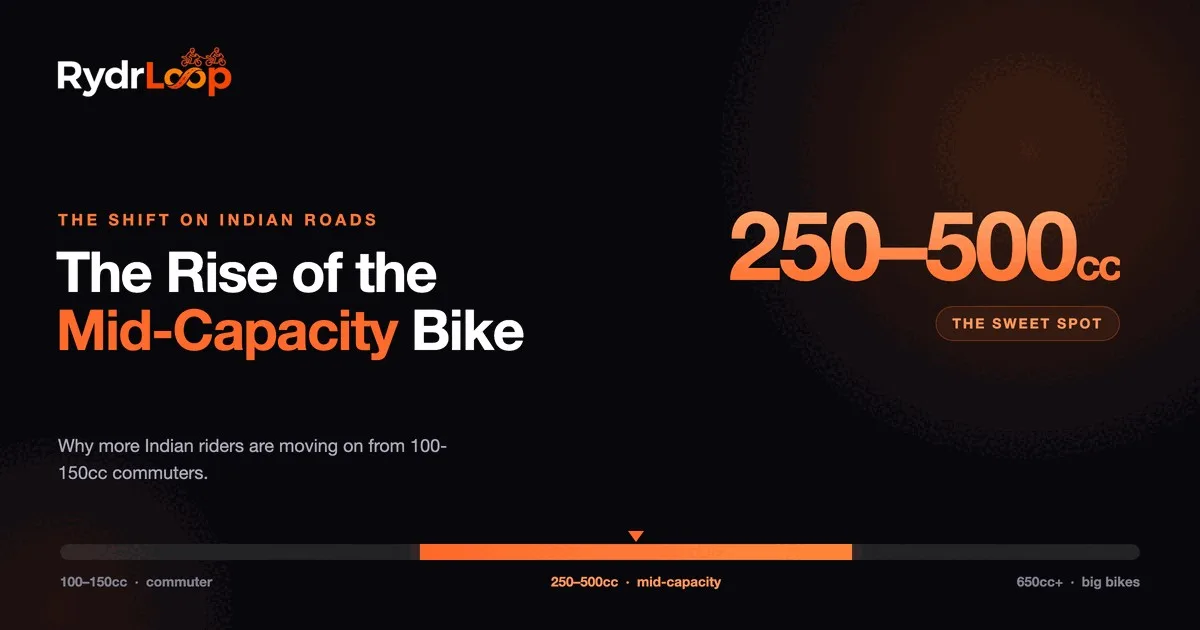
Stand at any decent-sized junction in an Indian city today and count the bikes that roll past. Ten years ago, that count would have been overwhelmingly 100-150cc commuters, Splendors, Pulsars, Passions, bikes built around one job, getting you to work and back as cheaply as possible. Today, mixed into that same traffic, you'll spot a noticeably different pattern, Hunter 350s, KTM Dukes, Dominars, the occasional Himalayan or Speed 400. Mid capacity bikes, the 250cc to 500cc range, have gone from a niche enthusiast choice to a genuinely mainstream one, and the shift didn't happen by accident.
This is worth understanding properly, not as a listicle of trendy new launches, but as a real change in what Indian riders actually want from a motorcycle, and why the old assumption, that a bike's only job is cheap, efficient transportation, stopped being the whole story for a growing number of riders. What follows looks at the actual forces behind it, infrastructure, culture, choice and financing, rather than treating it as a passing fashion that happened to catch on.
What Actually Counts as Mid Capacity Bikes
Before getting into the why, it's worth being precise about the what, because "mid capacity" gets used loosely. In the Indian market, this generally means the 250cc to 500cc band, sitting clearly above the sub-200cc commuter segment that's dominated Indian roads for decades, and below the 650cc-plus premium segment that remains a smaller, more enthusiast-driven category. It's the range that includes the KTM 250 Duke and 390 Duke, Royal Enfield's Hunter 350, Meteor 350 and Classic 350, the Bajaj Dominar 250 and 400, Honda's CB350 and Hness CB350, the Yezdi Roadster and Adventure, and newer entrants like the Triumph Speed 400 and Scrambler 400X.
What defines mid capacity bikes isn't just the engine size on paper, it's the role they occupy, capable enough for genuine highway cruising and weekend touring, while staying manageable enough in weight, seat height and running cost that they don't demand the commitment a full premium motorcycle does. That specific middle ground is exactly why this segment has grown the way it has.
The Commuter-First Era Is Fading
For most of the Indian two-wheeler market's history, the entire industry was built around one clear priority: cheap, fuel-efficient, low-maintenance transportation. Bikes in the 100-150cc range dominated for good reason, they matched what most riders actually needed, an affordable way to get to work, run errands and cover modest daily distances without much thought given to comfort over distance or performance beyond city speeds.
That era isn't over, small commuters still make up the bulk of India's two-wheeler market by volume, and for plenty of riders they remain exactly the right choice. But the assumption that a motorcycle's only job was transportation has genuinely faded for a meaningful and growing group of riders, replaced by a more varied set of expectations, comfort on longer rides, capability for weekend trips, and increasingly, the simple desire for a bike that's enjoyable to ride, not just efficient to own. Mid capacity bikes exist specifically to answer those newer expectations in a way small commuters were never designed to.
Highway Infrastructure Changed What Riders Expect From a Bike
This is one of the more underrated drivers of the shift, and it's genuinely structural rather than just a matter of taste. India's highway network has expanded substantially over the past decade, more expressways, more multi-lane national highways, longer stretches where sustained 90-100 km/h cruising is not just possible but normal. A small-capacity commuter engine, tuned for city speeds and fuel efficiency, has to work hard to hold that pace, higher RPM, more vibration, noticeably less comfort over a long stretch than it was ever designed to provide.
Mid capacity bikes handle exactly this differently. A 350-400cc engine cruising at highway speed is typically running at a more relaxed RPM, with more low-end torque available for overtaking without the frantic downshifting a smaller engine often needs. As more riders started actually using these expanding highways for weekend trips and longer rides, rather than treating a motorcycle as a purely local, city-bound tool, the practical gap between what a commuter bike could comfortably do and what riders actually wanted to do on a good highway stretch became impossible to ignore. Mid capacity bikes closed that gap directly.
Riding Became a Lifestyle, Not Just Transportation
Alongside the infrastructure shift, something changed in riding culture itself. Weekend group rides, touring trips and a genuine riding community built around the experience of riding, not just the utility of it, have grown substantially in Indian cities over the past several years. Social media and YouTube riding content played a real role here too, touring vlogs and group ride footage made longer-distance, weekend-focused riding visible and aspirational in a way it simply wasn't when motorcycles were viewed purely as commuting tools.
This cultural shift and the mid capacity segment's growth reinforce each other directly. A rider drawn into weekend touring culture through a friend's group or a ride they saw online quickly runs into the limits of a small commuter on a genuine weekend trip, cramped ergonomics, less confidence-inspiring highway stability, an engine working harder than it should for sustained distance. Mid capacity bikes are, in a real sense, the mechanical answer to a cultural shift that had already started happening, riders wanting their motorcycle to support a lifestyle built around riding for its own sake, not just getting from A to B.
More Manufacturer Choice Than Ever Before
A decade ago, a rider wanting something beyond a basic commuter had genuinely limited options in India, a handful of models, most from one or two manufacturers. That's changed dramatically. Royal Enfield alone now spans the Hunter 350, Meteor 350, Classic 350 and the newer Himalayan 450 within this range, each aimed at a different kind of rider despite sharing a displacement class. KTM's 250 Duke and 390 Duke brought genuinely sporty, performance-focused options into the segment. Bajaj's Dominar line targeted touring-focused riders directly, while its partnership with Triumph brought the Speed 400 and Scrambler 400X, genuinely global-brand motorcycles, to a price point that would have been unthinkable in this segment a few years earlier.
Honda's CB350 and Hness CB350 added a more refined, retro-styled option, Yezdi's revival brought the Roadster and Adventure into the mix, and Hero's partnership with Harley-Davidson produced the X440, putting an unmistakably American cruiser silhouette within reach of Indian buyers for the first time. This isn't a coincidence, manufacturers expanded into mid capacity bikes specifically because they'd correctly read the same shift in rider expectations described above, and the resulting competition has meant genuinely more choice, at more price points and in more styles, than Indian riders had access to at any point before.
Why the Jump Skips Past Small, Incremental Upgrades
For most of the commuter era, moving up meant a small step, 100cc to 125cc, 125cc to 150cc, marginal gains in power that stayed within the same fundamental category of bike. What's notable about the current shift is that it isn't following that same incremental pattern. Riders stepping away from small commuters are increasingly skipping straight past the 180-220cc middle ground and landing directly in the 250-500cc mid capacity bikes segment instead, and that's worth explaining rather than treating as obvious.
The reason is that a small incremental bump doesn't actually solve the problem driving the shift in the first place. A 180cc or 220cc bike is still, fundamentally, a commuter-derived engine asked to do highway and touring duty it wasn't designed around, more power than a 150cc, but not a meaningfully different riding experience at sustained highway speed. Mid capacity bikes solve a genuinely different problem, comfortable cruising RPM, a chassis and ergonomics actually built around longer distance, not a commuter frame with a bigger engine bolted in. Riders who've correctly identified that their needs have changed, not just their desire for slightly more power, are making a deliberate, bigger jump rather than a cautious small one, and manufacturers have responded by making that bigger jump considerably more affordable than it used to be.
What You Can See on the Ground, Even Without Sales Charts
You don't need industry sales figures to notice this shift, it shows up in plenty of visible, everyday ways. Showroom floor space that used to be almost entirely commuter models now regularly gives equal or greater prominence to mid capacity bikes, a clear signal of where dealerships expect genuine walk-in interest. Weekend group rides, visibly larger and more frequent than they were a decade ago, are now overwhelmingly built around mid capacity machines rather than the small commuters that would have made up most of a similar gathering years earlier.
The used and resale market tells a similar story. Mid capacity bikes used to hold their value poorly simply because too few buyers wanted a used one, a niche segment sold to a niche audience. That's changed noticeably, resale listings for models like the Classic 350, Dominar and Duke range move considerably faster than they once did, which is itself evidence of a maturing, broadening buyer base rather than a shrinking enthusiast niche. None of this needs a sales chart to see, it's visible in showrooms, on highways, and increasingly, in who's showing up to a weekend group ride on something considerably more capable than a basic commuter.
How Riding Culture Varies Across India, and Still Points the Same Direction
This shift doesn't look identical everywhere in the country, and it's worth acknowledging the regional texture rather than treating India as one uniform riding culture. In hill states like Himachal Pradesh and Uttarakhand, riders have long favoured torque-heavy engines simply because steep gradients and mountain roads punish underpowered bikes directly, mid capacity bikes have found a particularly natural audience here, solving a genuine mechanical need rather than just following a trend.
In the south, particularly Karnataka and Tamil Nadu, a strong existing weekend riding culture built around routes like the Western Ghats has pulled riders toward mid capacity bikes as that community itself grew more organised and more visible, group rides that used to be a small enthusiast activity have become considerably more mainstream. Along the western coast, Maharashtra and Gujarat's mix of coastal touring routes and strong urban commuter bases has produced a more mixed pattern, commuters still dominate daily use, but mid capacity bikes show up overwhelmingly for weekend and touring riding specifically. Despite these regional differences in how and why the shift shows up, the underlying driver stays consistent everywhere, riders wanting a bike genuinely capable of more than daily transportation, wherever in the country they happen to be riding it.
The Sweet Spot Between Practicality and Performance
Mid capacity bikes occupy a genuinely useful middle ground, and understanding why that middle ground works helps explain why the segment has grown rather than riders simply jumping straight to premium 650cc-plus machines instead. Fuel efficiency in the 250-500cc range, while lower than a small commuter, remains reasonable for regular use, nowhere near the running cost jump a full premium motorcycle demands. Weight and seat height stay manageable for the average Indian rider's build too, a genuine consideration in a market where rider height and experience vary widely, and where a bike that's intimidating to handle at a standstill puts off exactly the riders this segment is trying to reach.
Running and maintenance costs sit in a similarly sensible middle position, higher than a small commuter, but far more accessible than premium segment ownership, which often involves specialised servicing and significantly pricier parts. This balance, capable enough for real touring and highway use, without the cost, weight and intimidation factor of a full premium bike, is precisely what's made mid capacity bikes the practical entry point into serious riding for a huge number of Indian riders, rather than a smaller, more elite audience jumping straight to bigger machines.
Financing Made the Jump Easier
None of this shift would have reached as many riders as it has without a parallel change in how these bikes get bought. EMI schemes and financing options have become substantially more accessible across the mid capacity segment, bringing the monthly cost of owning something like a Hunter 350 or a Dominar 400 within reach of riders who'd never have considered the full upfront cost a few years earlier. Resale value has also matured as the segment itself has grown, a mid capacity bike is no longer the harder-to-sell niche purchase it once was, which reduces the perceived risk of stepping up from a commuter in the first place.
This financing shift matters more than it might seem, because it's changed who's actually able to make this jump. Mid capacity bikes were, for a long time, effectively reserved for riders with either significant savings or an enthusiast's willingness to stretch their budget. Easier financing turned that same purchase into a realistic option for a much broader, younger group of riders, which is a meaningful part of why the segment's growth has felt so visible on ordinary roads rather than staying confined to enthusiast meets.
What This Shift Means If You're Deciding What to Buy
If you're weighing whether to make this jump yourself, the honest answer depends entirely on what you actually do with a bike most weeks, not on the segment's growing popularity alone. A rider whose riding stays almost entirely within city limits, short commutes, occasional errands, may find a small commuter remains the more sensible, cheaper-to-run choice, mid capacity bikes don't automatically make sense just because they're trending. But a rider who's increasingly drawn to weekend rides, group trips or the idea of genuine touring is exactly who this segment was built for, and the specific model within it is worth choosing by riding style rather than by badge or displacement number alone. This breakdown of riding-style fit between adventure, naked and sport-oriented bikes is a useful next step once you've decided the mid capacity range itself makes sense for you.
The Trade-offs Nobody Should Ignore
It's worth being honest about what mid capacity bikes give up, because the segment's growth doesn't mean it's automatically the right choice for every rider. Fuel efficiency drops meaningfully compared to a small commuter, a real cost over months of daily use, not just a number on a spec sheet. The added weight and size, while manageable, do make pure stop-start city commuting and tight parking noticeably less effortless than on a lighter 125-150cc bike, something riders whose use case stays almost entirely urban should weigh honestly rather than buying into the trend regardless.
Insurance and upfront cost both step up too, and a rider who's stretching their budget purely to match a growing trend, rather than because their actual riding has genuinely outgrown a commuter, may find the extra cost isn't matched by extra use. Mid capacity bikes earn their growing popularity because they genuinely serve the riders whose habits have shifted toward longer rides and touring, not because they're objectively better for every kind of riding a small commuter already handles well.
Getting Ready to Actually Use What You Bought
Buying into this segment is really only the first step, the bikes themselves are built for a kind of riding, highway touring, weekend group trips, longer distance, that most riders stepping up from a commuter haven't necessarily built the experience for yet. If a mid capacity bike is part of a genuine plan to start touring or riding further afield, it's worth reading up honestly on what that actually demands, readiness for a long-distance ride covers exactly this gap, the bike being capable of the distance is only half the equation, the rider needs to be genuinely ready for it too.
Why This Segment, Rather Than Jumping Straight to Premium Bikes
It's worth addressing the other direction too, why riders moving up from commuters are landing in the mid capacity bikes segment rather than jumping straight to a 650cc-plus premium machine, since the ambition and the money exist for at least some of these buyers to go bigger immediately. Weight is the first honest answer, premium bikes carry substantially more mass, which matters enormously for a rider still building confidence in traffic, parking and slow-speed manoeuvring, skills a small commuter simply doesn't fully prepare you for.
Cost is the second, and it isn't just the upfront price, premium segment ownership typically means pricier servicing, more specialised parts availability, and often a genuinely steeper insurance bill. Mid capacity bikes let a rider build real experience with highway speed, longer distance and a heavier, more powerful machine than a commuter, without committing to the full financial and physical step up a premium bike demands. For most riders making this transition, that's not a compromise, it's the sensible middle step, and it's a large part of why the segment has grown into such a genuine, sustained category of its own rather than functioning as a brief stopover on the way to something bigger.
Final Thoughts: A Genuine Shift, Not Just a Trend
The move toward mid capacity bikes in India reflects something real, better highways that make sustained distance genuinely enjoyable, a riding culture that's grown well beyond pure commuting, far more manufacturer choice than existed a decade ago, and financing that's brought these bikes within reach of riders who'd never have considered them before. It isn't a fad that's likely to reverse, it's the market catching up to what a growing number of Indian riders actually want from a motorcycle, capability for the kind of riding they're increasingly doing on weekends, not just the daily commute a smaller bike was always built for.
If you've made the jump, or you're planning to, find riders on RydrLoop covering the same roads on similar machines, the mid capacity segment's growth has brought a genuinely broader riding community along with it, and that community is worth riding into as much as the bike itself.
Comments (0)
Join the conversation. Your thoughts matter!
Be the first to share your thoughts.