

Adventure Bike, Naked Bike or Sport Bike: Which One Matches Your Riding Style?
Stop picking a motorcycle by its badge or spec sheet. This guide matches adventure, naked and sport bikes to the way you actually ride, not the way you wish you rode.
 RydrLoop··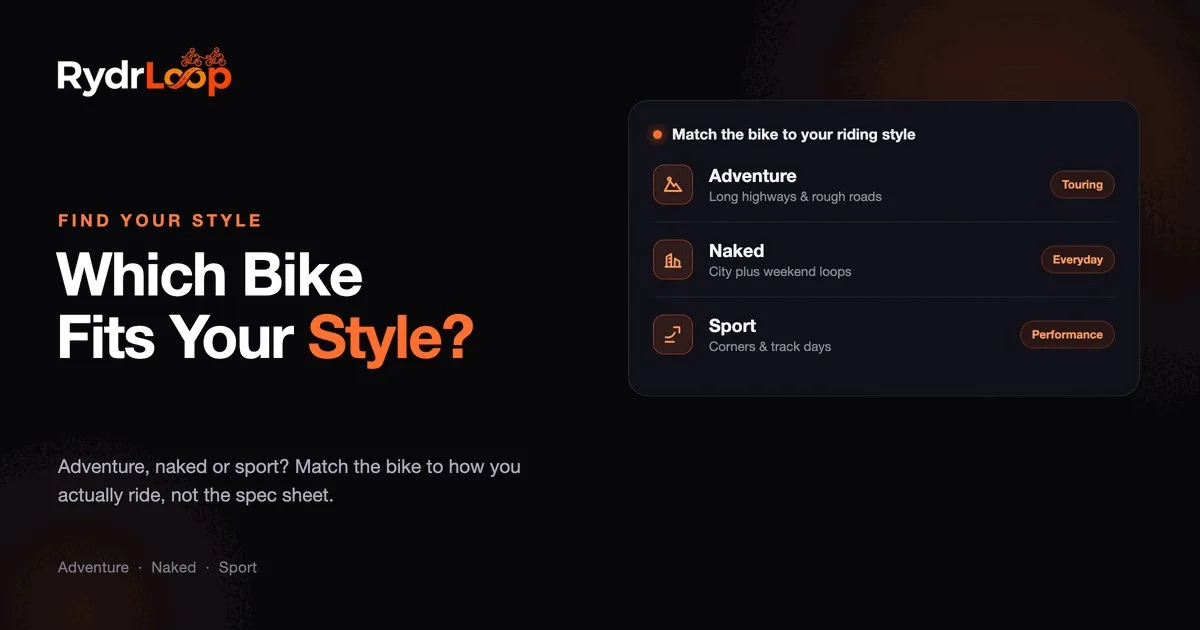
Walk into any motorcycle showroom and ask the salesperson which bike you should buy, and you'll get a question back before you get an answer: what do you want to ride? Most riders answer that with a mood. Something aggressive. Something that turns heads. Something like what a friend rides. Almost nobody answers with the one thing that actually predicts whether they'll love the bike six months later: their riding style.
This isn't another spec-sheet showdown between an adventure bike, a naked bike and a sport bike. You don't need another chart comparing horsepower, kerb weight and ground clearance, you can find twenty of those in ten minutes. What you actually need, and what most buying guides skip, is a way to look at how you ride, honestly, and let that decide the category before you even start comparing models within it. Your riding style is the real filter. The badge on the tank is just what you end up wearing.
Why "Best Bike" Is the Wrong Question, Riding Style Is the Right One
Every year, thousands of riders buy a bike that looks perfect in the brochure and feels wrong within a month. Not because the bike is bad. Because it was matched to an idea of riding rather than the actual riding. A sport bike bought for weekend highway runs that ends up doing 90% city crawling. An adventure bike bought for "someday touring" that spends its life being muscled into a tight apartment parking spot. A naked bike bought for daily commuting that then gets taken on a 600 km highway trip with a pillion and two duffel bags, and suddenly nobody's back is happy.
In every one of those cases, the rider picked a category first and their riding style second, if at all. Flip that order and the whole decision gets easier. Once you know your riding style, adventure versus naked versus sport almost answers itself, because each of these categories was engineered around a specific riding style in the first place. They're not random shapes with different price tags. They're answers to different questions about how a person rides.
So before comparing bikes, it's worth spending five honest minutes comparing riding styles. Not the riding style you aspire to. The one you actually have, based on where you ride, how often, how far, and who's usually on the back seat.
Adventure, Naked and Sport Bikes: What They're Actually Built For
Strip away the model names and marketing, and these three categories are really just three different answers to the same design question: where does this bike need to feel at home?
Adventure bikes are built around the idea that the road will be long and the surface unpredictable. Tall suspension travel to soak up potholes and broken tarmac, an upright seating position that keeps your spine happy for hours, a big fuel tank because fuel stops shouldn't dictate the trip, and a chassis that stays composed loaded with luggage and a pillion. The riding style this shape rewards is distance. Highway stretches, mixed-surface touring, the kind of ride where comfort at hour six matters more than lean angle at corner three.
Naked bikes strip away the wind protection and fairings and build around agility instead. Mid-set footpegs, a shorter wheelbase, light overall weight, and a riding position that's upright enough for traffic but sporty enough to still enjoy a twisty road. The riding style this shape rewards is the everyday one. City commuting, weekend rides that don't stretch past a couple of hours, quick filtering through traffic, and a bike that doesn't feel like a chore to wheel out of a parking spot every single day.
Sport bikes are built around one goal: cornering performance. An aggressive forward-leaning riding position that puts weight over the front wheel, rear-set footpegs for ground clearance when leaned over, a chassis tuned for high-speed stability and quick direction changes, and power delivery that rewards precise throttle control. The riding style this shape rewards is committed, focused riding, canyon roads, spirited weekend runs, occasional track days, where the reward is corner speed and the tradeoff is comfort everywhere else.
None of these is objectively "the best bike." Each is the best answer to a specific riding style, and a mismatch between shape and style is exactly why so many owned motorcycles spend more time being tolerated than enjoyed.
The Real Question: What Does Your Riding Style Actually Look Like?
Riding style isn't one dimension, it's a combination of a few honest answers. Go through these before you go through a single spec sheet.
Where do you actually ride, most weeks? Not where you'd like to ride. Where your bike's odometer actually racks up kilometres. If 80% of your riding is inside city limits, a bike optimised for 150 km/h highway stability is solving a problem you rarely have.
How far does a typical ride go? A 20-minute office commute and a 400 km weekend loop demand completely different things from a seat, a windscreen and a fuel tank. Be specific about your typical distance, not your longest ever ride.
How often do you ride with a pillion or luggage? A bike that's brilliant solo can become genuinely uncomfortable for a passenger, or unstable loaded with a tail bag and side panniers, if the category wasn't built with that in mind.
What's your tolerance for physical effort? A committed sport-bike riding position asks real things of your wrists, neck and lower back, especially in stop-start traffic. An adventure bike's tall seat height asks things of shorter riders at every stoplight. Be honest about your body, not your ego.
What actually makes a ride feel good to you? Some riders live for the moment a corner opens up and the bike tips in cleanly. Others live for the moment the city ends and the highway stretches out. Others just want the ride to work, comfortably, every single day, without asking much of them. There's no wrong answer here, but there is a wrong bike for each answer.
Once you've actually answered these, most riders find they already know which category they belong to. The three sections below just confirm it.
If You Mostly Ride City Plus Weekend Loops, You're a Naked Bike Rider
This is the most common riding style among Indian motorcyclists, and it's also the one most often mismatched to the wrong bike, usually because a sport bike simply looks more exciting in a showroom. If your week looks like a daily commute through city traffic and your weekends are occasional two to three hour rides to a nearby viewpoint, dhaba or riding meet, a naked bike is doing exactly what its shape was designed for.
The upright seating position means you're not fighting your own bike at every red light. You can see over traffic, other riders can see you, and your back isn't paying for it after twenty minutes of stop-start city riding. The lighter overall weight and shorter wheelbase make lane filtering and slow-speed manoeuvring, parking lots, narrow lanes, U-turns at a signal, feel natural instead of like a wrestling match. And because there's no fairing to crack in a low-speed tip-over, both the repair bills and the day-to-day maintenance stay simpler.
This riding style doesn't mean the bike is boring. A good naked bike is genuinely fun on a weekend ghat road, plenty of them are more agile through tight corners than a heavier adventure bike, and most riders find the power delivery friendlier and easier to read at real-world speeds than a full sport bike's. What you're trading away is wind protection on longer highway stretches and outright top-end composure at very high speed, both things that matter far less if your riding style rarely asks for them.
If this sounds like your week, worth reading next: what actually makes riding gear worth buying for exactly this kind of everyday riding, since a naked bike's lack of fairing means your gear is doing more of the protective work.
If You Chase Long Highways and Unpredictable Roads, You're an Adventure Bike Rider
If your idea of a good ride is leaving before sunrise, covering serious distance, and not particularly caring whether the road stays perfectly paved the whole way, your riding style points straight at an adventure bike. This is the rider who plans a 500 km weekend, rides two-up more often than not, and treats a cracked or gravel-strewn stretch of highway as part of the adventure rather than a problem to avoid.
The tall suspension travel that looks unnecessary in a city parking lot earns its place the moment the road surface turns unpredictable, potholes, broken patches, sudden gravel, monsoon-damaged tarmac, all things a long-travel suspension simply absorbs instead of transmitting straight into your wrists. The upright, relaxed seating position is tuned for hours in the saddle, not minutes, which is exactly what a long touring day demands. The larger fuel tank means fewer stops on stretches where the next petrol pump might be further than you'd like, and the chassis is built to stay planted and predictable fully loaded, luggage on the back, pillion on the seat, at highway speed.
This riding style also tends to belong to riders who value the journey being manageable more than it being thrilling in any single corner. An adventure bike won't out-corner a sport bike on a canyon road, and it isn't trying to. What it will do is make hour seven of a highway ride feel almost as fresh as hour one, which matters far more to this riding style than outright cornering speed ever will.
Before any longer ride on a bike built for exactly this kind of distance, it's worth running through a proper pre-ride checklist, since the whole point of an adventure bike is covering distance reliably, and reliability starts before the ignition turns.
If You Live for Corners and the Occasional Track Day, You're a Sport Bike Rider
There's a smaller but very specific riding style this category was built for: riders who genuinely chase the feeling of a bike leaned hard into a corner, who plan weekend rides around a specific twisty ghat section rather than a destination, and who either already do track days or want to. If that's an accurate description of what actually gets you excited about riding, no amount of comfort from the other two categories will substitute for what a sport bike gives you in a corner.
The forward-leaning riding position isn't there to look aggressive for its own sake, it shifts your weight over the front wheel exactly where it's needed for confident, fast direction changes. The rear-set footpegs exist so you have ground clearance to lean further before anything touches down. The chassis geometry, suspension tuning and often the electronics package are all built around one job: staying composed and communicative at speeds and lean angles the other two categories were never asked to handle.
This riding style comes with honest tradeoffs, and pretending otherwise does new sport bike buyers a disservice. Traffic-heavy commuting on a sport bike is genuinely uncomfortable, the riding position that feels perfect at speed puts real strain on wrists and neck at 15 km/h in a jam. Pillion comfort is usually an afterthought, not a design priority. And the fairings that make the bike look so complete are also the most expensive part to repair after even a minor low-speed drop.
None of that is a reason to avoid the category if this is genuinely your riding style, corner-focused, performance-first, occasional track days. It's a reason to be honest with yourself about how much of your actual riding time will be spent doing the thing this bike is built for, versus the thing it tolerates. Because this riding style demands more precision and more protective gear than the other two, it's worth being extra deliberate about the gear you're riding in before you start pushing lean angle.
When You Don't Fit Neatly Into One Riding Style
Plenty of riders read the three sections above and see pieces of themselves in more than one. That's not a failure of the framework, it's normal. Riding style isn't always a clean box, and a lot of real riders are genuinely hybrid: a weekday commuter who also does two serious tours a year, or a canyon-road enthusiast who also rides two-up on weekends.
When that's you, the fix isn't finding a mythical bike that's equally excellent at everything, that bike doesn't really exist, every category is a set of tradeoffs by design. The fix is being honest about which riding style eats more of your actual calendar. If you commute five days a week and tour twice a year, optimise for the commute, a naked bike, and treat the two tours as the exception you plan around, better gear, softer pace, more breaks. If you tour every other weekend and commute is a rare inconvenience, optimise for the tour, an adventure bike, and accept that city parking will occasionally be a small hassle.
There's also a genuine middle ground worth knowing about: scrambler and street-scrambler style bikes borrow the naked bike's agility with a bit of the adventure bike's ground clearance and upright comfort, without going as far into off-road capability or highway-touring bulk as a full adventure bike. If your riding style genuinely splits down the middle between everyday agility and occasional rough-road comfort, it's worth looking at this category specifically rather than forcing a choice between the other two.
A Quick Riding Style Self-Check
If you're still unsure, run through these questions honestly. Don't answer for the rider you want to be, answer for the rider your last three months of riding actually describe.
Do more than half your rides stay inside city limits and finish in under an hour? That's a strong signal toward a naked bike's riding style.
Does a typical weekend ride for you mean 300 kilometres or more, often with a pillion? That's a strong signal toward an adventure bike's riding style.
Do you plan rides specifically around a twisty section of road, or actively look forward to a track day? That's a strong signal toward a sport bike's riding style.
Does your back or wrists start complaining after 40 minutes on your current bike, regardless of what you're riding? That's less about which of the three categories you're in and more a sign your riding position needs revisiting entirely, sometimes within the same category, a slightly different model changes this completely.
Would you rather the bike disappear underneath you in traffic, or would you rather it disappear underneath you at speed on an open road? That single preference, more than any spec, usually says more about your true riding style than the rest of this checklist combined.
The Mistake Most Riders Make: Buying the Category Before Knowing the Style
The single most common regret riders share isn't about a specific model, it's about buying the wrong category for their actual riding style and only realising it months later. A rider who bought a sport bike because it looked incredible in photos, then spent a year wincing through daily traffic on it. A rider who bought a heavy adventure bike for touring dreams that never quite materialised, and now dreads every tight parking manoeuvre. A rider who bought a naked bike, loved it daily, then took it on one brutal 700 km highway day and finally understood what wind protection is actually for.
In almost every one of these stories, the bike wasn't defective and the category wasn't a bad one. The riding style was misjudged, usually optimistically, before the purchase. The honest version of this exercise isn't about your best possible riding day, the epic tour you're planning, the track day you might do someday. It's about your median riding day, the one that repeats fifty times a year. Match the bike to that, and the epic days tend to take care of themselves anyway.
Riding Style Is Also Why Group Rides Feel So Different Depending on the Bike
There's a practical, community side to this too, one that becomes obvious the moment you start joining group rides regularly. A naked bike rider on a fast-paced adventure-bike highway run will be working much harder to keep pace than everyone else. A sport bike rider on a slow, technical off-road-adjacent adventure ride will spend the whole day worried about ground clearance and tyre choice. Riding style mismatches don't just affect solo comfort, they affect how well a bike fits the group ride it's actually joining.
This is part of why, on RydrLoop, ride details show the kind of route and pace a ride is built around before you commit to it, so you can match your riding style to the ride, not just show up and hope your bike keeps up. Knowing your own riding style first makes that filtering almost automatic. A city-and-weekend naked bike rider naturally gravitates toward relaxed local loops and café stops. An adventure bike rider naturally gravitates toward the long weekend touring plans with two or three fuel stops mapped out. A sport bike rider naturally gravitates toward the ghat-road groups that plan a route around corners, not distance.
Final Verdict: Match the Bike to the Rider, Not the Rider to the Bike
There's no universally correct answer between an adventure bike, a naked bike and a sport bike, and any guide that claims otherwise is selling you something. What there is, for every single rider, is a correct answer for their specific riding style. Mostly city and occasional weekend rides points to a naked bike. Long highways, unpredictable roads and touring plans point to an adventure bike. A genuine love of corners and the occasional track day points to a sport bike.
The riders who end up happiest with their motorcycle almost always did this exercise honestly before they walked into a showroom, not after. They knew their riding style first, and let that decide the category, then picked the specific model that felt right within it. Do the same, and you'll spend a lot less time wondering if you bought the wrong bike, and a lot more time just riding the right one.
Whichever category matches your riding style, the fastest way to actually enjoy it is riding with people who ride the same way. Browse rides on RydrLoop built around your pace, your distance and your kind of road, and find out how much better your riding style feels with the right company.
Comments (0)
Join the conversation. Your thoughts matter!
Be the first to share your thoughts.