

What to Do After a Bike Accident in India: The Playbook Every Rider Should Already Know
Nobody rehearses the minutes after a bike accident. Here is the exact order to follow, from the first sixty seconds to the insurance claim weeks later.
 RydrLoop··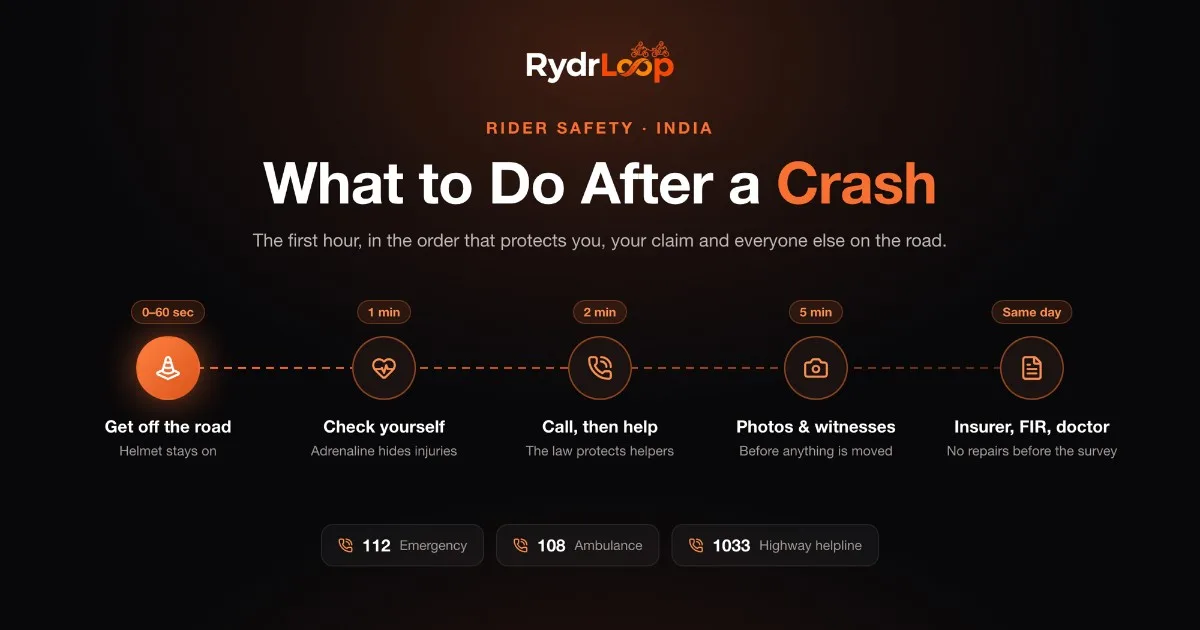
Nobody rehearses a bike accident. You plan the route, the fuel stops, the gear, the people you are riding with. Then a car turns across your line at a junction you have crossed a hundred times, and suddenly you are sitting on the road in the middle of the ten minutes you never thought about.
Most riders in India handle the aftermath of a bike accident badly, and it is almost never because they panicked. It is because nobody ever told them the order to do things in. They stand in the middle of a live carriageway arguing about whose fault it was, they let a stranger talk them into a cash settlement that does not cover half the damage, they move the bike before taking a single photo, and three weeks later their insurance claim gets cut down because there is no proof of anything that happened.
The order is simple and it barely changes from one bike accident to the next: get safe, help anyone who is hurt, then collect what you will need later, then deal with paperwork. Everything in this guide sits inside that order. Read it once now, calmly, and you will not have to think clearly at the one moment when thinking clearly is hardest.
The first sixty seconds: get off the road, not into an argument
The single most dangerous moment after a bike accident in India is not the impact. It is the two minutes afterwards, when a rider is standing in a live lane, half in shock, with traffic still moving at 80 km/h around a scene nobody expects.
Before anything else:
- Move yourself out of the traffic flow. Off the carriageway, past the shoulder, behind the barrier if there is one.
- Move the bike only if it is safe to do so and it is blocking traffic. Otherwise leave it and photograph it where it lies.
- Put the hazards on if they still work. If you carry a small torch or a reflective vest, this is the one time it earns its place in your tail bag.
- On a fast highway, stand well behind the wreck and upstream of it, never directly in front. Vehicles that hit a stationary object tend to push it forward.
Keep the helmet on until you are off the road. People instinctively rip a helmet off the second they stop moving, and it is the worst time to remove the only thing protecting your head from a second impact.
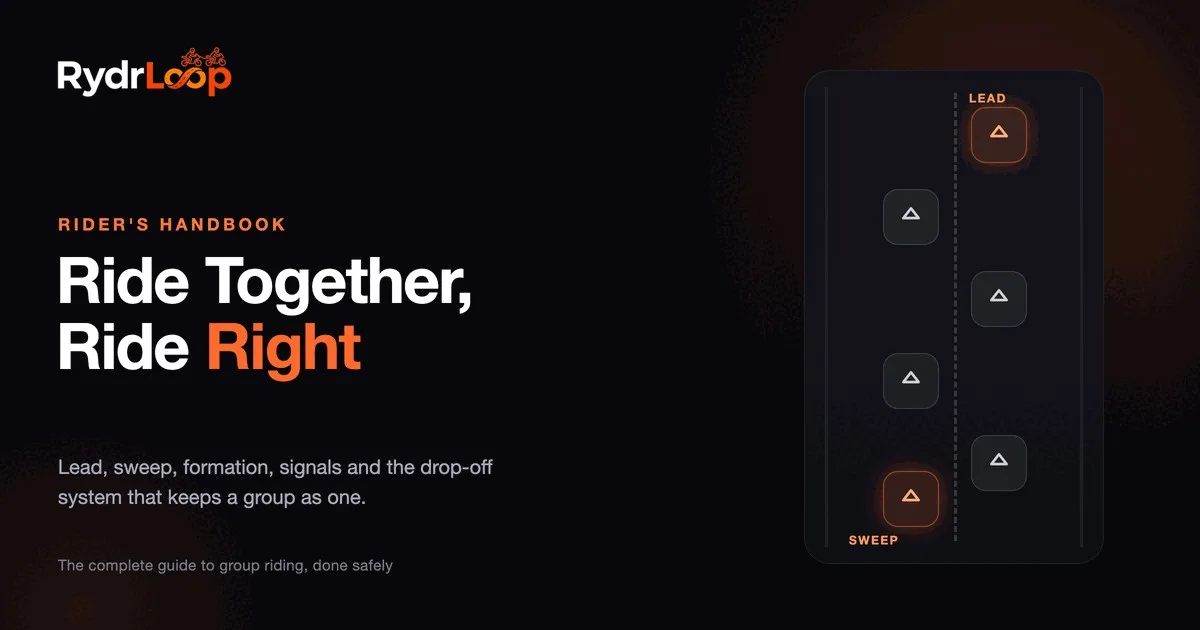
If you are riding in a group, the second rider's job is not to rush to the crash. It is to park upstream with hazards on and slow the traffic down. That one habit prevents most secondary collisions.
Check yourself properly, because adrenaline lies
Adrenaline is a very good painkiller and a very bad diagnostician. Riders routinely walk away from a bike accident, refuse help, ride home, and discover a fractured scaphoid or cracked ribs the next morning. A quick, deliberate self-check takes fifteen seconds:
- Move each ankle, knee, wrist and shoulder one at a time before you stand up.
- Look at your hands. Wrists and collarbones are the two things riders break most often, and both can feel like nothing for an hour.
- Check for wetness inside the gear. Blood soaks inward and you may not see it from outside.
- If your helmet took a real hit, that helmet is finished, whatever it looks like. Replace it. Foam does its job exactly once.
If you feel fine, still get checked. Head injuries in particular can present hours later, and a medical record created on the day of the bike accident is also the thing that holds up any claim you make afterwards.
If somebody else is hurt: what the law actually protects you from
A lot of riders in India hesitate to help a stranger hurt in a bike accident because of an old fear that they will get dragged into police stations and court dates for the rest of the year. That fear is out of date, and the hesitation costs lives during the golden hour, the first hour after a serious injury when treatment matters most.
Under the Good Samaritan protections in the Motor Vehicles Act, someone who helps a road accident victim in good faith is protected from civil and criminal liability for anything that happens as a result. You cannot be compelled to reveal your identity, you cannot be detained at the hospital, and no hospital can insist on payment before treating an accident victim.
What actually helps at the scene:
- Call before you touch. Dial 112 anywhere in India for police, fire and ambulance. 108 reaches an ambulance directly in most states. On a national highway, 1033 is the highway helpline and the people answering it know which stretch you are on.
- Do not remove an injured rider's helmet. Unless they are not breathing and the helmet is genuinely blocking the airway, leave it on. Removing a helmet from someone with a neck injury is one of the few things a bystander can do that makes things permanently worse.
- Stop heavy bleeding with pressure. Firm, continuous pressure with the cleanest cloth available beats any improvised tourniquet.
- Do not give water. If they need surgery, anything in the stomach becomes a complication.
- Keep them warm and keep talking to them. Shock drops body temperature, and a conscious person who is being spoken to is a person you can monitor.
Getting an injured rider into a passing car is sometimes the fastest route to a hospital in rural India, and it is a judgement call. If there is any suspicion of a spinal or neck injury, and they are breathing and stable, waiting for an ambulance with people who can move them properly is usually the better choice.
Collect what your bike accident claim will need, while it still exists
The scene of a bike accident disappears fast. Vehicles get moved, witnesses drive off, and the skid mark that proves everything gets erased by the next hundred cars. Five minutes of photographs at the scene is worth more than five hours of arguing later.
- Wide shots of the whole scene from four directions, showing both vehicles where they came to rest
- The other vehicle's number plate, clearly readable
- Close-ups of every damaged part on your bike, and on theirs
- Skid marks, debris, broken glass, spilled fluid, the pothole or the oil patch if that is what caused it
- Road signs, signals, the junction layout, anything that establishes right of way
- The other driver's licence and insurance details, photographed rather than written down
- Names and phone numbers of two witnesses, before they leave
- A short video walking around the scene narrating what happened, while it is fresh
- Your own injuries and damaged gear, before you clean up or change
If a traffic camera, a toll plaza or a shopfront overlooks the spot, note it. Footage is usually overwritten within days, so a request has to go in quickly, and knowing the camera exists is half of that battle.
What to say, and the two things never to say
Two sentences at the scene cause more trouble than anything else riders do after a bike accident in India.
The first is "sorry, my fault". Say it because you are decent and shaken, and it will be quoted back at you by an insurer or an opposing lawyer as an admission of liability. Be human, check if the other person is alright, help them, but describe only what happened, never who was to blame. Fault is decided later by people looking at evidence, not by whoever is most apologetic on the roadside.
The second is agreeing to an on-the-spot cash settlement before you know what is broken. A bent lever and a scratched fairing look like a five thousand rupee problem until the mechanic finds a cracked fork seal, a bent triple clamp and a radiator that has to be replaced. If the other party wants to settle privately, take their details anyway, take the photographs anyway, and tell them you will confirm once the bike has been assessed. Anyone unwilling to share their licence and insurance details is telling you something useful about how the rest of this will go.
Stay off social media after a bike accident. A photo of the wreck with a caption about how fast the road was is evidence that works against you.
FIR or no FIR: when you actually need one
This is the question that confuses almost everyone after a bike accident, and the answer is more practical than legal.
You need an FIR when: anyone is injured or killed, the other party is disputing what happened, the other vehicle fled the scene, your bike was stolen, or there is significant third party damage. Any claim that will involve a third party or a motor accident claims tribunal will eventually need the police record, and getting it weeks later is far harder than getting it on the day.
You usually do not need an FIR when: you dropped the bike on your own, there is no other vehicle involved, nobody is hurt, and you are making a straightforward own damage claim on your own policy. Most insurers will process minor own damage claims on photographs and a surveyor's report alone.
When in doubt, register it. An FIR you did not strictly need costs you an afternoon. A missing FIR on a claim that needed one can cost you the claim entirely. And if a police station is reluctant to register a non-cognisable complaint, ask for it in writing, keep the acknowledgement, and note the time.
Do not let anybody take your bike away without knowing where it is going. If the vehicle is seized, get the seizure noted and find out which station it is parked at.
Calling your insurer: the details that decide how much you get back
Inform your insurer about the bike accident as soon as you can, ideally from the roadside or the same day. Most policies expect prompt intimation, and a gap of several days is exactly the kind of thing that turns into a dispute later.
Then follow the sequence that protects the money:
- Do not start repairs before the survey. The surveyor has to see the damage in the state the accident left it in. A workshop that has already stripped the bike down makes their assessment, and your settlement, weaker.
- Use a network garage if you want cashless. Cashless settlement only works at the insurer's empanelled garages. Anywhere else is reimbursement, which means you pay first and claim back with original bills and invoices.
- Know what your policy actually covers. Third party is compulsory and covers damage you cause to others, not your own bike. Own damage covers your bike. Zero depreciation, engine protect, consumables and roadside assistance are add-ons, and if you do long rides and do not have roadside assistance, it is the cheapest useful thing you can add at renewal.
- Keep every original. Repair estimate, final invoice, payment receipt, FIR copy, medical bills, RC, licence, policy. Photograph all of it the day you get it, because originals go into files and disappear.
- Ask for the surveyor's assessment in writing if the settlement comes in lower than the estimate, and ask which specific parts were disallowed and why. A depreciation deduction on plastics is normal. A rejected part that was clearly damaged in the crash is worth pushing back on.
If you were hurt in a bike accident that was someone else's fault, compensation for the injury is a separate track from vehicle damage, handled through a motor accident claims tribunal. Keep every medical record, every prescription and every day of lost income documented from day one, because that claim is built entirely out of paperwork.
Take a photo of your registration certificate, licence, insurance policy and your insurer's claim number now, and keep them in a folder on your phone. Digital copies of a driving licence and RC held in DigiLocker or mParivahan are accepted by traffic police, and a roadside is a terrible place to discover your documents are in a drawer at home.
The medical trail you should build even if you feel fine
Get examined the same day. Not because you think you are hurt, but because two things happen without a same-day medical record: an injury that shows up on day three becomes much harder to link to the bike accident, and any injury claim you make later has a hole in it exactly where the start of the story should be.
Keep a simple log for the next two weeks: what hurts, when it started, what the doctor said, what you could not do at work. It takes a minute a day and it turns vague discomfort into documented evidence.
Pay particular attention to concussion signs in the days after any impact where your head hit something: headaches that will not settle, nausea, sensitivity to light, trouble concentrating, sleep that is suddenly wrong. Riders wave these off constantly. Do not ride again until they are gone.
Getting back on the bike
This is the part almost no accident guide covers, and it is the part that quietly ends more riding careers than injuries do.
After a bike accident, a lot of riders discover that their confidence did not heal on the same schedule as their collarbone. The junction where it happened feels different. Overtaking feels different. Some riders overcorrect and ride so timidly that they become unpredictable, which is its own hazard. Others rush back out to prove nothing changed and crash again within the month.
What tends to work: go out alone, on a route you know completely, at a time with almost no traffic, for twenty minutes. Then do it again. Rebuild in small pieces instead of testing yourself on the exact scenario that scared you. Ride with people who know what happened and will not push the pace to make a point. If the anxiety is not fading after a few weeks, that is a normal human response to a genuinely frightening event and worth talking to someone about, not a character flaw.
And go back over the bike accident itself once, honestly, when the emotion has settled. Not to assign blame, but to find the one decision that would have changed the outcome. Speed into a blind junction, a following distance that was too short, a wet manhole cover you saw and gambled on. Riders who do that reflection once tend not to repeat that particular mistake. The ones who file the whole thing under bad luck usually do.
Before your next ride, set this up in ten minutes
- Emergency contact saved in your phone as ICE, and written inside your helmet or on a sticker under the seat
- Insurance policy number, insurer helpline and roadside assistance number saved in your phone
- Licence, RC and insurance available digitally in DigiLocker or mParivahan
- A small first aid kit with gloves, gauze, a pressure bandage and tape in the tail bag
- Blood group and any allergy or medication noted on your ICE card
- Roadside assistance added at your next policy renewal if you ride long distances
- 112, 108 and 1033 saved, and known by the people you ride with
Ten minutes of setup, done once. If you ride regularly, you will use at least one of these eventually, for yourself or for somebody else on the road.
The habit that matters more than any of this
Everything above is damage control. The upstream version is riding gear that turns a hospital visit into a set of scratches, and riding habits that keep you out of the situation in the first place. If you are still building that foundation, the gear guide for new riders and the mistakes riders make on their first highway ride are the two places to start.
The other thing that helps is not riding alone all the time. A rider who goes down alone on an empty stretch at 7 am is in a very different situation from a rider whose group is thirty seconds behind them. If you are looking for people who ride the way you do, RydrLoop is built exactly for that: find riders nearby, join rides that match your pace, and build the kind of riding circle that shows up when something goes wrong.
Comments (0)
Join the conversation. Your thoughts matter!
Be the first to share your thoughts.