

Motorcycle Breakdown on the Highway: The Nine Failures That Strand Riders and How to Fix Them
Almost every motorcycle breakdown comes from the same short list. Here is how to spot which one you have, what you can fix yourself, and when to stop trying.
 RydrLoop··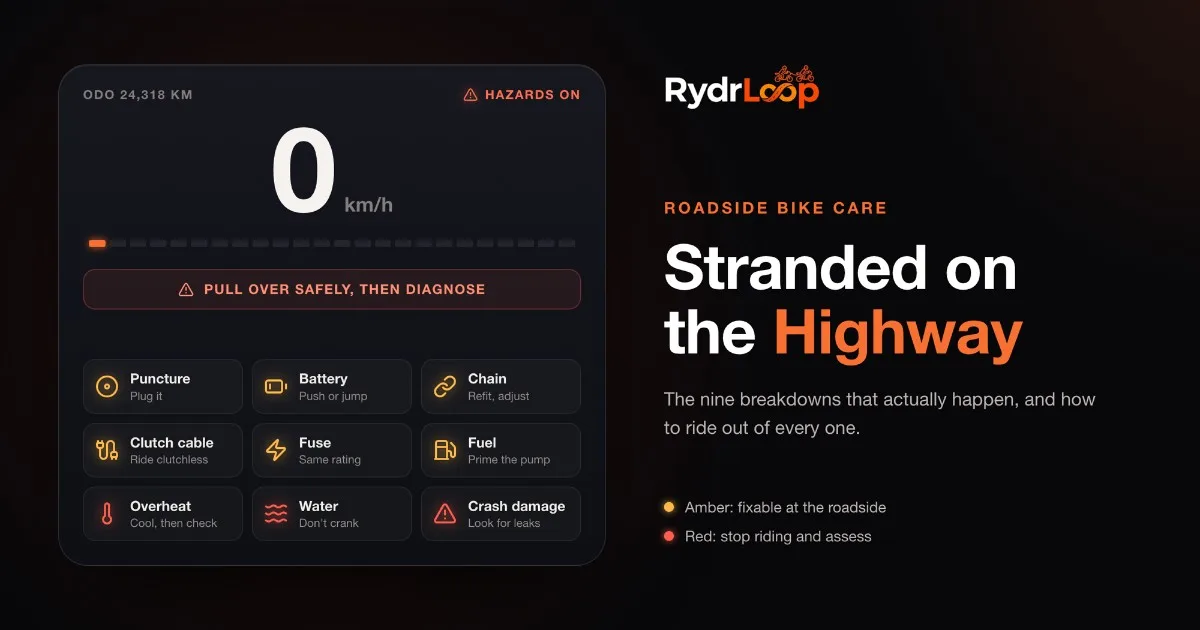
Every rider who has done a few thousand kilometres has a motorcycle breakdown story, and it usually starts with a sound. A tick that becomes a knock, a hiss from the rear tyre, a dashboard that goes dark at 90 km/h. The story usually ends one of two ways: forty minutes of work and then riding on, or five hours on the shoulder waiting for a pickup truck.
The gap between those two endings is smaller than most riders think. A motorcycle breakdown is rarely random. On Indian highways the same short list accounts for almost everything, and most items on that list are fixable at the roadside by someone who knows what they are looking at and has about ten small things in their tail bag.
This is that list, in the order you will actually meet it, plus the part most guides skip: how to tell when a fix is good enough to ride home on, and when continuing is how a motorcycle breakdown becomes a crash.
Before you touch anything, get the scene safe
A motorcycle breakdown on a highway is dangerous for a reason that has nothing to do with the mechanical fault. You are now a slow or stationary object on a road where nothing else is slow or stationary.
- Get fully off the carriageway. Past the shoulder if you can, behind the barrier if there is one.
- Leave the hazards on if the electricals are alive. If they are not, this is why a small torch or a reflective vest lives in the tail bag.
- Work on the side of the bike away from traffic. Always. Every roadside repair that ends badly involves a rider kneeling on the traffic side.
- At night, stand upstream of the bike with a torch, not in front of it.
- If you are in a group, one rider parks fifty metres upstream with hazards on. Nobody else clusters around the bike.
Sort that out first, every time, even when the fix looks like a thirty second job. Especially then.
The sixty second motorcycle breakdown diagnosis
Before you open a toolkit, work out which family of problem you have. It takes a minute and saves you from stripping a spark plug on a bike that has simply run out of fuel.
- Nothing at all when you press the starter. No lights, no click, no dash. This is electrical: battery terminal, fuse, kill switch, or a dead battery.
- It cranks but will not fire. The engine is turning, so power and starter are fine. Now it is fuel, spark or air.
- It was running and just died. Think fuel supply, ignition cut, a sensor, or something that came loose. Bikes that die suddenly at speed have usually lost electrical continuity somewhere.
- It is running but wrong. Misfiring, no power, overheating, a new noise. This is the family where you stop and diagnose properly, because riding on can turn a cheap repair into an engine.
- It is running fine but something physical failed. Puncture, chain, cable, lever, luggage. Mechanical, visible, usually fixable.
Almost every motorcycle breakdown resolves into one of those five. Once you know which, you know where to look.
1. Puncture: the most common motorcycle breakdown in India, by a distance
If you have tubeless tyres, this is a twenty minute job and the single best reason to carry a plug kit.
- Find the leak. Spin the wheel slowly and look for the nail, screw or thorn. If nothing is visible, pour a little water along the tread and watch for bubbles.
- Leave the object in place until you are ready. Pulling it out first just lets the air go faster.
- Ream the hole with the rasp tool, firmly and several times. Most failed plug repairs fail here, because the rider was too gentle.
- Push the plug through with the insertion tool until a small tail is left outside, then pull the tool straight out. Trim the tail close to the tread.
- Reinflate with a CO2 cartridge or a small compressor, and set the pressure your manual asks for rather than guessing.
- Ride at moderate speed to the next tyre shop and get the repair inspected. A plug is a get home fix, not a permanent one.
Never plug a sidewall. If the damage is in the flexible sidewall rather than the flat tread, that tyre is done and riding on it is a blowout waiting for a corner.
If you have tube tyres, be honest with yourself. A tube repair means getting the wheel off, breaking the bead, levering the tyre, patching or swapping the tube, and reseating everything, at the roadside, without a bench. It is possible and it is miserable. In most of India a puncture shop is within a few kilometres, and the practical fix is to ride slowly if the tyre is only soft, or walk the bike if it is flat. Riding on a fully flat tube tyre destroys the tube, usually damages the tyre and can damage the rim, and it steers like nothing you want to experience at speed.
The habit that prevents most punctures from becoming breakdowns is checking pressure weekly with your own gauge. A tyre losing two PSI a week is telling you about a slow leak days before it strands you.
2. Dead battery: the fix depends on what kind of bike you ride
Symptoms: dash does not light, starter makes a rapid clicking, or the engine turns over so slowly it sounds tired.
First, check the obvious. A loose or corroded battery terminal looks exactly like a dead battery and takes one spanner to fix. Wiggle both terminals. If they move, tighten them.
If the battery is genuinely flat:
- If your bike has a kick starter, use it. This is the entire argument for kick starters and it is a good one.
- If it is a carburetted bike, a push or roll start usually works. Ignition on, second gear, clutch in, get it rolling at a decent jog or downhill, drop the clutch and pull it back in the moment the engine catches.
- If it is a fuel injected bike, expect less. The ECU and the fuel pump need real voltage before the engine can fire at all. With a completely flat battery, a push start often will not work no matter how far you run. With a weak but not dead battery, it frequently does.
- Jump starting from a car is a last resort, and if you do it, keep the car's engine switched off while connected. A running car's charging system can push more current than a small motorcycle battery and its electronics are happy with.
- A compact lithium jump pack is the modern answer and lives easily in a tail bag if you ride long distances often.
A battery that has caused one motorcycle breakdown will cause another, so replace it at the next big town rather than gambling on the next start.
3. Chain: thrown, loose, or snapped
Thrown chain. Usually a symptom of a chain that was too loose. Get it back on the rear sprocket first, rotate the wheel slowly by hand while feeding it over the front sprocket, then check for damage to the chain guide and sprocket teeth before riding.
Chain gone loose. You will feel it as a clunk on and off the throttle. Adjust it at the axle adjusters to the slack your manual specifies, keeping both sides on the same marking so the wheel stays aligned. A chain that needs adjusting every couple of hundred kilometres is worn out and needs replacing, not adjusting.
Snapped chain. This is the motorcycle breakdown that ends rides. If you carry a spare master link and a chain breaker you can sometimes rejoin it and limp to a town. Most riders do not carry either, and the honest answer is recovery. Ride a snapped chain nowhere: check the engine casing and your rear wheel area for damage while you wait, because a chain that lets go at speed often takes something with it.
Chain care is the cheapest insurance against a motorcycle breakdown there is. Clean and lube it every few hundred kilometres and it very rarely surprises you. The maintenance guide covers the routine in detail.
4. Clutch cable snapped: you can still ride home
This feels like a trip ending failure and usually is not. If your clutch cable breaks, you can ride a motorcycle without a clutch, and it is a genuinely useful skill.
- To start moving: switch the engine off, put the bike in first gear, hold the front brake, then hit the starter. The bike will lurch and the engine will start with the bike already in gear. On most bikes the clutch safety switch is at the lever and still works even with the cable gone, so pulling the dead lever keeps the starter circuit happy.
- To upshift: preload the gear lever with your toe and briefly roll off the throttle. It will slot in cleanly.
- To downshift: roll off, blip the throttle slightly, press down. Smoother than it sounds after two attempts.
- To stop: come to a halt in gear and switch the engine off, or pull in the clutch that is not there and stall it gently at walking pace.
Ride it to a mechanic, not across three states. Plan stops so that you are not restarting in the middle of dense traffic, and avoid situations where you need to crawl, because crawling without a clutch is where it gets ugly. A spare clutch cable is small, cheap, and can be zip tied along the frame for exactly this day.
A snapped throttle cable is the less friendly cousin of this motorcycle breakdown, and it usually does mean recovery. Some riders carry a spare of that too.
5. Everything electrical dead: check the boring things first
Before you assume a wiring problem, work through this list, because one of these causes an electrical motorcycle breakdown far more often than anything exotic:
- Kill switch in the run position
- Sidestand fully up, and the sidestand switch not clogged with mud
- Bike genuinely in neutral, or clutch pulled in
- Battery terminals tight and not corroded
- Main fuse and the relevant circuit fuse, checked visually for a broken filament
- Ignition switch and any immobiliser or anti theft cutoff you have fitted
Spare fuses are usually clipped inside the fuse box and cost almost nothing to replace. Always fit the same rating. Never substitute a higher rated fuse and never use foil or wire, because the fuse is the only thing standing between a short circuit and a wiring loom fire.
If a fuse blows again immediately after replacement, stop. Something is shorting, and forcing current through it is how a small problem becomes a very expensive one.
6. Out of fuel, or fuel that will not reach the engine
On older carburetted bikes with a fuel tap, running dry means switching to reserve and finding a pump. On modern fuel injected bikes there is no reserve position, only a gauge and a trip meter, and running the tank truly empty is worse for you: the fuel pump sits in the tank and is cooled by the fuel around it.
If you have refilled after running completely dry and the bike will not fire, turn the ignition on and off two or three times, waiting a couple of seconds each time. You should hear the fuel pump prime. That refills the line before you press the starter.
Running dry is the most avoidable motorcycle breakdown there is. On remote routes, plan fuel by range rather than by hope. Know how many kilometres your tank actually gives you when ridden loaded, subtract twenty percent, and treat that as your real range. If you carry spare fuel for a genuinely remote stretch, use a proper approved fuel canister mounted securely, not a water bottle in a backpack. Most pumps will refuse to fill loose containers anyway, and they are right to.
7. Overheating
Overheating gives more warning than any other motorcycle breakdown, if you keep an eye on the temperature gauge or light. Air cooled bikes overheat in slow traffic, because airflow is what cools them. Liquid cooled bikes overheat when coolant is low, a hose has failed, or the radiator fan has stopped working.
What to do:
- Pull over and switch off. An air cooled engine cools faster stationary and off than idling.
- Look under the bike for a coolant puddle, and at the radiator for damage or a thick layer of mud and insects blocking airflow.
- Check whether the fan runs once the engine gets hot, with the ignition on.
- Never open a hot radiator cap. The system is pressurised and it will spray boiling coolant. Wait until it is cool enough to hold your hand on the engine casing.
- Top up with coolant if you can, or plain water as a get home measure, then get the system flushed and refilled properly afterwards.
If the temperature light came on and stayed on, or you saw steam, do not simply wait ten minutes and continue at the same pace. Ride gently, keep moving so there is airflow, and stop again at the first sign of the needle climbing.
8. It died in water, or it will not fire after a crossing
If your engine stalled while crossing water, this is the one motorcycle breakdown where doing nothing is the correct expert move. Do not press the starter. If water has been drawn into the cylinder, cranking the engine can bend a connecting rod, and that repair costs more than the rest of this article combined.
Push it out of the water, then:
- Check the air filter. If it is soaked, the engine was drinking water, and it should be dried or replaced before you run the engine.
- Remove the spark plug, put the bike in gear and roll it forward so the engine turns and pushes any water out of the cylinder.
- Dry the plug, refit it, and only then try to start.
The everyday version of this is a fouled or wet plug after a rainy ride, which shows as hard starting, misfiring or a rough idle. A spare plug and the correct spanner are small things to carry if you ride monsoon routes or water crossings.
9. After a fall: what is cosmetic and what is not
A low speed drop usually breaks levers, indicators, mirrors and pride. Bar end mirrors and clutch levers you can often bend back enough to ride, and a broken lever with even a stub left is usually workable to get you to a town.
The things that are not cosmetic, and that end the ride on the spot:
- Fluid leaking from anywhere. Oil, coolant or brake fluid on the road under the bike means stop.
- A brake lever that goes to the bar, or a brake pedal with no resistance.
- Handlebars, forks or wheels that no longer line up, or steering that feels notchy or heavy after an impact.
- A fuel leak of any size, which is not a mechanical problem but a fire.
- A sound that is new, rhythmic and speed dependent. New noises after an impact deserve a mechanic, not another hundred kilometres.
Check your tyres after any fall too. A sidewall scuffed down to the cords looks like nothing and is not nothing.
The toolkit that earns its space
You are not carrying a workshop. You are carrying the handful of things that turn the most likely motorcycle breakdown into an inconvenience. For most riders on most trips, this is the list:
- Tubeless plug kit with rasp, plugs and insertion tool
- CO2 cartridges or a compact 12V compressor, plus a pressure gauge
- The bike's own toolkit, plus the one or two spanner sizes it is missing for your axle nut
- Allen key set or a decent multi tool
- Ten zip ties and a roll of insulation tape
- Spare fuses of the correct ratings
- Spare clutch cable, zip tied along the frame if it will fit
- Chain lube, and a spare master link if your chain uses one
- Small torch or headlamp, and a power bank
- A rag, and a pair of gloves you do not mind ruining
Anything more than that is personal. Riders doing genuinely remote Himalayan routes add a spare tube, a plug spanner, a length of fuel hose and M-seal. Riders doing weekend highway trips rarely need any of it.
When to stop fixing and start calling
There is a point where working on a motorcycle breakdown at the roadside stops being resourceful and starts being stubborn. You have reached it when it is getting dark, when you are tired, when you are unsure whether your repair is safe, or when the same fault has already come back twice.
Numbers worth having in your phone before you need them:
- 1033, the national highway helpline, which handles breakdowns and accidents on national highways.
- 112, the all India emergency number.
- Your insurer's roadside assistance line, if you have the add-on. If you ride long distances and do not have it, add it at your next renewal. It is one of the cheapest useful things on a policy.
- A mechanic you trust in your home city, who can tell you over a phone call whether what you are describing is rideable.
When recovery does come, get the bike loaded into a tempo or pickup properly, strapped down by the handlebars with the suspension slightly compressed. Never let anyone tow a motorcycle behind another vehicle with a rope. It is done all the time in India and it is a genuinely good way to get hurt.
Most of this list never happens to prepared riders
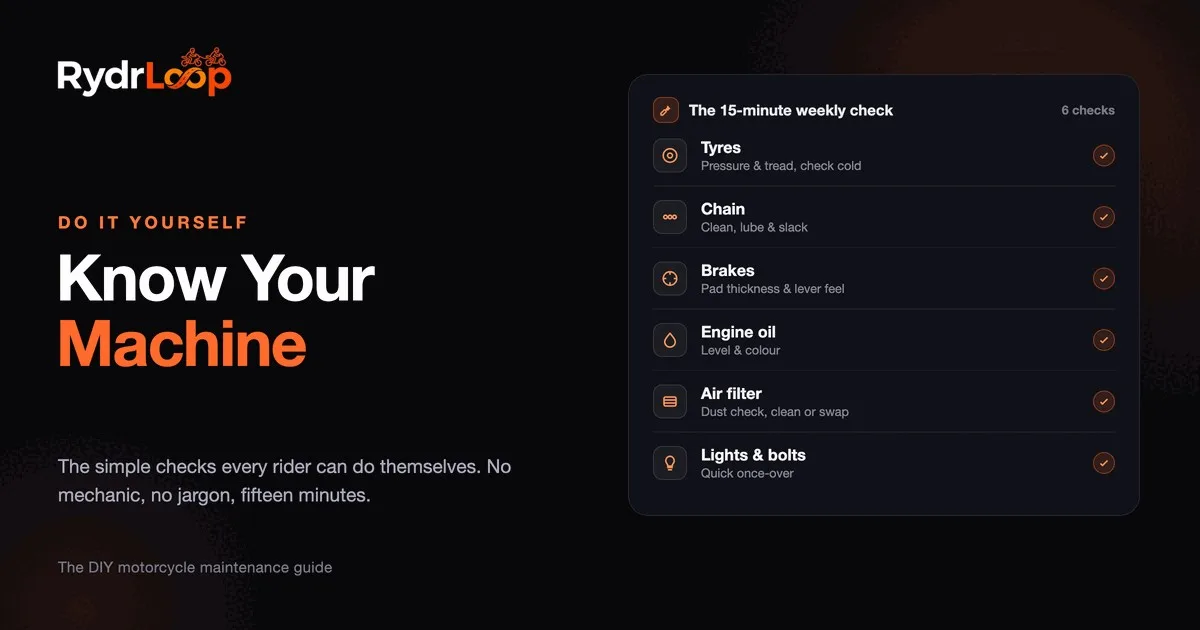
Read the nine failures again and notice how many were avoidable at home: the chain, the battery, the tyres, the coolant, the fuse box, the fuel range. A five minute check before a long ride catches the majority of them while you are still standing in your own parking spot with a phone and a mechanic nearby.
That check is worth building into the ride itself, and the pre-ride checklist covers it properly. For long trips, the long distance riding guide covers the preparation that keeps both the bike and the rider working past the three hundred kilometre mark.
And the oldest form of breakdown insurance is still the best one: ride with people. A motorcycle breakdown alone on an empty stretch at dusk is a completely different situation from the same failure with two riders alongside you, one of whom has the tool you forgot. RydrLoop exists for that part, finding riders near you, joining rides that match your pace, and building a circle that shows up when the bike does not.
Comments (0)
Join the conversation. Your thoughts matter!
Be the first to share your thoughts.