

The Biggest Mistakes New Riders Make on Their First Highway Ride
Your first highway ride can go smoothly or teach you a hard lesson. Here's exactly where new riders go wrong, and how to avoid every one of these mistakes.
 RydrLoop··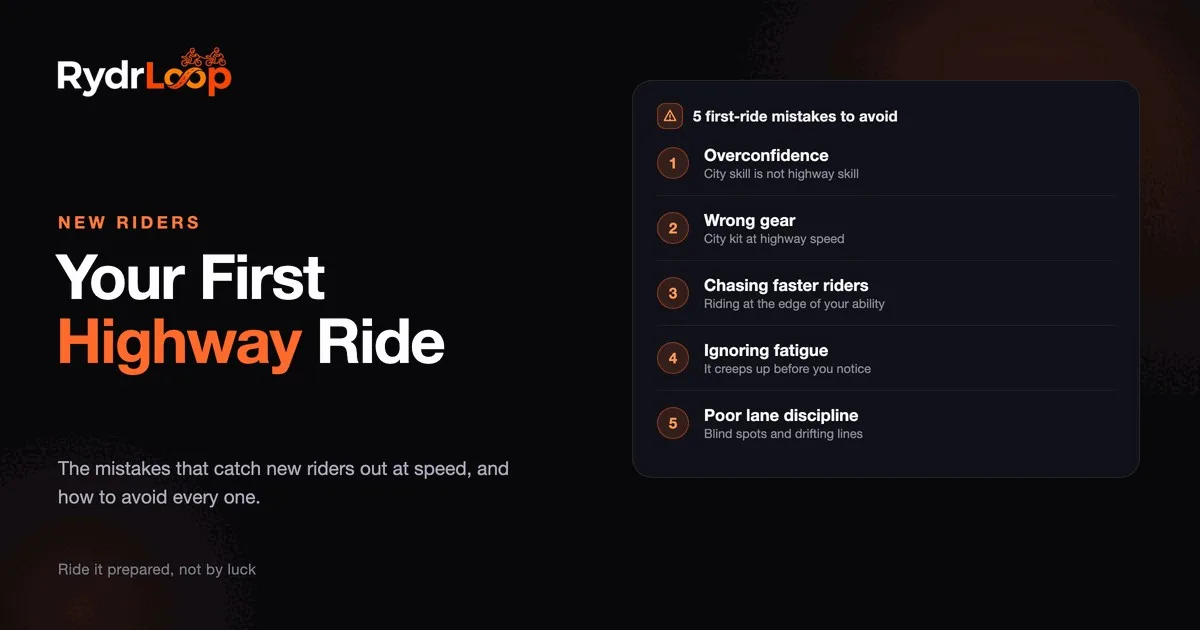
There's a specific kind of nervous excitement that comes before your first highway ride. You've ridden enough in the city to feel capable, you've watched enough highway footage on your feed to feel ready, and somewhere between the on-ramp and the first fast lane you merge into, you find out how different highway riding actually is from everything you've practiced so far.
Most new riders don't crash on their first highway ride because the highway is inherently dangerous. They run into trouble because city riding habits, reflexes and confidence don't transfer cleanly to sustained highway speed, and nobody tells them that clearly enough before they go. The mistakes that catch new riders out on a first highway ride follow a pattern, the same five or six, over and over, across almost every rider who's been through it. Knowing that pattern in advance is the difference between a first highway ride you remember for the right reasons and one you're lucky to walk away from.
Why the First Highway Ride Catches So Many New Riders Off Guard
City riding rewards quick reflexes over short distances. You're constantly braking, weaving, restarting, reading an intersection three seconds ahead. A first highway ride asks for something almost the opposite: sustained concentration at a speed where your reaction window shrinks and your margin for error does too. At 40 km/h in city traffic, a two-second lapse in attention is forgiving. At 100 km/h on a highway, that same two-second lapse covers over 55 metres of road, often without you consciously registering that you looked away at all.
Add to that the physical load a first highway ride puts on a body that's only ever ridden in short city bursts, constant wind pressure, engine vibration held at a steady RPM for an hour or more, the low hum of tyre noise that never lets up, and you get a ride that's tiring in ways new riders simply haven't experienced yet. None of this means a first highway ride is something to fear. It means it deserves actual preparation, not just the assumption that if you can handle city traffic, the highway will be easier because there's "less to worry about."
It's usually the opposite. There's less happening around you on a highway, but what does happen, happens faster and asks more of you when it does. Here's where that gap between expectation and reality shows up most often on a first highway ride.
Reading Highway Traffic Like a Highway Rider, Not a City Rider
Before getting into the specific mistakes, it's worth understanding why highway traffic behaves so differently, because a first highway ride is often the first time a new rider is reading traffic patterns they've never had to interpret before. City traffic is unpredictable but slow, a scooter can cut across three lanes at 20 km/h and the consequences stay manageable. Highway traffic is far more predictable in its patterns, but the consequences of misreading it scale up dramatically with speed.
Trucks and buses on Indian highways tend to hold the left lane and move at a steady, unhurried pace, but they also swing wide before a turn or a slowing manoeuvre in ways that catch new riders off guard on a first highway ride, because a truck's trailer doesn't track exactly where its cab points. Riding directly behind or alongside a long vehicle for an extended stretch puts you somewhere the driver may not be checking regularly, and overtaking one slowly, rather than committing to the manoeuvre, is one of the most common places new riders end up in a driver's blind spot without realising it.
Toll plazas deserve their own mention, because they're one of the few places on a first highway ride where highway-speed traffic suddenly compresses into stop-start chaos, lane-splitting cars, sudden merges, and vehicles cutting toward the FASTag lane at the last second. Treat a toll plaza the way you'd treat a busy city junction, not the way you'd treat the open highway on either side of it, and you'll avoid the single most common location for low-speed highway mishaps.
Learning to read these patterns isn't instinctive on a first highway ride, because city riding simply doesn't generate them. It's a skill built over a handful of highway rides, and knowing it's a skill you're actively building, rather than assuming you already have it, is most of what separates a smooth first highway ride from a stressful one.
Mistake #1: Overconfidence After a Few Good City Rides
This is the mistake that sets up almost every other mistake on this list. A rider who's spent a few months commuting confidently through city traffic starts to feel like riding, generally, is something they've figured out. That confidence is real and it's earned, but it's earned in a completely different riding environment, and carrying it unchanged onto a first highway ride is where the trouble usually starts.
Highway riding punishes small errors that city riding simply doesn't produce often enough to teach you. A slightly late reaction to a car changing lanes without signalling. A slightly wrong line through a long, sweeping curve at sustained speed. A slightly too-relaxed grip on the throttle when a gust of wind hits you on an open stretch. None of these are dramatic mistakes, but at highway speed, "slightly wrong" has much less room to correct itself than it does at 30 km/h near a signal.
The honest fix isn't to feel less confident, it's to recognise that highway competence is a separate skill from city competence, one your first highway ride is specifically there to start building, not one you're supposed to already have. Ride your first highway stretch like you're a beginner again, because on the highway, you are.
Mistake #2: Wearing the Wrong Gear for Highway Speeds
Gear that feels perfectly adequate in city traffic can become genuinely inadequate the moment you're sustaining highway speed for more than a few minutes. This is one of the most common and most avoidable mistakes new riders make on a first highway ride, mostly because city riding rarely punishes the gap.
A half-face or open-face helmet that's fine at 40 km/h turns into a serious problem at 100 km/h, where wind noise, bugs, dust and road debris hit you directly and constantly. A regular shirt or thin jacket that's comfortable in slow traffic won't stop wind chill from tiring you out over an hour of sustained speed, and it won't do much for you at all in a slide. Sneakers or sandals that are convenient for short city hops offer close to nothing if your foot needs to take an impact or grind along tarmac.
None of this requires expensive top-tier gear before your first highway ride, but it does require gear actually rated for the speed you're about to sustain, not just the speed you're used to. If you're not sure what that gear list should actually include before you go, this breakdown of riding gear that's genuinely worth buying is worth ten minutes before your first highway ride, not after a close call teaches you the hard way.
Mistake #3: Following Faster, More Experienced Riders
This mistake almost never looks like a mistake while it's happening. You're riding with friends or a group, someone more experienced sets a confident pace, and rather than admit you're not comfortable at that speed, you match it anyway. Nobody wants to be the rider holding up the group on their first highway ride, and that's exactly the pressure that gets new riders into trouble.
The problem isn't that faster riders are reckless, usually they're riding well within their own skill level. The problem is that their pace was calibrated by hundreds of hours of highway experience you don't have yet, and matching their speed means riding at the edge of your ability while they're riding well inside theirs. That gap is where mistakes on a first highway ride tend to happen, task-saturated attention, later braking than you'd normally choose, closer following distances than you're actually comfortable with, all because slowing down feels like falling behind.
The fix is almost embarrassingly simple and almost nobody does it: say it out loud before the ride starts. "This is my first highway ride, I'll be riding at my own pace." Any group worth riding with will adjust without a second thought, and the ones who don't adjust are telling you something useful about whether you want to ride with them again.
Mistake #4: Ignoring Fatigue Until It's Too Late
Highway fatigue doesn't feel like city tiredness, and that's exactly why new riders miss it on a first highway ride. City riding tires you out through constant small effort, braking, shifting, watching intersections. Highway riding tires you out through a slower, quieter build-up, wind pressure, vibration, engine drone and visual monotony that wear you down even when nothing eventful is happening.
By the time fatigue feels obvious, heavy eyelids, a genuinely tired body, it's usually already affecting your riding well before you notice it consciously. A missed gear shift. Drifting slightly within your lane without meaning to. Re-reading the same highway sign because it didn't register the first time. These are the real early warning signs on a first highway ride, and they show up earlier than most new riders expect, often within the first 60-90 minutes of sustained riding.
The fix isn't complicated, it's just something new riders rarely plan for in advance: build stops into a first highway ride before fatigue forces them. Fifteen minutes off the bike every hour or so, water, a short walk, helmet off, does more for a first highway ride than pushing through tiredness because the destination is "not that much further." Planning this properly starts before you even leave, and a proper pre-ride checklist is worth running through so fatigue management isn't something you're improvising for the first time at 100 km/h.
Mistake #5: Poor Lane Discipline and Positioning
City riding trains habits that don't hold up on a highway, and lane discipline is where this shows up most clearly on a first highway ride. Weaving between lanes to gain a few car lengths, riding in a vehicle's blind spot without realising it, drifting toward the edge of a lane while looking at something on the roadside, all things that feel low-risk in slow city traffic and become genuinely dangerous at highway speed.
Trucks and buses have significantly larger blind spots than cars, and a first highway ride often puts new riders directly inside one without them knowing it, especially when overtaking slowly or riding alongside a long vehicle for an extended stretch. The fix is simple positioning awareness: pass decisively rather than lingering alongside a larger vehicle, and always know whether you're visible in a vehicle's mirrors before assuming they know you're there.
Lane discipline also means picking one lane and committing to your line through it, rather than drifting within the lane while your attention is elsewhere. On a first highway ride, this usually happens when a new rider is looking at scenery, a road sign, or a phone mount rather than holding a consistent line. Your bike tends to go where your eyes go, and on a highway, that effect is amplified by speed in a way city riding never really demonstrates to you.
The Mistake Nobody Warns You About: Target Fixation
There's a sixth mistake that doesn't make most lists but shows up constantly on a first highway ride: target fixation, staring at the exact thing you're trying to avoid, a pothole, a stalled vehicle, debris in the road, until your bike drifts straight toward it. It's a well-documented reflex, not a character flaw, but it catches new riders specifically because a first highway ride is often the first time they've encountered a hazard at a speed where there's genuinely no time to think it through consciously.
The counter to target fixation isn't willpower, it's training your eyes to go where you want to go, not where the hazard is. Look at the gap you want to ride through, not the pothole you're avoiding, and your hands will generally follow your eyes there instead. It sounds almost too simple to matter, but it's one of the most reliable pieces of advice experienced riders wish someone had told them clearly before their own first highway ride.
How Weather Changes a First Highway Ride
New riders planning a first highway ride tend to check the weather for rain and stop there, but weather affects highway riding in ways that go well beyond whether you'll get wet. Wind is the one nobody warns you about. Open highway stretches, especially past large trucks or across bridges and flyovers, produce sudden gusts that can push a bike sideways in a way city riding, sheltered by buildings and slow speeds, never really prepares you for. Riding through the gust of a truck overtaking you at speed is a genuinely different sensation the first time it happens, and knowing to expect it, loose grip, weight low, no sudden correction, matters more than most new riders assume going in.
Heat is the other underestimated factor. A first highway ride in the middle of a hot afternoon, in full gear, at sustained speed, dehydrates you faster than the equivalent time spent in slower city traffic, because you're often riding for longer, uninterrupted stretches without the natural breaks a city commute forces on you. This compounds directly into the fatigue problem, a rider who's quietly dehydrating is a rider whose concentration is dropping well before they'd normally expect to feel tired.
Monsoon riding adds its own specific risk to a first highway ride: standing water hiding the true depth of a pothole, oil and rubber residue lifted to the road surface in the first heavy rain after a dry spell making braking distances unpredictable, and visibility dropping fast in genuinely heavy rain. If your first highway ride happens to fall in monsoon season, treat the plan as flexible. Waiting a few hours for a break in the rain, or postponing entirely, is a far better outcome than a first highway ride that becomes a lesson in wet-weather braking you didn't choose to learn that day.
A Simple Pre-Highway Checklist New Riders Should Actually Follow
Most of the mistakes above share a common root: riders didn't specifically prepare for a highway ride, they just rode the way they normally ride and assumed it would translate. A few honest steps before you go close most of that gap.
Gear, checked against highway speed, not city speed. Full-face helmet with a clean visor, a proper riding jacket, gloves and boots rated for more than a slow commute. If you're only going to upgrade one thing before a first highway ride, make it the helmet.
Set expectations with anyone you're riding with. Say it out loud that this is a first highway ride and you'll be setting your own pace. This single sentence prevents more of the mistakes on this list than almost anything else you can do.
Plan stops before fatigue forces one on you. Fifteen minutes off the bike every 60-90 minutes, water, a short walk, helmet off. Don't wait until you're already tired to decide you need one.
Know your route before you're relying on memory while tired. Fuel stops, toll plazas, exit points and rest areas mapped out in advance, not something you're figuring out on a phone mount while riding.
Check the weather beyond just "is it raining." Wind conditions, expected heat, and whether a monsoon system is likely to move in during your window all matter more on a first highway ride than they ever do in the city.
Give yourself permission to stop, turn back, or slow down. A first highway ride doesn't have to end where you originally planned for it to count as a success. The ride that ends early because something felt wrong is a far better outcome than the one that pushes through and doesn't.
None of this is complicated, and none of it takes long to run through. What it does is turn a first highway ride from something you're hoping goes fine into something you've actually prepared for, which is the entire difference between the two.
What Experienced Riders Wish They'd Known Before Their First Highway Ride
Talk to enough experienced riders and a pattern shows up in what they say about their own first highway ride: almost none of them regret going too slowly, and almost all of them remember, specifically, the moment they tried to keep up with someone they shouldn't have. The overconfidence, the wrong gear, the fatigue that crept in unnoticed, these aren't rookie mistakes in the embarrassing sense. They're close to universal, which is exactly why they're worth naming clearly instead of learning the hard way.
This is also where riding with the right group matters more than new riders expect. A first highway ride alongside people who know it's your first, and who've planned a pace and stops accordingly, teaches you the highway far faster and far more safely than pushing through solo or trying to match a pace built for someone else's experience. On RydrLoop, ride details show pace, distance and route before you commit, which makes it far easier to find a group that's actually a good match for a first highway ride rather than guessing and hoping.
Final Word: Your First Highway Ride Should Teach You, Not Test You
Every one of these mistakes, overconfidence, the wrong gear, chasing a faster rider's pace, ignoring fatigue, poor lane discipline, comes from the same place: treating a first highway ride like an extension of city riding instead of a genuinely different skill worth preparing for on its own terms. None of them are about talent, and none of them mean you're not ready. They're just the specific, well-documented ways new riders get caught out, and now you know them before you're the one finding out the hard way.
Ride your first highway ride at your own pace, in gear built for the speed you're actually riding, with stops planned before fatigue demands them, and you'll come back from it with exactly what a first highway ride is supposed to give you: real confidence, earned honestly, instead of a story about the mistake that almost happened.
Ready for it? Find a highway ride on RydrLoop with a pace and group that actually matches where you are, not where you're trying to prove you are.


Comments (0)
Join the conversation. Your thoughts matter!
Be the first to share your thoughts.