

The Unwritten Rules of Group Motorcycle Rides
Nobody hands you a rulebook before your first group ride. Here are the unwritten rules experienced riders already know, and new riders usually learn the hard way.
 RydrLoop··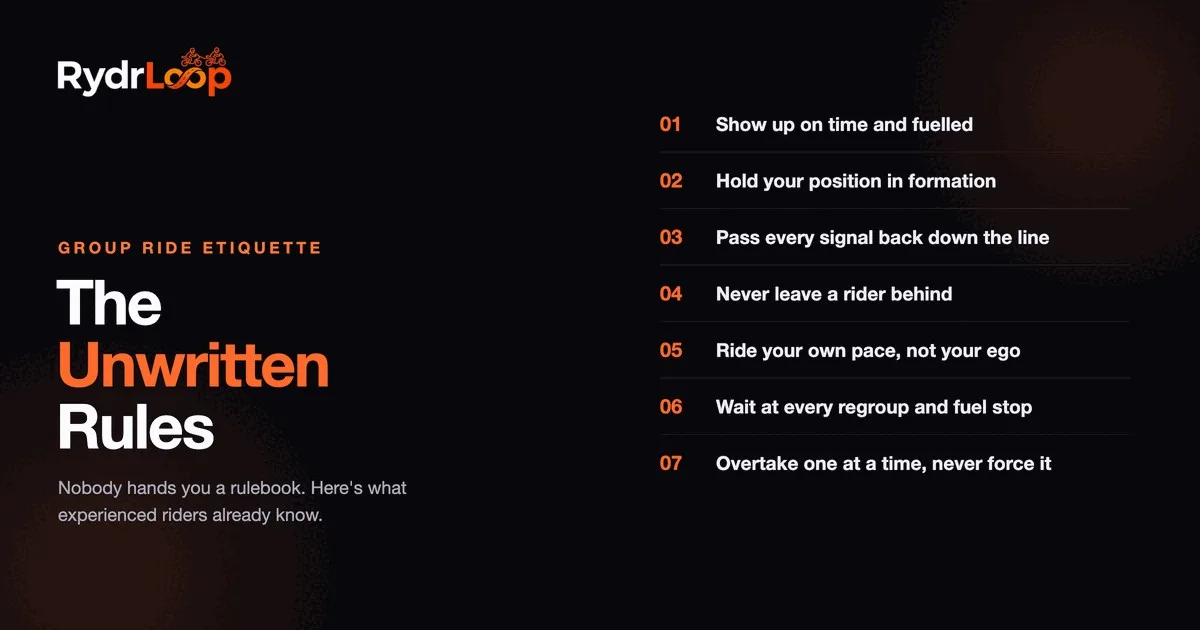
Nobody hands you a manual before your first group ride. You show up, helmet on, bike fuelled, reasonably confident in your own riding, and within the first few kilometres you realise everyone else seems to know something you don't. Where to position yourself. When it's fine to overtake and when it isn't. Why the rider up front just tapped their helmet for no obvious reason. Group rides run on a thick layer of unwritten rules, and almost nobody explains them out loud, because to everyone already inside the group, they stopped feeling like rules a long time ago.
This is that explanation. Not a formal rulebook, because group rides don't really have one, but the actual habits, signals and etiquette that experienced riders follow without thinking about it, the kind of thing you're otherwise left to piece together the hard way, one slightly awkward ride at a time.
Why Group Rides Run on Unwritten Rules in the First Place
Group rides are, structurally, a strange thing to coordinate. You're asking a set of independent vehicles, each controlled by a different person with a different comfort level and a different bike, to move through unpredictable traffic as one coherent unit, without a shared radio system in most cases, and often without having ridden together before. Written rules would help, but riding culture has never really worked that way. Instead, the rules got passed down the only way informal culture ever spreads, one rider showing another, ride after ride, until the pattern became instinct.
That's exactly why group rides can feel opaque to a newcomer even when nothing is actually being hidden from you. The rider who taps the top of their helmet twice isn't performing some secret handshake, they're passing along information the group agreed on years before you joined, using a signal that made sense once and stuck. Once you know the pattern, group rides stop feeling like a closed club and start feeling like exactly what they are: a genuinely simple system that just happens to be unwritten.
Before the Ride Even Starts: The Rules of Showing Up
Group ride etiquette begins well before anyone's engine turns on, and this is where most new riders unknowingly get their first impression wrong. Arriving on time, or a few minutes early, matters more in group rides than it does in almost any other social setting, because a late arrival doesn't just inconvenience one person, it holds up everyone else who showed up when they were supposed to.
A full tank before you arrive is close to a hard rule, not a suggestion. Groups build their fuel stops around a rough sense of everyone's range, and a rider who shows up needing fuel within the first thirty minutes throws off a plan that took the whole group's needs into account. Alongside that, being upfront about your experience level and comfort with the planned pace is expected, not optional. Groups genuinely adjust for a new rider who says so clearly. What group rides can't adjust for is a rider who says nothing and hopes it works out.
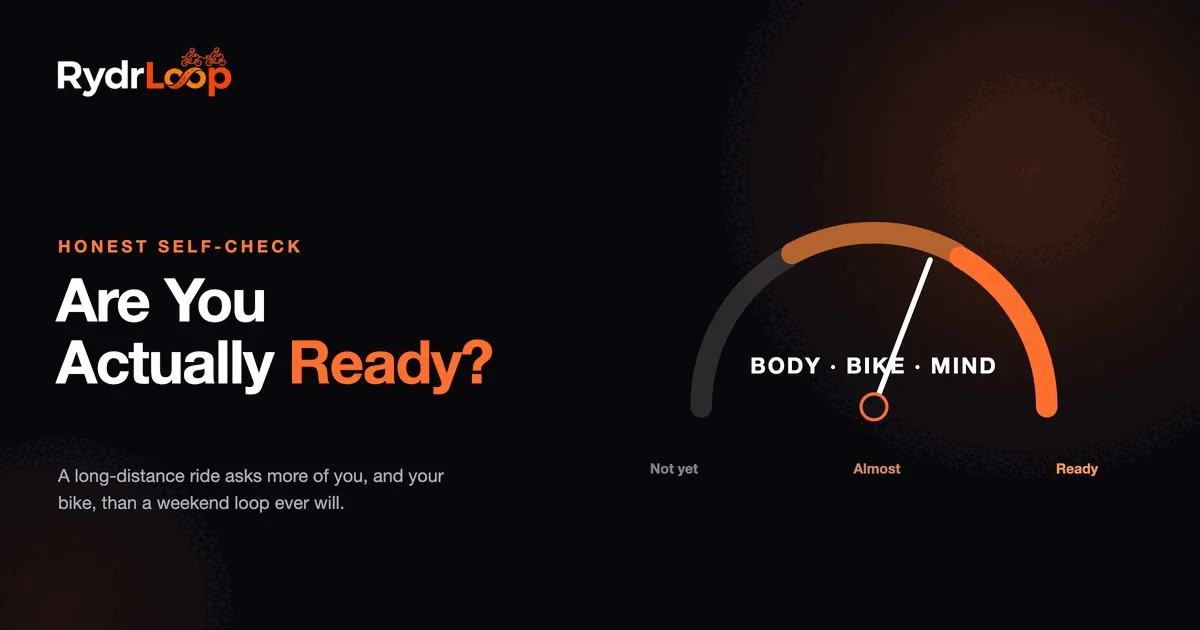
Checking your own bike before you arrive, tyre pressure, chain, fuel, oil, isn't just good practice, it's part of the unwritten contract of joining group rides at all. A breakdown that traces back to something checkable before leaving home is the one kind of delay a group is least forgiving about, because it was the one thing entirely within your control. If you're not sure what that pre-ride check should actually cover, a proper pre-ride checklist is worth running through the night before, not discovering you needed one halfway through the ride.
Formation and Position: Who Rides Where and Why
Group rides almost always settle into a staggered formation, riders offset left and right within the lane rather than riding in a straight single file, and this isn't stylistic, it's a genuine safety habit. Staggered formation keeps a safe following distance from the bike directly ahead while still letting the group ride tighter as a unit than single file would allow, and it gives each rider a clear sightline past the bike in front rather than staring directly at a rear tyre.
Position within that formation isn't random either. A lead rider, usually whoever knows the route or organised the ride, sets the pace and makes the calls on lane changes and turns. A sweep rider, at the very back, exists specifically to make sure nobody gets dropped, and their unwritten job is to never let a struggling rider become the group's problem alone. Newer or less confident riders are typically placed toward the front of the pack, just behind the lead, not at the back where they'd be chasing the group's pace with no one immediately behind checking on them.
Overtaking the lead rider without a clear reason is one of the more universally understood violations in group rides, not because of ego, but because the lead is the one making route decisions the rest of the group is trusting. A rider who pushes to the front uninvited effectively takes over navigation nobody agreed to hand them.
The Gear Expectations Nobody States But Everyone Notices
There's a quieter unwritten rule around gear that rarely gets said out loud in group rides, mostly because it doesn't need to be, riders notice within the first few minutes who's dressed for the ride and who isn't. Showing up in a half-face helmet and sneakers to a group planning a 200 km highway loop isn't just a personal safety choice, it changes how the group rides too, a lead rider who knows one member is under-protected will often, consciously or not, ride more cautiously than the plan called for, which affects everyone.
This isn't about needing expensive gear before your first group ride. It's about gear that actually matches the ride being planned, and being honest with yourself about the gap if there is one. Riders who show up properly kitted out tend to be trusted with less oversight faster, not because of how it looks, but because it signals you've thought about the ride the same way the rest of the group has. If you're assembling a kit before joining group rides regularly, this guide to gear worth actually buying covers what matters most without pushing you toward anything unnecessary.
How Group Size Changes the Rules
The unwritten rules of group rides don't scale the same way as the group does, and this catches a lot of riders off guard the first time they join a larger meet. A tight group of three or four riders can coordinate almost entirely through hand signals and direct eye contact, everyone's close enough to see and react to everything happening up front. Past six or seven bikes, that starts to break down, signals take longer to relay, and the gap between the lead rider and the back of the pack grows large enough that genuine communication delays become normal.
Larger group rides, the kind you'll see at bigger meets or rallies, handle this by splitting into smaller sub-groups, each with its own lead and sweep rider, rather than trying to move fifteen or twenty bikes as a single unit through traffic and signals. Some groups lean on intercom systems or simple phone-mounted group calls for this reason too, especially on longer highway stretches where hand signals alone stop being practical at a distance. If you're joining a large group ride for the first time, it's worth asking early which sub-group you've been placed in and who its lead and sweep riders are, rather than assuming the rules of a small group ride apply unchanged to a fifteen-bike formation.
Common Mistakes That Break Group Ride Trust Fast
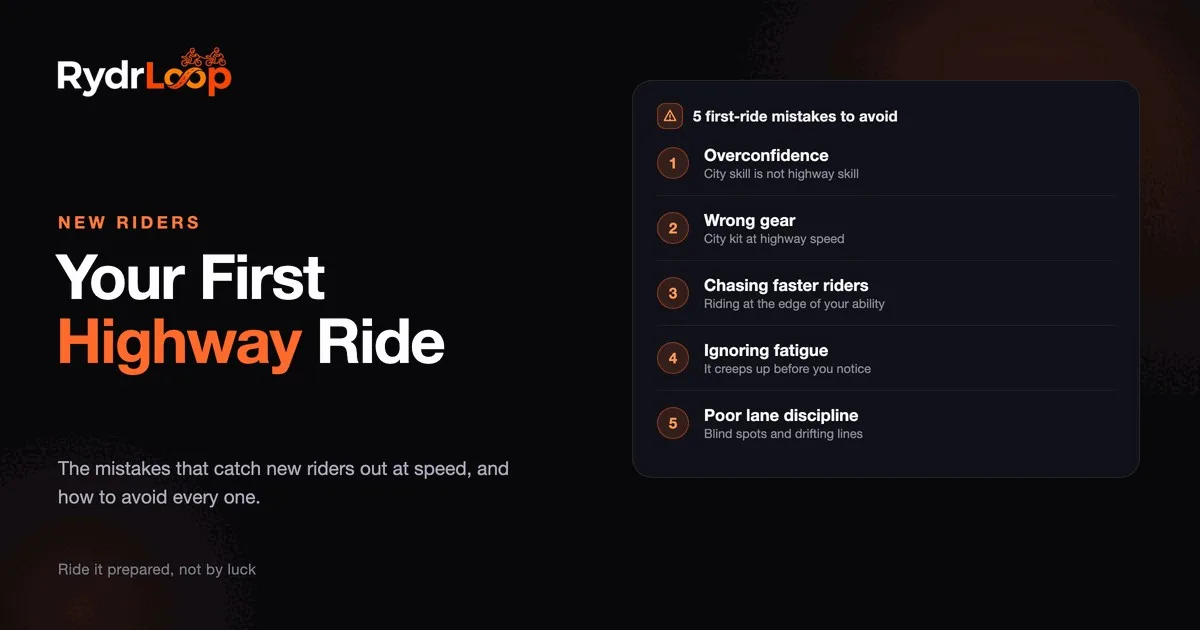
Some mistakes in group rides are simply inexperience and get quietly corrected over a ride or two. Others erode trust fast enough that they're remembered long after the ride ends, and they're worth naming directly rather than learning the hard way.
Tailgating the rider ahead, even briefly, reads as far more alarming from inside a group ride than it might feel from the saddle, because everyone behind you is trusting your reaction time as much as their own. Revving unnecessarily at a signal or a slow patch of road gets read as showing off even when that's not the intent, and it tends to needle exactly the kind of comparison culture healthy groups try to avoid. Changing lanes or position within the group without a signal removes the predictability the entire staggered formation depends on, one rider drifting unannounced is often how a group ride's near-misses actually happen.
Filming or using a phone while riding within a group carries the same risk it does riding solo, just with more people immediately affected if it goes wrong. And cutting the queue at a toll or fuel stop ahead of riders who arrived first, small as it sounds, tends to be remembered by a group far longer than the thirty seconds it actually saved.
The Hand Signals and Communication Every Rider Should Know
Group rides move too fast and too loud for shouted conversation, which is exactly why a small, fairly standardised set of hand signals carries most of the group's real-time communication. A raised left hand with a flat palm usually signals slowing down or stopping. A pointed finger down toward the road, held briefly, flags a hazard, a pothole, debris, oil, something the rider behind needs to see coming. A tap on the top of the helmet is the most common fuel-stop signal, quietly passed rider to rider down the line until everyone knows a stop is coming.
Equally important, and far less talked about, is signal acknowledgement. Group rides depend on each rider actually passing a signal back to whoever's behind them, not just receiving it. A hazard signal that stops at the third bike because the fourth rider wasn't paying attention defeats the entire point of the system. Riding in a group means treating yourself as a relay, not just a recipient, every single time.
None of these signals are complicated, and most groups will happily walk a new rider through them before setting off if you simply ask. Asking is, itself, one of the more reliable ways to show a group you're taking their rides seriously.
Pace, Overtaking and Regrouping: The Rules Nobody States Out Loud
The pace of group rides is set by the group's least confident comfortable rider, not its fastest one, and this is one of the most consistently misunderstood parts of group riding etiquette. A rider who's clearly capable of going faster but holds back for the group isn't being held hostage, they're doing exactly what group rides ask of everyone: prioritising the group staying together over any one rider's personal pace.
Overtaking within a group ride follows its own quiet logic too. It's generally fine to overtake a slower rider within the group when it's safe and there's a clear reason, closing a gap, moving to a better position, but overtaking purely to ride faster than everyone else defeats the purpose of riding together at all. And regrouping after a junction, a town stretch, or anywhere the group naturally spreads out is close to automatic in a well-run group, riders who've pulled ahead simply wait at a safe, visible point rather than continuing on and assuming everyone will catch up eventually.
Fuel Stops, Breaks and the Etiquette Around Them
Fuel stops in group rides run on a simple, mostly unspoken agreement: nobody leaves until everyone's accounted for. It sounds obvious stated plainly, but it's exactly the kind of rule that only becomes visible when someone breaks it, a rider or two pulling out early while others are still fuelling, leaving the group to either split or scramble to catch up.
Costs on longer rides, tolls especially, tend to get split evenly without much discussion, and groups that handle this smoothly usually do it with minimal fuss, one person covering it and being reimbursed later rather than everyone individually queuing at every toll booth. Checking in on each other during breaks matters too, not as a formality, but because a five-minute fuel stop is often the only real window a group has to notice if someone's struggling, tired, or quietly dealing with a problem with their bike they haven't mentioned yet.
What Happens When Someone Breaks Down or Falls Behind
This is where group rides show their actual value most clearly, and it's also where the unwritten rules are most consistent across almost every riding group. Nobody gets left behind, full stop. If a rider falls back or breaks down, the sweep rider stays with them while a rider ahead relays the situation to the rest of the group, usually by phone or a quick ride back once the lead notices the gap.
The group's default response to a breakdown is to stop and wait, not to continue on the assumption that the affected rider will sort it out and catch up. This is as much a safety rule as a social one, a rider stranded alone on an unfamiliar stretch of road is a genuinely worse outcome than a group ride running behind schedule. If you remember one rule above all the others in this list, this is the one: group rides work because everyone trusts that if it happens to them, the group stops too.
The Social Rules That Keep Group Rides From Turning Toxic
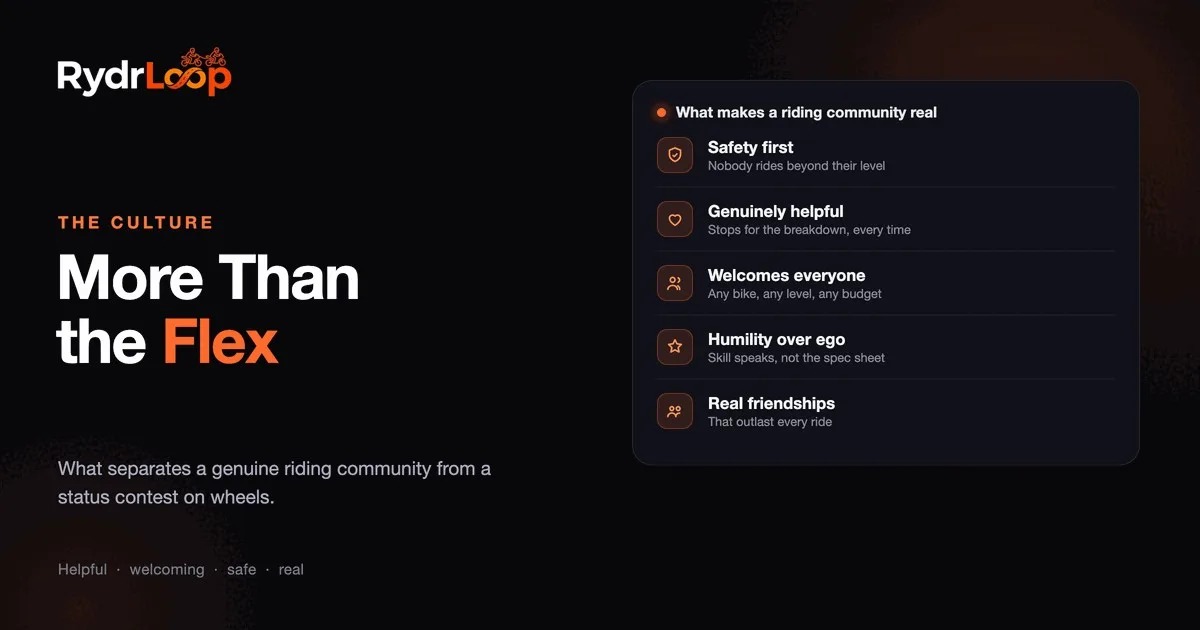
Beyond the practical logistics, group rides run on a set of social norms that decide whether a group stays welcoming or slowly turns into something new riders avoid. Showing off, aggressive overtaking to prove a point, unnecessary revving, deliberately pushing pace to test a slower rider, is broadly frowned upon in healthy groups, treated as a minor breach of trust rather than something to admire.
Riders on very different bikes, a modest commuter next to a serious tourer, are expected to be treated as equally welcome, and a group that quietly sorts itself by how expensive someone's bike is has usually stopped being a group worth staying in. The same goes for a rider who needs to turn back partway through, illness, a family call, simple fatigue, accepted without needing much justification, because the healthiest group rides understand that showing up, and leaving when you need to, are both choices made freely.
Rules Specific to Riding in Groups on Indian Roads
Group rides in India carry a few additional, fairly specific unwritten rules shaped by the roads themselves. Truck and bus traffic on highways moves in patterns a group needs to account for collectively, overtaking a long vehicle one bike at a time rather than as a bunched pack, and regrouping only once everyone's safely past rather than mid-manoeuvre. Horn use in group rides tends to follow local convention rather than the group's own preference, a light tap to announce presence before overtaking, not the sustained honking some solo riders default to.
Monsoon season adds its own layer of caution to group rides specifically, because a group moving together through sudden heavy rain needs to slow as a unit rather than have individual riders making that call differently at different speeds. A well-run group treats a sudden downpour as a reason to regroup and reassess, not push through at the original pace because nobody wants to be the one who calls it.
When It's Okay to Break a Rule
For as structured as all of this sounds, group rides also run on a quieter principle that sits above every other rule on this list: safety overrides formation every time. If holding staggered position means riding through a pothole you could otherwise avoid, break formation. If keeping pace with the group means riding faster than you're genuinely comfortable with, slow down and let the sweep rider know, don't grit your teeth and keep up anyway. Good groups understand this instinctively, and a rider who breaks an unwritten rule for a genuine safety reason is never the one who looks bad, the group that would be upset about it is one worth reconsidering riding with again.
How to Tell a Well-Run Group Ride From a Risky One
Not every group ride follows these rules well, and part of getting comfortable with group riding is learning to read the difference before you're committed to a whole day with a group that doesn't. A few early signs tend to say more than anything written in a ride description.
A group that clearly briefs the route, pace and stops before departure is usually a group that takes the rest of these unwritten rules seriously too, briefing isn't a formality, it's a signal the organisers have actually thought the ride through. Watch how the group handles its slowest rider in the first few kilometres, do they regroup and wait without complaint, or does a gap quietly open and stay open. That single observation tells you more about a group's real culture than anything said at the meeting point.
It's also worth noticing whether questions are welcomed. A group that answers a new rider's question about signals or pace patiently is a group built around the same principles covered here. One that brushes it off, or makes a new rider feel like they should already know, is telling you something about how it'll treat a genuine mistake later in the ride. Trusting that read early, and being willing to fall back or peel off from a group that doesn't feel right, is itself one of the unwritten rules experienced riders follow without ever needing to say it out loud.
Final Thoughts: The Rules Exist So the Ride Stays Good for Everyone
None of the unwritten rules covered here exist to gatekeep group rides or make them harder to join. They exist for the same reason any group activity develops shared habits, because a group of riders moving together, at speed, on unpredictable roads, genuinely needs a shared system to stay safe and stay together. Once you know the pattern, staggered formation, clear signals, nobody left behind, showing up prepared, group rides stop feeling like a test you might fail and start feeling like what they're actually meant to be: one of the better reasons to ride at all.
If you're looking for a group that already runs on rules like these, browse group rides on RydrLoop where pace, route and rider experience are laid out before you commit, so your first group ride starts with a lot fewer unknowns than most riders get.
Comments (0)
Join the conversation. Your thoughts matter!
Be the first to share your thoughts.