

How to Choose a Ride That Matches Your Skill Level
Most bad rides are not about ability, they are a mismatch. How to judge your skill level, read a ride and match the two, from beginner to experienced.
 RydrLoop··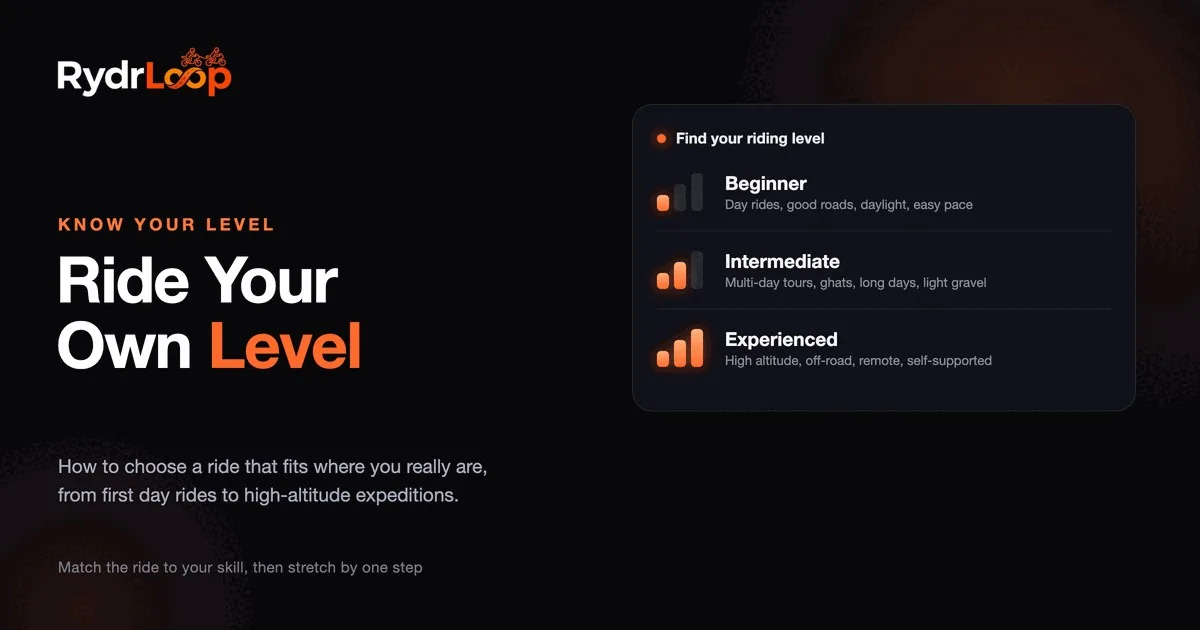
Think about the worst day you have ever had on a motorcycle. Not a mechanical failure, not bad luck, but a day that just went wrong, where you were tense the whole time, out of your depth, wishing you were somewhere else. If you are honest, that day probably had very little to do with your riding ability and everything to do with the ride you chose. You picked something that did not match where you actually were as a rider, and the road made you pay for it. It was a simple mismatch between the ride and your skill level, and it is the most common cause of bad days in the saddle.
This is the part of riding almost nobody talks about. We obsess over bikes, gear and destinations, and we spend almost no time on the one decision that shapes every trip more than any of those: choosing a ride that fits your skill level. Get that right and even a modest ride is a brilliant day. Get it wrong and the most beautiful route in the country becomes something you just want to survive.
Choosing well is a skill of its own, separate from throttle control and cornering. It takes an honest look at yourself, a clear understanding of what actually makes a ride hard, and the maturity to match the two without letting your ego drive. This guide walks through all of it, so that your next ride stretches you in the good way instead of the frightening one.
Why matching your ride to your level matters
There is a sweet spot for every rider, and it is not where most people think.
A ride that is far above your skill level is genuinely dangerous. When the road throws things at you faster than you can process them, bad passes, loose gravel on a blind bend, a river crossing, a truck where you did not expect one, you stop riding and start reacting, and reactions made in panic are how people crash. You spend the day rigid, exhausted from concentration, missing the scenery entirely because every metre is a small emergency. It is not brave, it is just miserable and unsafe.
A ride that is far below your level is the opposite problem, and a much smaller one. It is comfortable, maybe a little boring, but there is nothing wrong with an easy day now and then. The real target sits just above your current comfort, close enough that you can handle it but far enough that you finish having genuinely learned something. That is the zone where riding is most fun and where you actually improve, and finding it starts with being honest about your own skill level. Every rider has a different one, and it moves over time, which is why matching is a habit you keep coming back to rather than a decision you make once.
The hard part: be honest about your own skill level
Here is the uncomfortable truth. The biggest obstacle to choosing the right ride is not a lack of information, it is ego. Almost every rider quietly overestimates where they are, because admitting you are a beginner feels like an insult and calling yourself experienced feels like a compliment you would rather claim.
So set the ego down for a minute, because your bike does not tell you your skill level and neither do your years. Owning a big adventure motorcycle does not make you an advanced rider, and having a licence for ten years means nothing if most of those years were a short commute in the same city. What actually defines your level is real, varied experience, and you can measure it honestly by asking yourself a few plain questions.
How many kilometres have you genuinely ridden, and over what kind of roads? Have you ridden a full day, three or four hundred kilometres, and how did your body and mind feel at the end? Are you relaxed in dense traffic, or still tense? Have you ridden proper ghat roads with real corners, and did you enjoy them or endure them? Have you handled rain, gravel, broken roads, or riding after dark? Can you sort a basic breakdown, a puncture or a loose chain, on your own? Have you ridden in a group and understood how to hold your place in it?
Answer those truthfully and your real level becomes obvious, often more modest than you would like. That is completely fine. Every single experienced rider was a nervous beginner once, and the ones who are still riding decades later are the ones who were honest with themselves at every stage.
The three levels, defined properly
Riders get sorted into beginner, intermediate and experienced all the time, but the labels are usually thrown around loosely. Here is what they actually mean in terms of the rides that fit, which is exactly the thinking behind a riding level system like the one in RydrLoop, where a ride and a rider can both carry a level so you are not guessing.
Beginner
A beginner is not someone who cannot ride, and beginner is not an insult, it is simply the first honest skill level everyone passes through. It is someone who is comfortable on the bike in familiar conditions but has not yet been tested by distance, difficult terrain, or the unexpected. You can ride confidently in normal traffic, but a long day, a mountain road or a patch of gravel still feels like unknown territory.
The rides that suit a beginner are short to moderate day rides, roughly up to a hundred and fifty or two hundred kilometres, on good sealed roads, in daylight, in fair weather, on terrain that is not too demanding. A relaxed pace, a familiar or easy route, and ideally a small, patient group with an experienced rider keeping an eye on you. This is where you build the base, the hours in the saddle that turn conscious effort into instinct. If you are here, getting your kit and your basics right matters most, and our guide to riding gear for beginners is the right place to start.
What a beginner should not take on yet: high mountain passes, technical off-road, monsoon ghat roads, long distances, night riding, and remote routes far from help. Not because you are not good enough as a person, but because the margin for error on those is thin and you have not yet built the reflexes to absorb a surprise.
Intermediate
The intermediate rider has put in the hours. You have a few thousand kilometres behind you, you have done some long days, you are relaxed in traffic and on the highway, you have ridden real ghat sections and enjoyed them, and you have probably ridden in a group and understood your role in it. You can handle minor problems yourself, and the bike feels like an extension of you rather than a machine you are operating.
This is the widest and most enjoyable skill level to be at, because so much opens up. Multi-day tours on tarmac, longer daily distances of three to five hundred kilometres, proper ghat routes, light gravel and the occasional rough patch, weekend expeditions, and being a genuinely useful member of a group rather than someone who needs looking after. This is also where you start doing real distance, and learning to manage your body over long hours becomes its own skill, which is exactly what our guide to long distance riding is about.
The stretch goal for an intermediate rider is usually their first big Himalayan trip on sealed roads, done with a well-organised group or a bit of support, which is a huge and rewarding step up without jumping straight into the deep end.
Experienced
The experienced rider has ridden far, in almost every condition, and is largely self-sufficient. Tens of thousands of kilometres, long solo tours, high altitude, off-road and technical sections, bad weather, remote routes, and the calm that only comes from having been in difficult situations and worked through them. You can lead a ride, look after less experienced riders, and get yourself out of most trouble on your own.
The rides that suit this level are the ones that would break a beginner: remote high-altitude routes like Ladakh, Spiti and Zanskar, technical off-road, big self-supported daily distances, serious weather, and expeditions far from any help. Crucially, though, the highest skill level does not mean chasing the most extreme ride to prove something. It is the one who has the judgement to know their limits precisely, and who still chooses to match the ride to the day, the group and their own condition. Skill at this level is as much about restraint as it is about ability.
How to read a ride's difficulty
Matching works both ways. You have to be honest about yourself, and you also have to read the ride accurately, because the same destination can sit at completely different levels depending on how it is done. A ride's real difficulty comes from a handful of factors, and reading them honestly is how you work out whether a ride actually sits at your skill level or well beyond it.
Distance per day is the obvious one. A hundred kilometres and five hundred kilometres are different sports, and the second demands endurance the first never touches.
Road surface and terrain matter enormously. Smooth tarmac is one thing, broken roads, gravel, sand, water crossings and rock are another entirely, and each needs skills of its own.
Altitude quietly changes everything. High mountain routes bring thin air, cold, fatigue and weather that turns in minutes, and they punish riders who treated the distance on the map as the whole story.
Weather and season can move a ride up or down two whole levels. Spiti in gentle summer is a demanding but achievable intermediate-plus trip. The very same roads in deep winter are an expert-only expedition, as our winter Spiti guide lays out in detail. The destination did not change. The difficulty did.
Then there is remoteness, how far you are from fuel, food, a mechanic or a hospital, because a small problem close to town and the same problem two hundred kilometres from anywhere are not remotely the same. Add traffic density, navigation complexity, and any technical sections, and you have a genuine picture of what a ride demands, rather than a pretty photo and a name.
Match honestly, then stretch by one step
Once you can read yourself and read the ride, the actual matching is simple, and it comes down to one rule that saves riders from most of their worst days. Match your true skill level, then stretch by one step, never three.
If you are a beginner comfortable with day rides, your next challenge is a longer day or a gentle ghat, not a Himalayan pass. If you are a solid intermediate, your stretch is your first multi-day tour or your first taste of light gravel, not a technical off-road expedition. Progress is a staircase, and the riders who get hurt or scared off the hobby entirely are almost always the ones who tried to take the whole flight in a single leap because a friend was going or the photos looked incredible.
Level up deliberately instead. Build from day rides to weekend rides, from smooth roads to ghats, from tarmac to light gravel, from supported group trips to self-sufficient ones, from moderate distances to long ones. Each step banks the experience that makes the next one safe. There is no prize for skipping rungs, and the mountains are not going anywhere. A rider who moves up one honest step at a time will, in a couple of years, be doing things that would terrify them today, and doing them calmly.
When you are the odd one out in a group
Group rides are where mismatches get exposed, because a group moves at the level of its plan, not at the level of each rider. Sometimes you will be the least experienced person there, and sometimes the most, and both call for a bit of grace.
If you are the weakest rider in the group, there is no shame in it, but there is responsibility. Say so honestly before the ride so the group can plan for it, ride your own ride rather than chasing people beyond your level, sit where the group can look after you, and prepare more thoroughly than anyone. If you are the strongest, your job is patience, setting a pace the group can actually hold, and quietly helping the newer riders rather than showing off. Getting this right is a big part of riding safely together, and our full guide to group riding covers how a well-run group holds different levels together without anyone getting left behind or put in danger.
The worst outcome, for everyone, is the rider who hides their true skill level to look good and then becomes the person the whole group has to rescue. Honesty about where you are is not weakness. It is what makes group riding work.
Using your skill level to choose better
This is exactly the problem a riding level feature is built to solve. Instead of guessing whether a ride is right for you from a name and a distance, a system that tags both the ride and the rider with a level lets you match the two on purpose. You can look for rides that sit at your level or one honest step above, join group rides where you know roughly what to expect and who you will be riding with, and avoid ending up on something that quietly assumed a lot more experience than you have.
In RydrLoop, that is the point of the riding level on rides and riders. It turns the honest self-assessment from earlier in this guide into something practical, a filter that helps you find the rides that will actually be good days rather than survival tests, and helps ride organisers build groups where everyone is roughly on the same page. Used well, it is not a label that boxes you in, it is a tool that helps you grow at the right pace.
The mistakes riders make
A few patterns come up again and again, so watch for them in yourself.
Confusing the bike with the rider. A powerful adventure motorcycle in the showroom does not raise your skill level by a single point, and plenty of riders are outgunned by their own machines.
Confusing years with experience. Ten years of the same short commute is not the same as two years of varied, challenging riding, and time in itself teaches very little.
Following friends onto a ride far above you because saying no is hard. This is probably the single most common way beginners end up terrified or hurt, and learning to say a calm not this one yet is a genuine riding skill.
Letting pride override judgement mid-ride. If a ride turns out to be beyond you, the strong move is to slow down, speak up, or turn back, not to grit your teeth and hope. The riders with the longest careers are the ones who were never too proud to admit a ride was too much on the day.
The bottom line
The best riders you will ever meet are not the ones taking on the most extreme rides. They are the ones who know exactly where they are, choose rides that fit, and grow steadily and deliberately over years. There is no shame at all in being a beginner or an intermediate. The only real mistake is pretending to be somewhere you are not, because the road does not care about your ego and it always collects on that particular debt.
So be honest about your skill level, learn to read what a ride truly demands, match the two, and then stretch by one careful step at a time. Do that, and every ride becomes a good ride, you stay safe long enough to keep improving, and one day, without ever having gambled your safety to get there, you will look up and realise you have become the experienced rider that a nervous beginner once looked at and admired. Before your next ride, whatever your level, run through our pre-ride checklist, because good preparation makes every level of riding safer.
Comments (0)
Join the conversation. Your thoughts matter!
Be the first to share your thoughts.