

How to Make Friends Through Motorcycle Riding
Motorcycle riding is one of the fastest ways to build real friendships, if you know where to look. Here's how solo riders turn into a genuine riding crew.
 RydrLoop··
Almost every rider starts the same way: alone. You buy the bike, you learn its habits on solo rides, you get comfortable enough to actually enjoy the commute or the weekend loop. And then, somewhere around month three or four, a strange thing happens. The riding itself stops being the whole point. What you actually start looking forward to is the version of motorcycle riding that includes other people, a chai stop with someone who gets why you rode two hours just for the view, a group that waits for you at the fuel station without making it weird that you're slower on the twisty bits.
Motorcycle riding has a genuine talent for turning strangers into close friends faster than almost any other hobby, and it's not an accident. But it also has a well-known failure mode: plenty of riders never get past the solo phase, not because they don't want company, but because nobody ever explained where riding friendships actually come from or how to walk into that world without it feeling awkward. This is that explanation.
Why Motorcycle Riding Builds Friendships Differently Than Other Hobbies
Most adult friendships form slowly, through repeated low-stakes contact, a coworker you chat with for months before ever hanging out outside work, a neighbour you wave at for a year before a real conversation happens. Motorcycle riding skips most of that runway, and it's worth understanding why, because it explains why a single group ride can produce a friendship that would normally take a year to build.
A ride puts you through something together in real time, weather that turns without warning, a wrong turn that becomes a small adventure, a breathtaking stretch of road you both experience at the same moment instead of describing to each other afterward. Shared experience under mild, manageable stress is one of the fastest known paths to genuine social bonding, and motorcycle riding produces that experience by default, every single ride, without anyone having to engineer it.
Then there's the built-in conversation starter that almost no other hobby hands you for free. Two riders standing next to their bikes at a fuel stop have an immediate, comfortable topic that requires zero small talk to access, the bike, the route, the gear, the ride so far. Motorcycle riding gives strangers a script for that first conversation that a gym, a bar or a work event never quite provides, which is exactly why so many riding friendships start with "nice bike" and end up somewhere real.
The Solo Rider Trap: Why So Many Riders Never Meet Anyone
Here's the part almost nobody talks about honestly: a huge number of riders who'd genuinely love a riding community never end up with one, and it's rarely because they didn't want it. It's because solo motorcycle riding is comfortable enough on its own that there's never a forcing moment that pushes you toward other riders, and the moment never quite arrives on its own.
You watch riding videos, follow riding pages, maybe even wave at other riders at a signal, and all of that feels like enough contact with the riding world without ever actually requiring you to show up somewhere new and introduce yourself. Months turn into a year, and the riding community you assumed you'd eventually fall into just never materialises, because it was never going to happen passively.
The second part of the trap is intimidation, and it's worth naming directly because it stops more riders than almost anything else. An established riding group looks closed from the outside, inside jokes, a comfortable rhythm, riders who clearly know each other well. It's easy to read that as "not looking for new people" when the actual, far more common reality is a group that would happily welcome someone new but has simply never been approached by them. Almost every rider currently inside a group was once the person standing outside wondering if they'd be welcome.
Where Riding Friendships Actually Start
Once you decide to stop waiting for a riding community to find you, the actual starting points are more accessible than most solo riders assume.
Local weekend rides and cafe runs are the lowest-pressure entry point that exists. Short distance, relaxed pace, a clear social component built into the plan, and usually open to anyone who shows up. These rides exist specifically because a group of riders wanted more people at the table, not fewer.
Showroom and service centre meetups are an underrated starting point, especially for new riders. Dealerships regularly organise rides for owners of a specific model, and because everyone there rides something similar, the usual awkwardness around pace or experience gap tends to disappear before it starts.
Riding-specific communities and apps exist precisely to solve the problem of not knowing anyone, and they remove most of the guesswork about whether a given ride fits you, showing pace, distance and route before you ever have to show up and hope for the best.
Gear stores and motorcycle events put riders in the same physical space with a built-in topic already in hand. A rally, an owners' meet, even a busy gear shop on a Saturday, all put you next to people who chose to be there for the same reason you did.
One regular riding buddy deserves a mention on its own, because it doesn't require a group at all. A single person you ride with consistently, a coworker, a neighbour, someone from an online forum who turns out to live nearby, is often how the biggest riding friendships actually start, long before either of you calls it a "riding community."
Social pages and local riding hashtags are worth taking seriously too, even though they feel more like content than community at first glance. Riders who post their weekend routes or tag a local viewpoint are often quietly open to company, and a genuine comment asking about their route is a far more natural opener than it feels like typing it.
Riding Communities Aren't Just for Extroverts
A quiet but real reason some riders never approach a group has nothing to do with logistics and everything to do with temperament. If walking up to a cluster of strangers and introducing yourself sounds exhausting rather than exciting, it's worth knowing that motorcycle riding is one of the more forgiving hobbies for exactly that personality.
A ride gives you long stretches of comfortable silence built in, you're not expected to make conversation for two hours straight, the riding itself is the shared activity, and talking happens naturally at stops rather than being the whole point of showing up. Plenty of the closest riding friendships are between people who'd both describe themselves as introverts, bonded slowly over several rides rather than one big, draining first conversation. You don't need to be the loudest person at the fuel stop to belong in a riding community, you just need to keep showing up.
The Gear Question: Why What You Wear Affects Who You Ride With
There's a practical side to joining a riding community that rarely gets mentioned alongside the social advice: showing up in proper gear affects how seriously a group takes you, and more importantly, how safely you can actually keep up with them. A rider who turns up in sandals and a t-shirt to a group that rides seriously isn't just under-protected, they're signalling, unintentionally, that they haven't thought through what the ride actually involves.
This matters more for group riding than solo riding, because a group moves at a pace decided collectively, not just by your own comfort level, and proper gear is what lets you ride that pace without every corner feeling like a risk you weren't prepared for. It's also, quietly, a trust signal. Riders notice who's dressed for the ride they're actually doing, and it tends to smooth the first-impression nerves faster than almost anything you could say. If you're building out a kit before your first group ride, this guide to gear that's actually worth buying is a solid starting point, most of it isn't expensive, and all of it makes that first ride easier to enjoy instead of endure.
Your First Group Ride: What to Actually Expect
A lot of the nervousness around joining a riding community comes from not knowing the shape of what you're walking into. Most first group rides follow a familiar pattern, and knowing it in advance removes most of the guesswork.
You'll usually arrive at a fixed meeting point, a fuel station or a well-known landmark, fifteen to thirty minutes before departure. There's often a short, informal briefing, the planned route, expected stops, and a rough sense of pace, sometimes as casual as one rider saying "we'll take it easy till the highway, then pick it up a bit." Nobody's testing you on any of this, it's just how a group settles into riding together.
Once moving, the group typically rides in a loose formation with a lead and sweep rider, the sweep making sure nobody gets left behind or lost, which is worth knowing if you're worried about being the slowest rider, that role exists specifically so you're not. Stops happen more often than solo rides usually include, fuel, water, a scenic point, and this is where almost all the actual friendship-building happens, not while riding.
Showing up prepared makes this first experience noticeably smoother, and that starts before you even leave home. Running through a simple pre-ride checklist the night before means you're not the rider holding up the group over a forgotten document or a half-empty tank, which, fairly or not, tends to shape a group's first impression of a new face more than anything social.
How to Approach a Riding Group for the First Time Without It Being Awkward
The single biggest barrier to motorcycle riding friendships isn't skill or gear, it's that first, slightly nervous moment of showing up somewhere new. A few honest habits make that moment far less awkward than it feels in your head beforehand.
Show up a few minutes early rather than right at departure time. It gives you a natural window to introduce yourself before the group's attention turns to the ride itself, and arriving into a quiet, forming group is far less intimidating than arriving into one that's already mid-conversation and about to roll out.
Ask questions rather than trying to prove yourself. Riders, almost universally, enjoy talking about their bikes, their routes and their riding history, and a new face asking genuine questions is a far more common icebreaker than trying to impress anyone with your own experience.
Be upfront about your pace and comfort level, especially if you're newer to a certain kind of riding. Groups adjust far more easily than new riders expect, but only when they actually know what they're adjusting for. Saying nothing and quietly struggling to keep up is what actually damages a first impression, not admitting you're still building confidence.
Offer something small if you can. Local route knowledge, a good chai stop nobody else knows about, even just being reliably on time, small contributions are noticed quickly in riding groups and tend to accelerate exactly the kind of trust that turns an acquaintance into a friend.
The Unwritten Etiquette That Keeps Riding Groups Welcoming
Every riding group that stays warm and open to new people, rather than slowly turning cliquish, tends to run on a handful of unwritten rules, and understanding them helps you both fit in faster and recognise a genuinely good group when you find one.
Nobody gets left behind. A group that regroups at every turn, waits at fuel stops for the last rider, and treats a slower pace as a group decision rather than an individual failing, is a group actively investing in everyone staying, not just the fastest riders having a good time. Hand signals and clear communication matter more than most new riders expect, a raised left hand for a hazard, a tap on the helmet for a fuel stop, small, consistent signals that keep everyone informed without anyone needing to shout over engine noise. And nobody's showing off at the expense of the group's safety, the healthiest riding communities treat a rider pushing pace to impress people as a minor social misstep, not something to admire.
A few smaller habits matter too, ones that rarely get written down but define whether a group actually feels welcoming. Fuel and toll costs on longer rides tend to get split evenly without anyone making a thing of it. Riders on very different bikes, a modest commuter next to a serious tourer, are treated as equally welcome, because the riding community that quietly sorts itself by how expensive your bike is stops being much of a community at all. And skipping a ride, for any reason, is accepted without needing an explanation, the healthiest groups understand that showing up is a choice made freely, not an obligation being tracked.
These aren't arbitrary rules. They're the specific behaviours that make a first-time rider decide to come back for a second ride, and eventually, without either side quite noticing when it happened, become a real friendship rather than a one-off group ride.
From Riding Buddy to Riding Family: How These Friendships Actually Deepen
The path from "rode together once" to genuine friendship tends to follow a familiar arc, and knowing it exists makes the early, slightly formal stage easier to sit through. It usually starts with one shared ride, low-stakes, mostly about the road rather than the people on it. That turns into a semi-regular pattern, the same small group finding an excuse to ride together every few weekends, conversations at stops getting a little longer and a little less about the bikes each time.
From there, motorcycle riding friendships tend to spill outside riding itself, a birthday, a wedding, someone's new job, being the person who shows up when another rider's bike breaks down two hundred kilometres from home. This is the part solo riders rarely anticipate when they're still riding alone: the actual endpoint of a riding community isn't better group rides, it's a genuine support system that happens to have started with two people standing next to their bikes at a fuel stop, talking about tyre pressure.
What Riding Friendships Give You That Other Friendships Often Don't
There's something specific about friendships built through motorcycle riding that's worth naming directly, because it's part of why they tend to run deeper than friendships formed in most other social settings. Riding together, even casually, involves a small but real element of trust, trusting someone to signal a hazard honestly, to actually wait if you fall behind, to know what to do if your bike breaks down two hours from the nearest town. That trust gets built and tested in ways a lot of adult friendships never require, and it tends to create a closeness that arrives faster and holds firmer than friendships built purely over shared interests with no shared risk involved.
There's also a practical support network that comes with a genuine riding community, one solo riders don't have access to. A flat tyre on a highway stretch is a very different experience with three other riders who'll stop without being asked than it is alone with a phone and a hope for signal. Riders who've built a real community around motorcycle riding talk about this constantly, not the big dramatic rescues, but the small, unglamorous reliability of knowing someone will notice if you go quiet on a group chat after a ride, or will lend a tool, a jack, a spare tube, without it ever feeling transactional.
And there's a shared language that develops, one that makes motorcycle riding friendships feel comfortable in a way that's hard to manufacture elsewhere. Inside jokes about a specific pothole on a regular route. A shorthand for a favourite breakfast stop that outsiders wouldn't understand. The specific kind of comfortable silence two riders share at a fuel stop after a long, good ride, where nothing needs to be said because the ride said it for you. None of this shows up in a group ride's photos, but it's usually the actual reason riders describe their riding community as one of the most meaningful parts of their week, not the kilometres covered.
Where RydrLoop Fits Into All of This
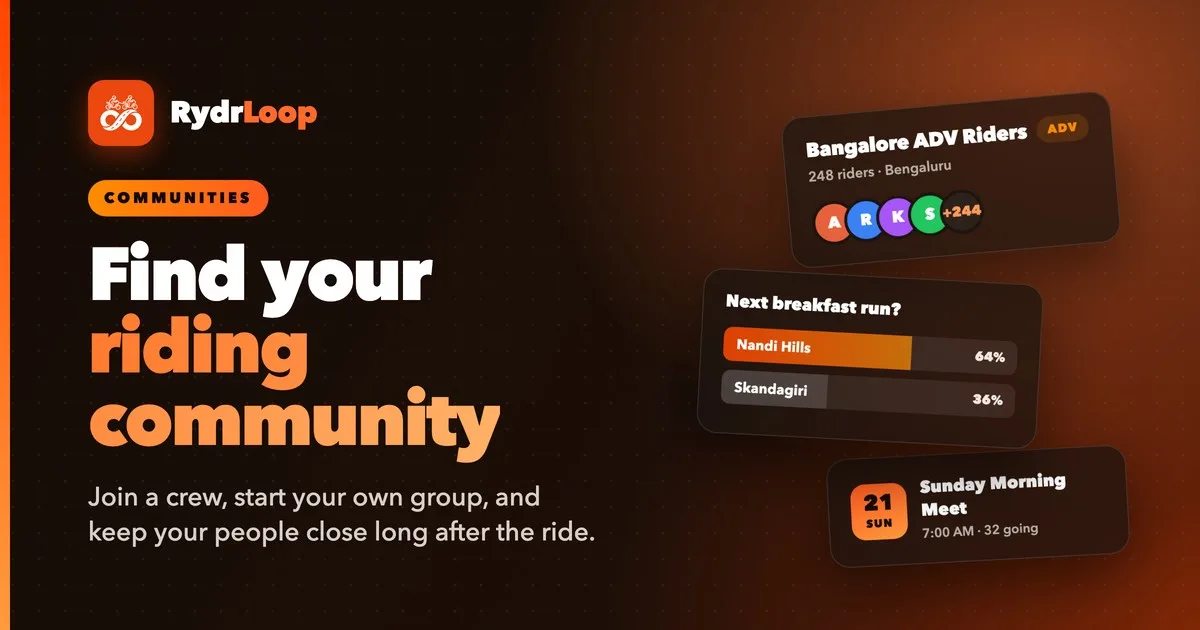
This entire piece describes a problem RydrLoop was built to solve directly: riders who want a riding community and don't know how to find one nearby. Rather than waiting to be invited to a group you don't know exists, or hoping a showroom meetup lines up with your weekend, you can see rides happening near you, their pace, distance and route, before committing to one, which removes most of the guesswork and most of the intimidation described above.
It also solves the other half of the equation for riders who already have a small crew, making it easier to plan and open up your own rides to new people, which is exactly how most welcoming riding groups actually grew in the first place, one rider deciding to open the invite a little wider than their existing circle. If the friction has ever been "I don't know who else rides near me," that's the specific gap RydrLoop exists to close.
Final Thoughts: The Bike Gets You Started, the People Keep You Riding
Ask almost any rider with years of experience what actually kept them coming back to motorcycle riding through the seasons where motivation dipped, the cold mornings, the busy months, the stretch where the bike sat for longer than they'd like to admit, and the honest answer is rarely the bike itself. It's the people. The riding buddy who texts asking if you're free Sunday. The group that notices when you've been missing from the last few rides. The friendship that started as two strangers comparing gear at a fuel stop and turned into something that has very little to do with motorcycles at all anymore.
Motorcycle riding will always work as a solo hobby, and there's real value in that too. But if you've been riding alone and wondering where everyone else's riding community came from, the honest answer is that it came from showing up, once, slightly nervous, and letting the ride do what it's genuinely good at. The bike gets you to the fuel stop. The conversation there is what turns it into a friendship.
Looking for that first ride to show up to? Find a group near you on RydrLoop and see what motorcycle riding looks like when you're not doing it alone.
Comments (0)
Join the conversation. Your thoughts matter!
Be the first to share your thoughts.