What Makes a Good Riding Community?
Any group with a logo calls itself a community now. What really separates a genuine riding community from flex culture, and how to find the real thing.
 RydrLoop··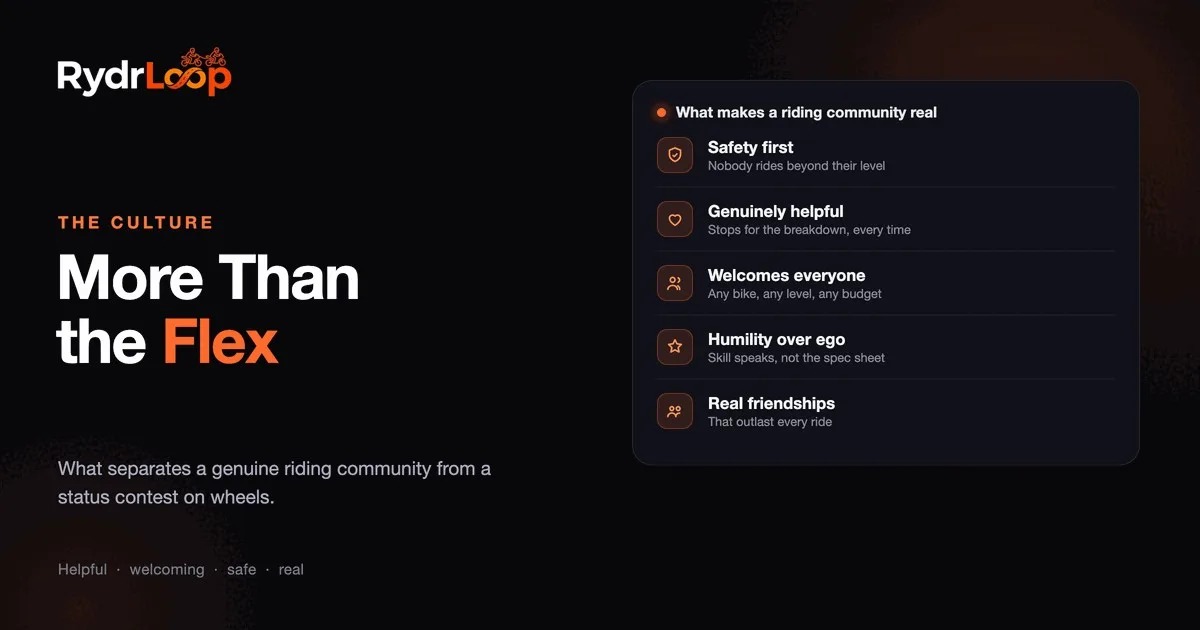
Every rider eventually meets both kinds of group, and both of them will proudly call themselves a riding community. The first one you can spot from across the parking lot. Expensive bikes lined up for photos, a lot of talk about horsepower and top speed, a quiet sizing up of what you ride the moment you roll in, and a distinct sense that you have to earn your place by owning the right machine and pulling the right stunts. The second kind is quieter. Someone waves you over, asks where you are headed, and twenty minutes later a stranger is on their knees in the dirt helping you sort a problem with your bike that you could not have fixed alone.
Both of these call themselves a riding community. Only one of them actually is.
The word gets used so loosely that it has almost stopped meaning anything. Any WhatsApp group with forty riders and a logo calls itself a community now. But most riders, if they are honest, have been part of groups that drained them, made them feel small, or quietly pushed them into riding in ways that were not safe, and they have also, if they are lucky, been part of the rare group that genuinely made them a better and happier rider. The difference between those two is worth understanding clearly, because the group you ride with shapes your riding more than your bike ever will.
The fake version: flex culture in a helmet
Let us name the thing that pretends to be a riding community but is really just a status contest on wheels.
You know the signs. The first question is not where do you like to ride, it is what do you ride, and the answer decides how you get treated. Respect is handed out by the price of the machine and the brand on the jacket, not by how you carry yourself. There is a constant, low hum of one-upmanship, whose bike is faster, whose kit is more expensive, who did the more extreme thing, and it never quite stops. New riders are looked down on rather than looked after. Slower riders get left behind at every turn and quietly made to feel like a burden. And somewhere in the mix there is always pressure, spoken or not, to ride beyond your ability, to keep up, to do the risky overtake, to hit the speed, because backing off looks weak in front of the group.
The clearest tell of all is what the group actually produces. Flex culture produces photos. Endless, carefully staged photos of bikes and gear and lean angles, and very little else. Strip away the images and there is no real substance underneath, no genuine help, no friendship that survives a bad day, no one who would actually show up for you when it matters. It looks like a riding community from the outside and feels hollow the moment you need something real from it.
This culture is not just annoying, it is genuinely dangerous. A group whose value system rewards showing off and punishes caution will, sooner or later, get someone hurt. Peer pressure has put more riders in hospital than bad brakes ever have. If a group makes you feel that your safety is less important than your image, that is not a community you want, no matter how good the photos look.
What a good riding community actually looks like
Now the real thing, because it exists, and once you have been part of one you will never settle for the fake version again. A genuine riding community is built on a completely different set of values, and you can recognise it by a handful of clear markers.
Safety comes before everything
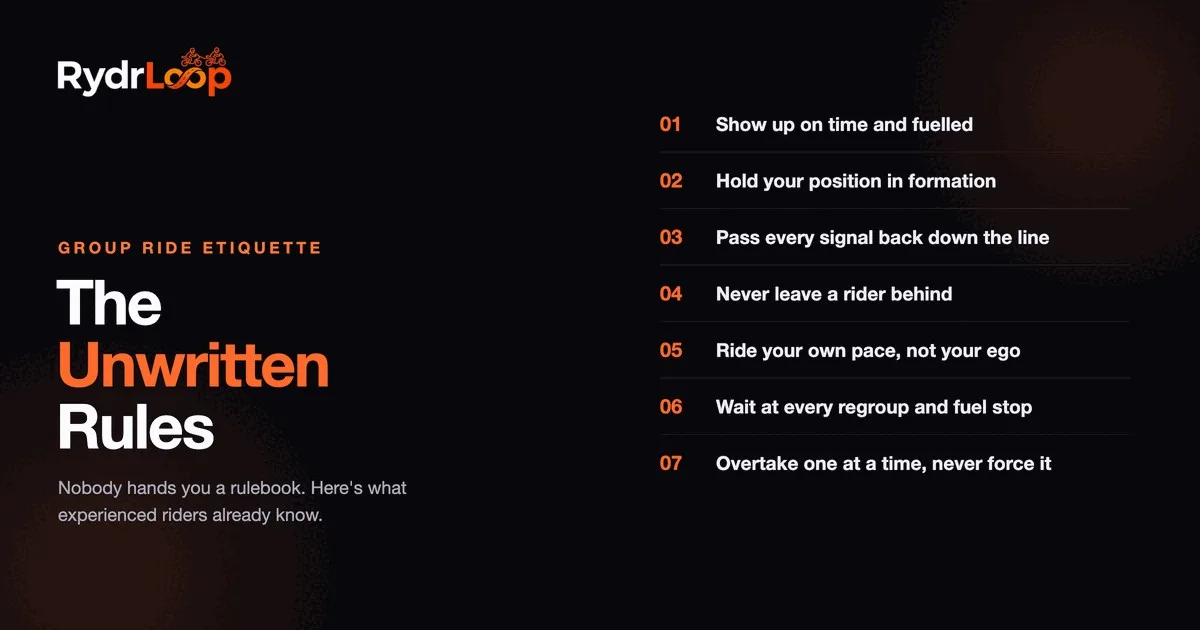
In a real riding community, nobody is ever pressured to ride beyond their level, and looking after each other is simply how the group operates. There is a lead who sets a sensible pace, a sweep who makes sure nobody is left alone, and a shared understanding that the whole group only moves as safely as its least experienced rider. Backing off is respected, not mocked. This safety-first culture is the backbone of any group worth riding with, and it is exactly what our guide to group riding is built around, because riding well together is a skill the good communities take seriously.
It is genuinely helpful
This is the heart of it. A good riding community helps. Someone breaks down and three people stop. A new rider asks a basic question and gets a real answer instead of a smirk. Knowledge flows freely, about routes, about maintenance, about gear, about the mistakes the veterans made so you do not have to. Nobody is protecting their status by hoarding what they know. The measure of a real community is simple: when you are stuck, at the roadside or just starting out, does it actually help you, or does it just watch.
It welcomes people instead of gatekeeping them
A genuine riding community does not care whether you arrived on a commuter or a superbike, whether your gear is top of the range or the best you could afford, or whether you have ridden for twenty years or twenty days. Every kind of rider is welcome, because the shared love of riding matters more than the machine it happens on. The daily commuter is as valid a member as the cross-country tourer, and a beginner who turns up in whatever affordable riding gear they could manage is met with encouragement, not a price check. Gatekeeping, the real bikers only nonsense, is the surest sign that you are looking at flex culture wearing a community costume.
Humility outweighs ego
In the good ones, the most experienced riders are almost always the most humble. They help without being asked, they teach without condescending, and they have nothing to prove because their skill speaks for itself quietly. Ego is the currency of the fake community. Humility is the currency of the real one.
The relationships are real
The final marker, and the one that separates a group of riders from an actual community, is that the bonds outlast the ride. These are people who show up for each other off the bike too, who become genuine friends, who you would call at 2am. The rides are the excuse. The people are the point. A group that only exists for the photo op dissolves the moment the photo is taken. A real riding community is still there years later.
The bike does not make the rider
Here is the truth that flex culture cannot survive, so it never says it out loud. The best members of any riding community are very often the ones on the most modest bikes.
Character is not sold with cubic capacity. The rider who stops to help a stranger, who patiently teaches a nervous beginner, who sets a safe pace so nobody gets left behind, who represents riders well to the world, that rider is worth ten of the loud one on the expensive machine who does none of it. Some of the finest riders and the finest people you will meet in any riding community are quietly covering huge distances on humble, well-loved motorcycles, and they have long stopped caring what anyone thinks of their spec sheet. Once you understand this, the entire flex hierarchy collapses, because it was measuring the wrong thing all along.
The new rider test
If you want to judge a riding community quickly, do not look at its best riders or its best bikes. Look at how it treats its newest, least experienced, least flashy member.
Watch what happens when a nervous beginner on a small bike shows up alone. In a real community, someone makes them feel welcome, checks they are okay, puts them somewhere safe in the group, and quietly keeps an eye on them all day. In a flex group, that same rider is ignored, judged, or left struggling at the back. That single moment tells you everything, because a community reveals its true character not in how it treats its heroes but in how it treats the person who has the least to offer it in status. Everyone was that nervous beginner once, and the good communities never forget it.
Online clout is not a community
It is worth being clear about something the phone era has blurred. A large following is not a riding community, and a busy group chat is not one either. You can have ten thousand people watching your reels and not a single one who would stop for you on a dark highway. You can be in a WhatsApp group of two hundred riders that is loud all week and produces nothing but forwarded photos and arguments about which bike is better.
Numbers are not connection. The flex version of riding culture has moved online with enthusiasm, because the internet is the perfect stage for a status contest, all image and no substance, all reach and no depth. It rewards the loud and the extreme, and it quietly convinces newer riders that the point of riding is to be seen doing it. A real riding community absolutely can live partly online, that is often how people first find each other now, but the online part is only ever a doorway. The community itself is proven on the road, in the help that actually turns up, in the ride that waits for the slow rider, in the friendship that survives being offline. If a group exists only as content and never quite becomes real riding with real people who look out for you, it is an audience, not a community, however big the follower count.
A community is a two-way street
There is one more thing that flex culture never mentions, because it only ever wants to take. A real riding community is something you contribute to, not just consume.
The good ones work because enough people show up as givers. They stop for the breakdown even when it is inconvenient, they answer the beginner's question patiently for the hundredth time, they organise the ride nobody else wanted to organise, they share what they know instead of hoarding it. If everyone only takes, waiting to be helped, entertained and impressed, the community hollows out no matter how many members it has. So the honest question is not only what a riding community can do for you, but what kind of member you are within it. Be the one who helps before being asked, who welcomes the new face, who represents riders well to every driver, pedestrian and shopkeeper you pass. Communities are not found fully formed and perfect. They are kept alive by the people who choose to give to them, and the more you put in, the more the whole thing is worth to everyone in it.
How the right community makes you a better rider
Being part of a genuine riding community is not just nicer, it actively makes you a better and safer rider, faster than you could ever manage alone.
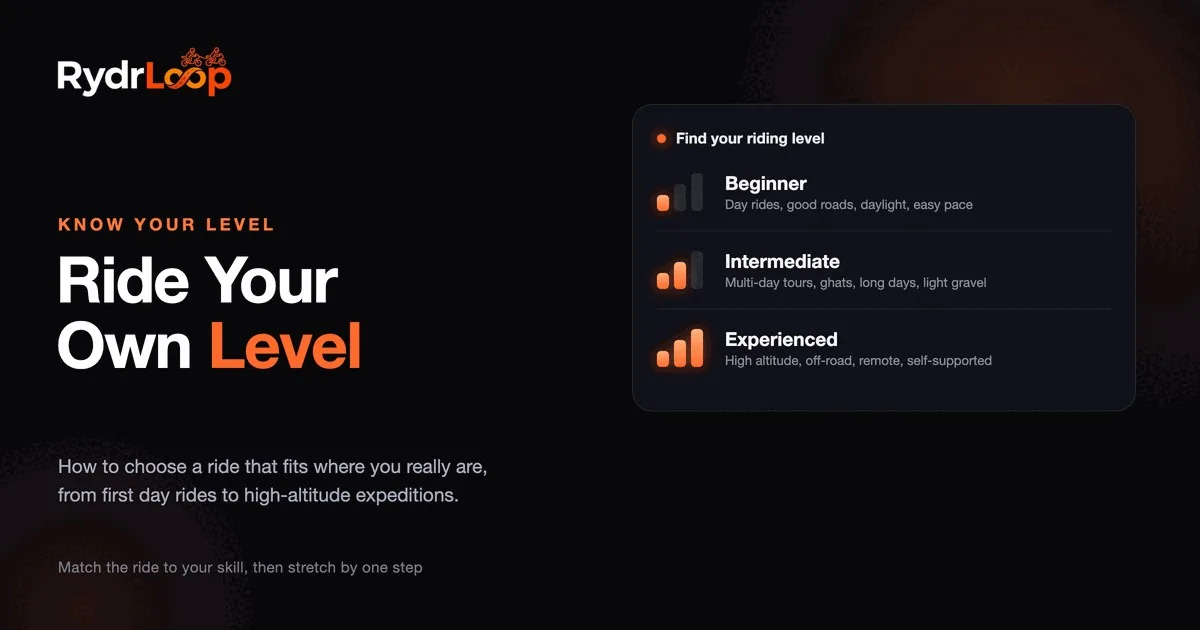
You learn from people ahead of you, absorbing years of hard-won knowledge in conversations at fuel stops. You are encouraged to grow at the right pace, stretched a little at a time rather than thrown in the deep end or held back by ego. You ride more, because there is always someone to ride with, and hours in the saddle are what build skill. And you ride more safely, because good habits are contagious in the same way bad ones are. The best communities are quietly obsessed with helping their members improve, and matching riders to rides that suit where they actually are, which is the whole idea behind knowing your riding skill level and choosing rides that fit it. A flex group makes you reckless to keep up. A real community makes you better on purpose.
How to find or build one
So how do you actually find the real thing, and avoid the hollow version.
Start by watching how a group behaves before you commit to it. Do people ask what you ride or where you ride? Do they help a stranger or ignore one? Is there room for a beginner, or only for the fast and the flashy? Do the conversations have any substance beyond bikes and speed? Ride with a group once or twice before you decide, and trust what you feel. If you come away energised, welcomed and a little wiser, that is a keeper. If you come away tense, judged, or pushed into riding you were not comfortable with, walk away without guilt, no matter how impressive the machines were.
This is exactly the problem RydrLoop is built to solve, connecting riders around genuine riding rather than clout. Rides are organised around real routes, real pace and honest riding levels, so you can find people who ride the way you actually ride, at a level that fits you, with the intent that matters to you, instead of gambling on whichever loud group you stumble into. The goal is not another gallery of bike photos. It is to make the good kind of riding community, the helpful, welcoming, safety-first kind, easier to find and easier to be part of.
And if you genuinely cannot find one near you, then build it, starting with yourself. Every real riding community began with a few people who decided to be helpful, welcoming and safe, and let that culture spread. Be the rider who stops for the stranger, who welcomes the beginner, who never makes anyone feel small for what they ride. Set the tone you wish others would set, and you will be amazed how quickly the right people gather around it. Culture is not something you wait to receive. It is something you start.
Why any of this matters
You will forget most of the bikes. This is the quiet thing every long-time rider eventually realises. The specs, the upgrades, the machines you lusted after and eventually owned, they all blur together over the years. What you remember, what actually stays with you, is the people. The friend who rode through the night to reach you when you were stranded. The veteran who taught you to corner without ever once making you feel stupid. The group that felt like coming home every weekend.
That is what a good riding community really is, and it is worth far more than any badge on a tank. Flex culture offers you a place to be seen. A real community offers you somewhere to belong, people who make you safer, better and happier on two wheels, and friendships that outlast every motorcycle you will ever own. Hold out for that one. And when you find it, or build it, look after it, because it is the best thing this whole obsession with motorcycles has to give.
Ready to ride with the good kind? Find your people on RydrLoop, where rides are built around real routes, honest levels and riders who actually look out for each other.
Comments (0)
Join the conversation. Your thoughts matter!
Be the first to share your thoughts.