

Long Distance Riding: How to Survive the Big Days in the Saddle
The bike is rarely what gives up first on a 700km day. You are. A practical guide to fatigue, ergonomics, hydration and pacing on the really big rides.
 RydrLoop··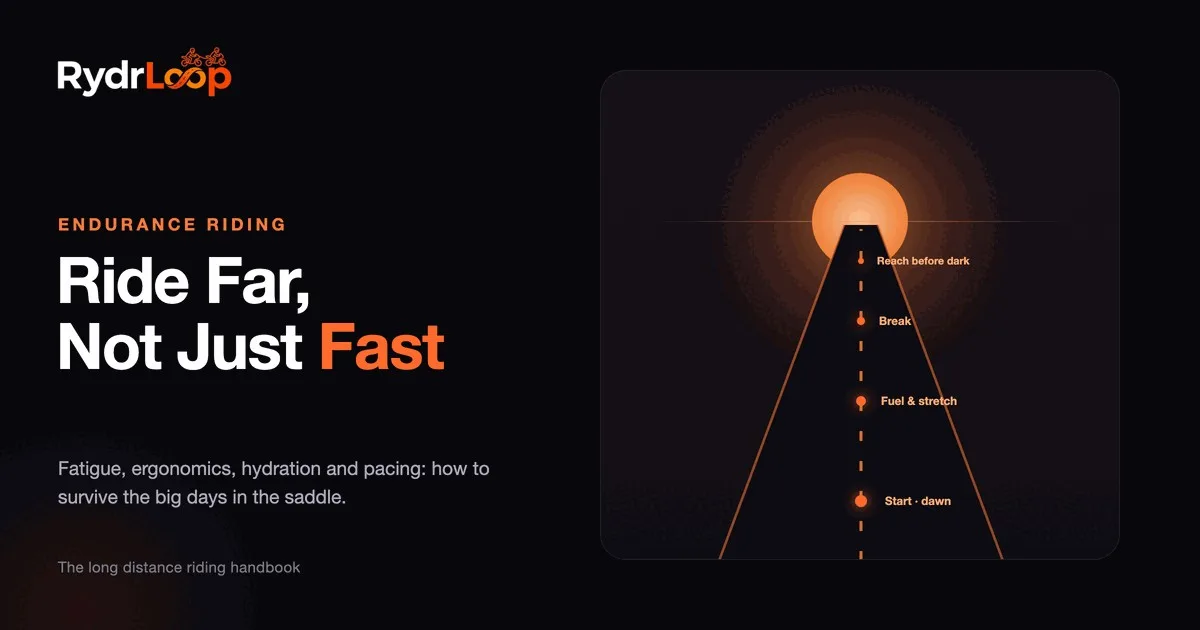
Ask a new rider what the hardest part of a 700 kilometre day is and they will talk about the bike. The engine, the power, whether it can hold triple digits all day. Ask someone who has actually done a few of those days and they will laugh, because they know the truth. The bike is almost never the thing that gives up first. You are. In long distance riding, the hard limit is nearly always the rider, not the machine.
This is the part of motorcycling nobody prepares you for. Riding fast is a skill you can see and admire. Riding far is a quieter, stranger skill, and it has almost nothing to do with how quick you are through a corner. Long distance riding is an endurance sport, closer to a marathon than a sprint, and like any endurance sport it rewards the people who understand their own body and punishes the ones who just twist the throttle and hope.
The good news is that everything about it is learnable. The riders who calmly knock out 600 or 800 kilometre days and get off the bike smiling are not superhuman. They have just figured out a set of small, unglamorous habits that keep the body fresh and the mind sharp long after the enthusiasm has worn off. This is the honest guide to those habits, written for the day the excitement fades at kilometre 300 and there are still 400 to go.
It is an endurance sport, not a speed one
The first thing to unlearn is the idea that a big day is about going fast. It is not. It is about going steadily, for a very long time, without falling apart.
Here is the maths that surprises people. A rider who holds a calm, sustainable average and takes short, sharp breaks will comfortably beat the rider who blasts to 130, then collapses at a dhaba for forty five minutes, then blasts again. On Indian roads your average speed over a full day is decided far more by how little time you waste and how few mistakes you make than by your top speed. The rider who never has to stop for long, never gets a puncture from riding carelessly, never takes a wrong turn because they are too tired to read signs, is the one who gets there first and in one piece.
So the entire mindset of long distance riding flips. You stop chasing speed and start protecting momentum. Smooth inputs, a relaxed pace you can hold for hours, and a body you are actively managing so it does not force an unplanned stop. Think of yourself as a diesel engine built to run all day, not a firecracker.
Fatigue is the real enemy, and it lies to you
Every long day is a slow negotiation with fatigue, and the dangerous thing about fatigue is that it arrives long before you consciously feel tired. Your reactions dull, your focus narrows, you start missing things in your mirrors, and you have no idea it is happening. By the time you actually feel sleepy or exhausted, your riding has already been degraded for a while.
There are three kinds of tired that stalk a long distance rider. Physical fatigue, from holding a riding position and fighting the wind for hours. Mental fatigue, from the constant low-level concentration of reading traffic and road. And the sneakiest one, the drowsiness that creeps in on long, monotonous straights, sometimes called highway hypnosis, where the road hums past and your mind drifts and you realise you have covered ten kilometres with no memory of them. That last one is how experienced riders end up in ditches on empty highways in the early afternoon.
The single most important rule in all of long distance riding follows from this. Stop before you are tired, not when you are. If you wait until you feel wrecked to take a break, you have waited far too long. Build the breaks into the plan and take them whether you feel you need them or not, because the version of you that decides you can skip a break is exactly the tired version whose judgement you cannot trust.
Set the bike up for the long haul
A motorcycle that feels perfect on a two hour ride can quietly destroy you over ten. In long distance riding, comfort is not a luxury, it is a safety feature, because a rider in pain is a rider making mistakes. The difference is your three contact points: the seat, the handlebars and the footpegs. On a short ride your body absorbs a bad setup. On a long one, every small wrongness compounds into real pain.
The seat is the big one, and it is where most stock bikes fail. The flat, thinly padded seat that came with your bike was designed to look good in the showroom, not to carry you for eight hours. This is the upgrade that changes long distance riding more than any other. A proper touring seat, a gel pad, a sheepskin cover or even a cheap air cushion can be the difference between finishing a day comfortable and finishing it in agony. Try before you commit to a big tour, not on the tour itself.
The handlebars decide what happens to your wrists, shoulders and lower back. A reach that has you leaning too far forward puts your weight on your palms, and after a few hours your wrists ache and your hands go numb. Bar risers that bring the bars up and back, so you sit more upright with a slight bend in the elbow and your weight on your spine rather than your hands, are a cheap and transformative change on many bikes.
Then there is the wind. At highway speed, the constant push of air on your chest is doing quiet work on your neck and shoulders all day, and it is a bigger source of fatigue than most riders realise. Even a small windscreen that lifts the blast off your torso pays for itself in how fresh you feel at the end. If your bike is naked and you tour on it, this is worth a serious look.
Look after the body
Nothing exposes a weak body like long distance riding. Your body is the engine that actually fails, so treat it like one.
The famous one is saddle soreness, what long riders bluntly call monkey butt. It is not just discomfort, it can genuinely end a day. The fixes are simple and they work. Padded cycling shorts or proper riding jeans with good construction, worn under your gear, cut it down enormously. Keep the area dry, because heat and moisture are what turn soreness into raw skin, and a little anti-chafe balm or powder before a big day helps. And the oldest trick of all, stand up on the pegs for a few seconds every so often, or shift your position on the seat, to move the pressure around and get blood flowing.
Your hands are next. Numb, tingling hands come from two things, vibration and a death grip on the bars. The vibration you manage with good gloves and sometimes bar-end weights. The grip is on you. New long distance riders squeeze the bars far harder than they need to, all day, and their hands pay for it. Consciously relax your grip. You are guiding the bike, not strangling it. On a straight highway your hands should be light.
Your lower back and neck round it out. A strong core does more for long distance comfort than any farkle you can bolt on, so the fittest riders genuinely suffer less. In the saddle, roll your shoulders, tuck your chin to stretch your neck against the wind, and at every stop actually get off and move rather than slumping on the bike. Two minutes of walking and stretching at a fuel stop resets more than you would think.
Hydration and food win the day
This is the factor that decides more long days than anything on the spec sheet, and it is the one riders ignore the most. Dehydration produces the exact same symptoms as fatigue, tiredness, headache, poor concentration, bad mood, slow decisions, and on a bike in the Indian sun you dehydrate faster than you notice because the wind dries your sweat before you feel it.
Drink constantly, not occasionally. A hydration bladder in a backpack, with the tube routed to your shoulder, is the best money you can spend on long distance riding, because it lets you sip every few minutes without stopping. If you are riding in real heat or sweating hard, plain water is not enough, add electrolytes, an ORS sachet or a hydration tablet, to replace what you are losing. A rider who stays properly hydrated stays sharp for hours longer than one who does not, full stop.
Food is the other half. The classic mistake is the big, heavy lunch at a highway dhaba, followed by an hour of fighting your own eyelids as your body diverts everything to digestion. That afternoon slump is largely self-inflicted. Eat light and eat often instead. Smaller meals, some nuts and fruit and energy bars in your tank bag, keep your energy level even without the crash. Save the big feast for when you have parked for the night. Caffeine has its place, but use it as a tool, a coffee at a planned stop when you feel the focus slipping, not a substitute for the rest your body is asking for.
Pace the day, and start it early
How you structure the hours matters as much as how you ride them.
Start at dawn. This is the single best habit in long distance riding and almost nobody does it. The early morning gives you cool air, empty roads, no glare, and, crucially, it lets you bank a big chunk of your distance before the traffic, heat and fatigue of the afternoon arrive. A rider who is on the road at 5.30am and has done 250 kilometres by 9am is having a completely different, far safer day than one who rolls out at 10am and is still grinding through the heat at dusk.
Be honest about daily distance. On a good highway, a fit and experienced rider can cover a lot of ground. On Indian roads, through towns, traffic, broken patches and the general chaos, a realistic full day is often 400 to 500 kilometres, and in the hills it can be far less. Ghat roads and mountains are measured in hours, not kilometres. Plan for the road you are actually on, build in buffer time for the things that always go wrong, and you will arrive relaxed instead of riding the last two hours in a panic.
That panic has a name among tourers, get-there-itis, and it is a genuine killer. It is the compulsion to push on to a fixed destination no matter how tired you are, how dark it has got, or how bad the weather has turned, simply because that is where you said you would sleep. Learn to let the target go. A hotel is not worth your life. If the day has beaten you, stop early, stop somewhere unplanned, and finish tomorrow. The riders who have been touring for decades are the ones who mastered the art of quitting for the day at the right time.
The stop strategy
In long distance riding, breaks are not lost time, they are what makes the moving time possible. The rider who resents stopping and tries to gut out huge stints is the one who ends up making a tired mistake.
The rhythm that works for most people is a short break roughly every two hours or every 150 to 200 kilometres, whichever comes first. Not a long, sprawling halt, just ten or fifteen minutes to get off the bike, walk, stretch, drink, eat something small and let your eyes and mind reset. Fuel stops fold neatly into this, since you are stopping anyway, so tie your breaks to your tank. The key is that a break means actually getting off and moving your body, not sitting on the bike scrolling your phone. Move, hydrate, then go.
In long distance riding, short and frequent beats long and rare every single time. Your body stays looser, your mind stays fresher, and you lose less total time than you would to one giant recovery stop when you finally hit the wall.
Gear that reduces fatigue
For long distance riding, choose your kit for comfort and low fatigue, not just protection.
Start with your ears. Wind noise at highway speed is loud enough to cause real, cumulative fatigue and long-term hearing damage, and the difference a set of cheap foam earplugs makes to how fresh you feel after ten hours is genuinely startling. If you take one small thing from this guide, take earplugs. A quiet, well-fitting helmet that is not too heavy matters for the same reason, since a noisy or heavy lid wears on your neck and mind all day.
Dress for the whole day, not the moment you set off. Mornings are cold, afternoons are brutal, and a mesh jacket with a windproof liner, plus a base layer you can add or remove, keeps you comfortable across that range. Comfortable, broken-in gloves and boots matter more than aggressive ones on a tour. And on long, straight, empty highways, a simple throttle lock or cruise assist that lets you rest your right hand for a while is a small luxury that saves your wrist over the hours. It is not cruise control, so you stay fully in command, but it takes the constant strain off.
Before any of this, the machine itself has to be sorted, because a breakdown four hundred kilometres from anywhere turns a great tour into a nightmare. Tyres, chain, brakes, oil and lights all get checked before a big trip, and our pre-ride checklist walks through exactly what to look at. For building out a comfortable, protective kit in the first place, our guide to riding gear for beginners covers the essentials.
The mental game
The body is only half the battle. Long straight roads, especially the good ones, are mentally numbing, and a wandering mind is a slow mind.
Different riders manage this differently. Some break the day into chunks and ride from one small target to the next, the next fuel stop, the next town, the next hundred kilometres, rather than staring down the whole enormous distance at once. Some ride to music or podcasts at low volume, which keeps the mind engaged on empty stretches, though there is a real debate about whether that dulls your awareness in traffic, so keep it off or low when the road gets busy. Some simply ride with the road, settling into the rhythm and letting the miles become a kind of meditation, which is exactly the flow state that makes long distance riding so addictive once you find it.
Whatever your method, the goal is the same, stay actively engaged rather than letting the road hypnotise you. The moment you notice your mind has drifted, that is a signal, and often it is the first sign that you need a break.
A word on night riding
Night is where long distance riding gets genuinely dangerous. If you can avoid finishing a long day in the dark, avoid it. Night stacks every hazard on top of a body that is already tired.
On Indian roads after dark you get unlit trucks parked on the carriageway, cattle and dogs wandering out of nowhere, potholes you cannot see until you are in them, and oncoming high beams that blind you at the worst moments, all while your fatigue is at its peak. This is precisely the combination that turns a manageable day into a disaster. If your plan regularly has you riding well into the night, your plan is too ambitious, so start earlier and shorten the day. If you genuinely must ride at night, slow right down, double your following distance, keep your visor and headlight clean, and treat every dark shape as a hazard until proven otherwise.
Recovering between days on a tour
Here is the hidden half of long distance riding. Multi-day rides are won in the evenings. What you do after you park decides how you feel when you throw a leg over the bike the next morning.
Rehydrate properly the moment you stop, because you are almost certainly behind. Eat a real meal, stretch out the muscles that have been locked in one position all day, and protect your sleep, since sleep is the actual recovery and everything else is just support. Go easy on the alcohol, however tempting the end-of-day beer is, because it wrecks your sleep quality and leaves you dull the next morning. And prep the bike at night, not in the morning, a quick check of the chain, tyres and oil, and refuel if you can, so that you can simply wake up and ride at dawn without eating into your best riding hours.
Do this well for a few days in a row and you will be amazed how your body adapts. The third and fourth days of a long tour are often easier than the first, because you have found the rhythm.
The mistakes almost everyone makes first
If you are new to long distance riding, you will probably make a few of these, so here they are in one place. Chasing speed instead of protecting your average. Skipping breaks to save time and paying for it with a tired mistake. Gripping the bars too hard and wondering why your hands go numb. Forgetting to drink until you already have a headache. Eating a giant lunch and losing the afternoon. Setting a daily distance based on a map instead of on real Indian roads. And the big one, refusing to stop when your body is clearly telling you to, because you fixed a destination in your head and your ego will not let it go.
None of these make you a bad rider. Everyone learns them the hard way once. The trick is to learn them from a guide like this instead of from a close call.
Why long distance riding is worth it
After all these warnings you might wonder why anyone does this. The answer is that there is nothing else quite like it. A long distance ride, done right, settles into a rhythm that clears your head like almost nothing else in modern life. The world narrows to the road, the machine and your own thoughts, hour after hour, and somewhere out there you stop counting the kilometres and just flow. The great multi-day journeys, the Himalayan expeditions, the coast-to-coast runs, the trips you will remember for the rest of your life, are all just this skill applied over enough days.
That is the real reward of long distance riding. Master the endurance and the whole map opens up. Start with a single long day, be honest with yourself about your limits, look after your body the way this guide describes, and build from there. The distance will come. It always does, to the riders who treat it with respect.

Comments (0)
Join the conversation. Your thoughts matter!
Be the first to share your thoughts.