

Where to Ride in India, Month by Month: A Rider's Season Calendar
India is three climates at once. This calendar shows where to ride in India each month, and which part of the country will punish you for showing up.
 RydrLoop··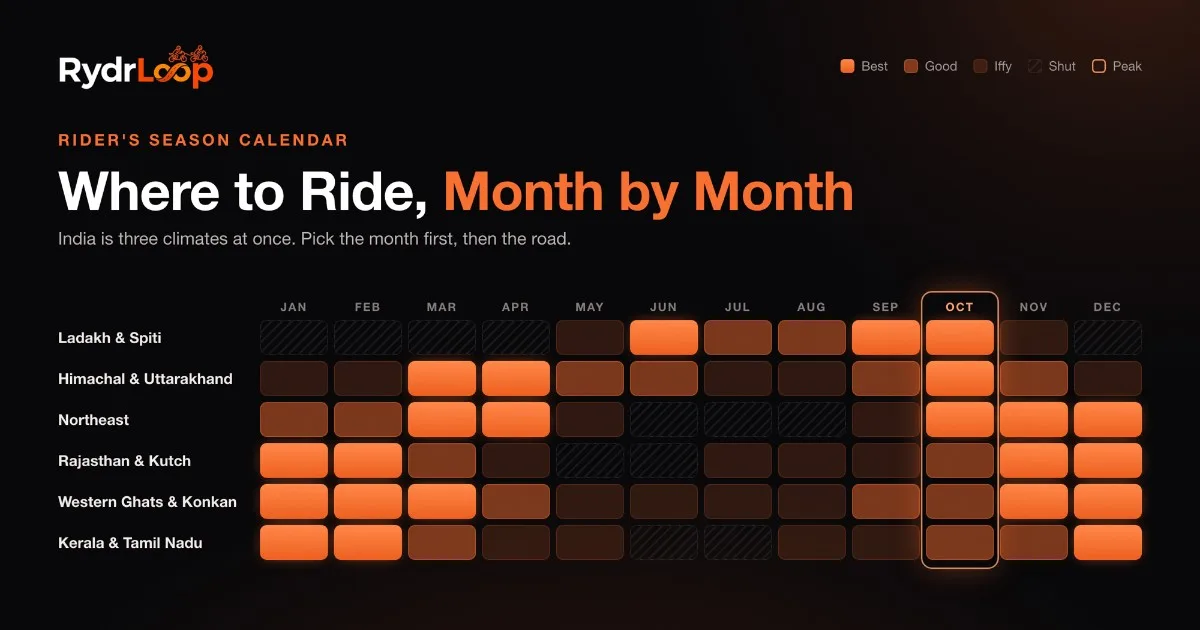
India does not have a riding season. It has several, running at the same time in different parts of the country, and the best place to ride in India one month can be the worst place the next. The difference between a great trip and an expensive disappointment is usually nothing more than the month you picked.
The same week that makes Ladakh perfect makes Rajasthan unbearable. The monsoon that closes half the Western Ghats to sane riding is exactly what makes Spiti and Lahaul, sitting in the rain shadow behind the Himalaya, some of the only dry high altitude roads on the subcontinent. Riders lose entire trips to this, booking leave in May for a Himalayan pass that will not open until June, or riding into Meghalaya in July and spending four days watching rain from a guesthouse balcony.
This is the calendar version: twelve months, where to ride in India in each of them, what is shut, and what will catch you out. Treat it as a planning tool, not a promise, because weather in India has been getting less predictable every year and local conditions always beat any calendar.
How to read this calendar
Before the months, three questions decide where and when to ride in India, in this order:
- Is the road physically open? High Himalayan passes are closed by snow for five to seven months of the year, and no amount of planning gets you over Kunzum La in February. This question has one right answer and it is not negotiable.
- Will the weather let you enjoy it? A road can be open and still be a bad idea. Rajasthan in June is open. Riding across it at 45 degrees in full gear is a form of self harm.
- How many other people had the same idea? Manali in the first week of June and Goa between Christmas and New Year are open, pleasant and full. Shoulder weeks on either side of peak season are the single easiest upgrade to any Indian bike trip.
Most riders only ask the first question. The riders who come back saying it was the best trip of their life usually asked all three.
January and February: the south, the west and the desert
Deep winter makes the northern plains one of the hardest places to ride in India. Dense fog on the Delhi, Punjab and UP highways drops visibility to a few metres in the early morning, which is exactly when riders like to set off, and highway fog is genuinely one of the most dangerous conditions in the country. If you are riding in the north in these months, leave at 10 am, not 5 am, and accept the shorter day.
Everywhere else, this is a beautiful time to be on a bike.
At their best now:
- Kerala, Tamil Nadu and coastal Karnataka. The south is at its most rideable, dry, warm without being punishing, and every ghat road through Munnar, Valparai, Kodaikanal and Coorg is at its best.
- Goa and the Konkan coast. Dry, mild, and the coastal road from Mumbai down through Ratnagiri and Malvan is one of the great rides in India. Avoid the last week of December and first week of January unless you enjoy traffic.
- Rajasthan and the Rann of Kutch. Desert riding only makes sense in winter, and this is the window. Cold mornings, perfect afternoons, and the white salt flats of Kutch at their most surreal.
- Central India. Madhya Pradesh, the Satpura and Vindhya ranges, the roads around Pachmarhi and Panchmarhi's ghats, quiet and cool.
- Winter Spiti, for a specific kind of rider. The Shimla to Kinnaur to Kaza route stays technically open in winter and is a genuinely serious undertaking, sub-zero, icy, and not a casual plan. If it appeals, read the winter Spiti preparation guide before you commit to anything.
Shut or pointless: Manali to Leh, Zoji La, Kunzum La, most of the high Himalaya. Northeast high altitude sections like Sela Pass can see heavy snow.
Watch for: morning fog in the north, genuinely cold nights in Rajasthan and central India, and holiday crowds in Goa and Rajasthan through the first week of January.
March and April: the shoulder months nobody uses well
This is the most underrated time to ride in India, and the reason is simple. The Himalaya has not opened yet, so riders who only think about mountains write these months off entirely, and the rest of the country is left half empty just as it comes into its best condition.
At their best now:
- The Western Ghats and the Sahyadris. Before the heat and long before the rain. The Nashik, Igatpuri, Bhandardara, Tamhini and Amboli stretches in Maharashtra, and further south through Chikmagalur and Agumbe, all ride beautifully in March.
- The Northeast. Meghalaya, Assam and the Arunachal foothills sit in a completely different rhythm from the rest of the country. March and April are warm, mostly dry and green, and the crowds are nowhere near what the Himalaya sees.
- Uttarakhand and Himachal's lower hills. Rishikesh, Chakrata, Mussoorie, Kasol, Tirthan and Jibhi. The valleys are open and the tourist load has not arrived.
- Kashmir valley. April into May is when the valley is at its most spectacular, and the Srinagar side is accessible well before the road over to Ladakh is.
Opening around now: Srinagar to Leh via Zoji La typically clears somewhere between late March and May, depending on the winter's snowfall and how quickly the border roads organisation gets through it. Treat any specific date you read online as a rumour until it is confirmed.
Watch for: heat building fast in the plains from mid April, pre-monsoon thunderstorms in the south and east, and very variable conditions on anything above 3,000 metres.
May: the plains bake, the mountains wake up
May is the hinge of the Indian riding year. The plains become genuinely hostile, with 42 to 47 degree afternoons across Rajasthan, Gujarat, central India and the Gangetic plains, and the Himalaya starts opening one pass at a time.
If you must ride in the plains in May, ride between 4 am and 9 am and stop. Riding through the afternoon in full gear at those temperatures leads to heat exhaustion faster than most riders expect, and dehydration degrades judgement long before it feels like a problem.
At their best now:
- Ladakh, from late May onward. The Manali to Leh highway typically opens somewhere between mid May and mid June once the border roads organisation clears Baralacha La and the stretches beyond it. Early season means fewer people, more water crossings from fresh snowmelt and colder nights.
- Himachal's high valleys. Lahaul is reachable year round through the Atal Tunnel now, which has changed early season planning completely. Spiti from the Manali side has to wait for Kunzum La.
- Sikkim and the eastern Himalaya. Before the monsoon reaches the east, which it does earlier than most riders assume.
- The Nilgiris and high south Indian hills, as a heat escape rather than a destination in themselves.
Watch for: snowmelt water crossings at high altitude, which are shallow in the morning and deepest in the late afternoon after a day of sun. Cross early. Also, altitude. Going from sea level to 5,000 metres in three days is how riders end up with acute mountain sickness, and it does not care how fit you are.
June to September: the monsoon, and the two ways to handle it
The monsoon generally reaches Kerala around the start of June and works its way north over the following six weeks, then retreats from mid September. For anyone who wants to ride in India through the monsoon, it splits the country into two completely different propositions.
June
The first half of June is the last clean window before the rain, and the high Himalaya is in full swing. It is also the single most crowded stretch of the year in Manali, Leh and Spiti, because school holidays and pass openings collide. If you want the same roads with a third of the traffic, ride them in the second half of September instead.
By late June the monsoon is well into the west coast and the Ghats, and Ladakh becomes the obvious answer for anyone who wants dry roads.
July and August
The rain shadow trick. Ladakh, Zanskar, Spiti and Lahaul sit behind the main Himalayan range, which catches most of the moisture before it arrives. These are the driest high altitude roads you can ride in India during peak monsoon, and it is the reason Ladakh is a July and August destination at all.
The catch is real and it is worth stating plainly: the approaches are not in the rain shadow. Landslides, flash floods and washed out sections on the Manali to Kaza road, the Kinnaur stretch along the Sutlej, and the Jammu to Srinagar highway are a normal monsoon occurrence, and they close roads for hours or days. If you ride to the rain shadow in monsoon, build slack days into the plan and follow local road status rather than a blog.
Riding in the rain, deliberately. In monsoon the Western Ghats become one of the most beautiful places to ride in India, green in a way photographs do not capture, and every waterfall in Maharashtra, Goa and Karnataka is running. It is also slippery, low visibility riding on roads with hidden potholes, and the riders who enjoy it are the ones who slow down, pick soft compound tyres with life left in them, and treat painted lines, metal covers and diesel patches as ice.
Avoid outright: the Northeast at peak monsoon. Meghalaya and Arunachal receive some of the highest rainfall on earth, and July and August there is not a riding holiday, it is an indoor holiday with a motorcycle parked outside.
September
The second half of September is, quietly, one of the two best times to ride in India. The monsoon is retreating, the Himalaya is washed clean and clear, the summer crowds have gone home, the passes are all still open, and the light is the best it will be all year. If you can only take one long trip, and you are flexible about when, this is the fortnight to take it.
October and November: the best riding weeks of the year
If somebody asks for the single best month to ride in India, the answer is October.
At their best now:
- The entire Himalaya, while it lasts. Ladakh, Spiti, Uttarakhand and Himachal are clear, dry and stable through October, with high passes usually staying open until somewhere between mid October and mid November depending on the first heavy snowfall.
- The Northeast. October through April is the Northeast's season, and October is where it begins. Meghalaya, Assam, Nagaland in early December for Hornbill, and Arunachal for riders willing to handle permits and genuinely rough roads.
- Rajasthan and Kutch. The heat breaks and the desert becomes a pleasure.
- Everywhere else, honestly. Post monsoon, pre winter, the whole country is rideable at the same time, which happens exactly once a year.
Watch for: the first snowfall, which arrives whenever it wants. Riders get caught on the wrong side of a pass in late October every single year. If you are running a high altitude route this late, have a plan for what you do if the pass closes behind you, and do not plan to cross anything above 4,000 metres on the last day of your leave.
November is October with shorter days and colder nights. Superb in the plains, the desert, the Ghats and the Northeast, and progressively over for the high Himalaya as the month goes on.
December: winter settles in
The high mountains are shut, the north plains get foggy, and the country moves south and west again. The places to ride in India now are Goa, Kerala, Tamil Nadu, coastal Karnataka, Rajasthan and Kutch, and all of them are excellent. The Rann is at its most striking, Hampi and the Deccan ride beautifully, and the Konkan coast is perfect.
Two practical notes. First, the last ten days of December are the most crowded travel window in India, so either book far ahead or ride the first three weeks. Second, north Indian winter mornings are colder on a bike than the forecast suggests, because 8 degrees at 80 km/h is not 8 degrees. Layer properly, and if you are going long, the long distance riding guide covers the fatigue side of cold weather riding in detail.
The high passes, honestly
Every year, riders who want to ride in India's high Himalaya plan around pass opening dates they found on a forum from three seasons ago. Here is the honest version.
- Manali to Leh: typically opens somewhere between mid May and mid June, closes somewhere between mid October and November.
- Srinagar to Leh via Zoji La: usually opens earlier than the Manali route, often between late March and May, and is generally kept open later.
- Kunzum La, for Spiti from the Manali side: usually one of the later openings, often June, and one of the earlier closures.
- Spiti via Shimla and Kinnaur: the year round route, subject to landslides and winter conditions, and the only way in during the cold months.
- Sela Pass, for Tawang: generally open through the year now, with snow closures of a day or two in deep winter.
Every one of those is a range, not a date, and it moves with the winter. The rules that actually work: check the border roads organisation and local district announcements rather than travel blogs, ask a guesthouse in the nearest town a week before you leave, and never plan a trip where the only version that works is the one where the pass opens on the earliest date it has ever opened.
Three mistakes to avoid when planning a ride in India
- Booking leave before checking the season. Leave is the hardest thing to move and the road status is the hardest thing to change. Pick the month from the map, then apply for those dates.
- Chasing a photograph into the wrong month. That green Spiti meadow shot was taken in August. That empty Ladakh road with snow walls was taken in early June. Both places look completely different in the month you are actually going, and going in the wrong month for a photo is how riders end up disappointed by a genuinely great place.
- Ignoring the shoulder weeks. The week before a season starts and the two weeks after it peaks are consistently the best value times to ride in India: same roads, same views, a fraction of the people, and hotels that answer the phone.
Plan the month, then find the people
Once you know when to ride in India, the where gets much easier. The Explore Rides section has route by route detail with distances, road conditions and best seasons already worked out, and the two day trips from Delhi are a good place to start if the long trip is still a few months away.
The harder part is usually people. Long trips fall apart because the one friend who was definitely coming backs out in the last week, and solo is not always what you wanted. On RydrLoop you can find riders near you planning rides in the same window, join rides that match your pace and experience level, and turn a month on a calendar into an actual plan with actual people on it.



Comments (0)
Join the conversation. Your thoughts matter!
Be the first to share your thoughts.