

How to Ride in a Group: The Complete Group Riding Guide
A group of good solo riders is not a good group. The lead and sweep roles, staggered formation, hand signals and the drop-off system that hold a ride together.
 RydrLoop··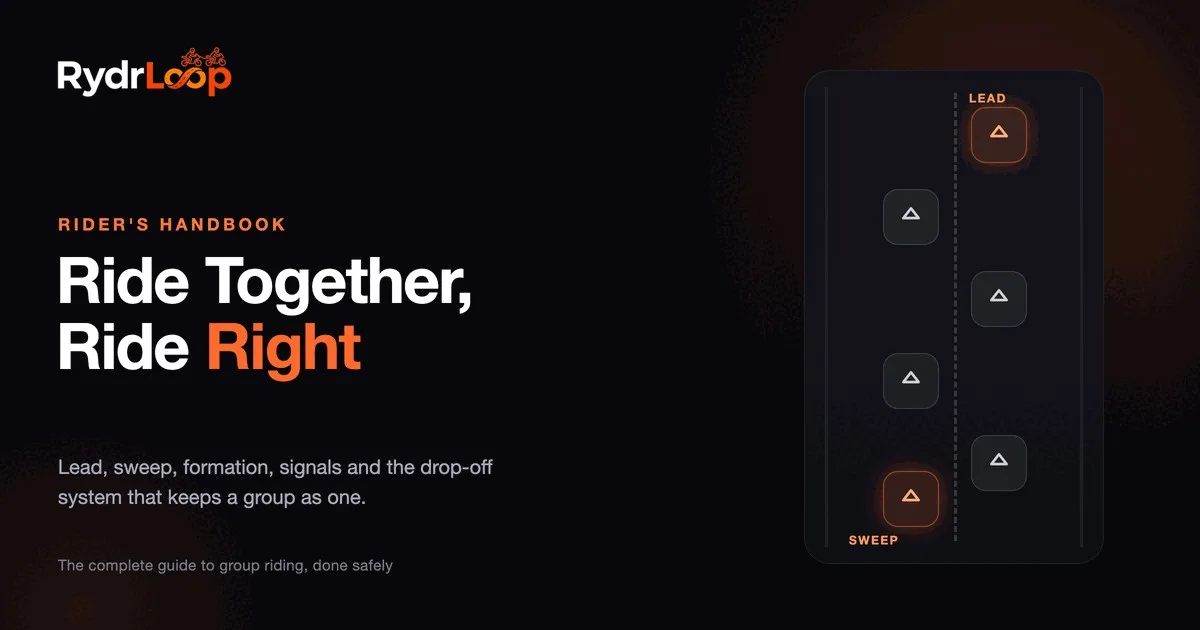
There is a photo almost every rider has on their phone. A dozen bikes lined up at a dhaba, helmets on tanks, everyone grinning, mountains in the background. That photo is the reason most of us fell in love with riding in the first place. What the photo never shows is the part that actually decides whether the day was brilliant or a disaster: the two hours before it, and the quiet discipline of group riding that held everyone together on the road.
Because here is the truth nobody tells you when you join your first big ride. A group of good solo riders is not automatically a good group. Put ten skilled riders on a highway with no plan, no roles and no system, and you get a stretched-out, panicked mess where the fast riders vanish, the slow riders get left at every turn, and somebody eventually runs a red light in a blind rush to catch up. That is when accidents happen. Not on the twisties, but in the gaps.
Group riding is a skill of its own, completely separate from how well you ride alone. The good news is that it is a learnable skill, built on a handful of simple systems that experienced clubs have used for decades. Learn them once and every ride you do for the rest of your life gets safer and smoother. This is the honest, practical guide to how it actually works.
Group riding is a system, not a vibe
The single biggest mental shift is this. When you ride alone, you make every decision for yourself. When you ride in a group, you are one part of a moving machine, and your job is to be predictable so the people around you can trust you.
That word, predictable, is the whole game of group riding. A good group rider does not do anything sudden. No surprise braking, no darting between lanes, no closing gaps aggressively, no showing off. The rider behind you is reading your body and your bike constantly, and every unexpected move you make travels backwards through the group like a shockwave. Ride smooth, hold your line, signal early, and you have already done eighty percent of what it takes to be a good group member.
Everything below is just structure built on top of that one idea.
Before you turn a wheel: the briefing
If you take one thing from this entire guide, take this. The pre-ride briefing is the most important part of group riding, and it is the part almost every casual group skips. Five to ten minutes standing next to the bikes, before anyone starts an engine, prevents nearly every problem that ruins a ride.
A proper briefing covers a short, fixed list:
The route and the day. Where are we going, roughly how many kilometres, and what time do we want to reach. Everyone should have at least the rough shape of the day in their head, not just the lead.
The fuel and break plan. Where are the fuel stops, and how often are we stopping. This gets planned around the smallest fuel tank and the weakest bladder in the group, not the biggest. More on that later, but it gets decided here.
Who is leading and who is sweeping. Name the two people out loud so everyone knows the bike at the very front and the bike at the very back. These are the anchors of the whole group.
The formation and the pace. Are we riding staggered on the highway, single file on the ghats, and roughly what pace are we holding. Set the expectation that the pace is for the slowest comfortable rider, not the fastest.
The hand signals. Run through the handful of signals the group will use, so a new rider is not seeing them for the first time at 80 kmph.
What to do if you get separated. This is the one people forget and the one that causes the most panic. Agree on it now. The simplest rule that works: if you lose the group, do not chase. Slow down, ride safely, and stop at the next fuel station or the next town, because the sweep will always come to you.
Emergency basics. One person notes down a couple of emergency contacts, someone confirms who is carrying a basic first aid kit and a tool roll, and everyone saves the lead and sweep numbers.
That is it. Ten minutes. Do it every single time, even with people you have ridden with for years, because the day the route changes or a new rider joins is exactly the day skipping it bites you.
The two most important riders: lead and sweep
Every group ride, whether it is three bikes or thirty, needs two defined roles. Get these two right and everything else mostly takes care of itself.
The lead, or road captain
The lead rides at the very front and sets the direction, the pace and the rhythm of the whole group. In group riding, this is not a reward for being the fastest. In fact the fastest rider is often the worst choice, because a good lead has to constantly hold back.
A good lead sets the pace for the slowest comfortable rider in the group, checks the mirrors obsessively, and never, ever leaves anyone behind. The lead thinks two steps ahead: spotting the turn early and signalling it in time, easing off before a bad patch of road, choosing safe overtaking gaps, and remembering that a move that is easy for the front bike might be impossible for the tenth bike a hundred metres back. When the lead brakes late or takes a gap that only just exists, that decision multiplies into chaos down the line. A great lead makes the whole group feel like the road is opening up smoothly in front of them.
The sweep, or tail gunner
The sweep rides at the very back, and this is the most underrated job in group riding. The one rule that defines the sweep is simple: nobody is ever behind the sweep. If your bike is the last one, the group is complete. The moment someone drops back, breaks down or pulls over, the sweep is right there.
The sweep should be one of the most experienced and calmest riders in the group, ideally someone who can handle a basic breakdown, carries the tool roll and first aid kit, and does not panic. The sweep also acts as the group's eyes from behind, watching the whole pack stretch and bunch, and flagging problems the lead cannot see. On a good ride the lead and sweep are in constant loose contact, by intercom if they have it, and by a shared understanding of the plan if they do not.
If it is a large group, the lead and sweep should be the only two people who never swap positions all day. Everyone else can shuffle around. Those two are the fixed points.
Formation: how to actually position your bike
This is where a lot of riders new to group riding quietly get it wrong, because it feels natural to just bunch up or ride two abreast. Do not. There is a right way, and it exists for safety, not style.
Staggered formation
On an open highway or a wide road, ride in a staggered formation. The lead takes one side of the lane, say the right third. The second rider takes the left third, a couple of seconds back. The third rider goes back to the right third, and so on, zig-zagging down the lane.
Why staggered works: it gives every rider their own braking space and an escape path, it lets the group take up less road length than single file, and it keeps you visible to each other. The key measure is time, not distance. Keep roughly a two second gap to the rider directly ahead of you on your side, and about a one second gap to the staggered rider diagonally in front. When the pace rises, those gaps stretch. When it drops, they close. Never ride directly beside another bike, wheel to wheel, because neither of you has anywhere to go if something happens.
Single file
The moment the road gets narrow, twisty, broken, or you hit a ghat section or heavy traffic, the group should drop into single file, one bike behind the other, with a healthy gap. Corners are the big one. You never want two bikes trying to share a lane through a blind mountain bend. The lead can signal single file, or a good group just does it automatically the moment the road tightens.
The habit to build is this: staggered on the open stuff, single file the instant it gets tight, and back to staggered when it opens up again. It becomes second nature quickly.
The golden rule: ride your own ride
Print this one on the inside of your visor. In group riding, you ride your own ride, always.
It means never riding faster than you are comfortable just to keep up with the bike in front. If the group is quicker than you today, that is completely fine. You do not need to see them at every second. That is exactly why the systems exist, so that the group can wait and regroup without you having to take risks. The riders ahead will slow, wait at the turns, and let you catch your breath.
The flip side is for the fast riders. Your ego does not get to set the pace of the group. If you want to attack the corners, do it on a track day or a solo ride. On a group ride, the mature, genuinely respected riders are the ones who can ride well within themselves and still enjoy the day. Nobody remembers who was fastest to the dhaba. Everybody remembers who caused the crash.
And one hard line that has no exceptions: never overtake the lead. The lead is navigating and setting the pace. The moment someone jumps ahead of the lead, the group has two front bikes going two different speeds toward two different ideas of the route, and that is genuinely dangerous.
Hand signals every group should know
Clear hand signals are the backbone of safe group riding. Before intercoms existed, groups ran entirely on them, and they still matter because not everyone has a headset and batteries die. You do not need a huge vocabulary. A small, shared set that everyone in the briefing has seen is worth more than an elaborate one half the group does not know.
The essentials:
Left and right turn. Standard indicators plus, in a noisy group, an arm out in the direction of the turn so it passes back visibly.
Slow down. Left arm out and patting downward toward the road, palm down. This travels back through the group fast and prevents concertina braking.
Stop. Left arm out, palm back or hand raised. Used firmly and early.
Hazard on the road. Point at it. Point down and to the side at a pothole, a patch of gravel, oil, a speed breaker or a dead animal, so each rider passes the warning to the next. This one signal alone prevents a huge number of group spills.
Single file. One finger raised straight up. Means the road is tightening, fall into line.
Staggered or open up. Two fingers, or a flat hand waving the group to spread back out.
Fuel stop. Point at the tank.
Follow me or this way. Arm swung forward over the shoulder, used at junctions.
The discipline that makes signals work is passing them back. When you get a signal from the rider ahead, you repeat it for the rider behind. That way a warning from the lead reaches the last bike in the group in a couple of seconds.
The drop-off system: how big groups never get lost
This is the single best technique in group riding, and it is the one most casual groups have never heard of. If you learn one advanced group riding trick, make it this one. It solves the oldest problem in the book: how do you keep a big group together through a city full of turns and traffic lights without anyone getting lost, and without the lead crawling along at walking pace.
It works like this. Only the lead knows the full route. At every turn or junction where the group changes direction, the lead signals and the second rider in the group peels off and stops at that corner, in a safe and visible spot, and marks it. That rider stands there, pointing the way, while the rest of the group rides past and follows the turn. The corner marker stays put until the sweep arrives at the back of the group. Once the sweep reaches them, the marker pulls out and slots in just ahead of the sweep, at the back.
Think about what that achieves. The lead can ride at a normal, safe pace without ever waiting, because there is always a rider physically standing at every turn to guide the group through. Nobody can take a wrong turn, because every change of direction is manned. And because the marker rejoins in front of the sweep, the group naturally rotates, so the same person is not always the one stopping. No radios needed, no phones, no shouting. It scales beautifully to large groups and it is genuinely satisfying to watch a well-drilled group do it.
The two rules that keep it safe: only stop somewhere safe, never in the middle of a busy junction or on a blind bend, and never leave your corner until you actually see the sweep. If you are unsure whether the sweep has passed, wait. It is always better to hold the corner too long than to abandon it and leave a gap.
Pace, gaps and the accordion effect
Managing pace is one of the subtler skills in group riding. Every group that rides long enough feels the accordion. The front pulls away, the back stretches to catch up, then the front bunches at a light and the back piles in, and it repeats. Managed badly, the accordion is exhausting and dangerous, because the riders at the back end up constantly sprinting and braking.
Two habits smooth it out. First, the lead should be gentle with the throttle out of every slow point, a corner, a light, a village, because a small surge at the front becomes a desperate chase at the back. Accelerate away smoothly and let the group flow rather than snap. Second, never brake-check the group. Slow down early and progressively using engine braking and gentle inputs, and use the slow-down hand signal so the message travels back before your brake light even comes on.
As a rider in the middle, resist the urge to close every gap instantly. A steady, slightly larger gap that you hold smoothly is far safer than surging up to the bike ahead and then braking. Smoothness beats speed every time in a group.
Fuel, breaks and headcounts
Plan the fuel around the smallest tank in the group. It does not matter that your adventure bike can do 400 kilometres on a fill. If someone is on a small commuter with a 250 kilometre range, the group stops before that, every time. Nothing sours a ride like one bike running dry on a highway shoulder while everyone else waits.
Same logic for breaks. Plan them around the person who needs them most, not the iron-bottomed rider who could go all day. A tired, stiff, dehydrated rider makes bad decisions, and one bad decision affects the whole group. Short, regular breaks keep everyone sharp.
This kind of logistics is unglamorous, but it is exactly what separates smooth group riding from a stressful day. And do a headcount at every stop and before every departure. This sounds obvious and gets forgotten constantly. Before the group pulls out of a fuel stop or a dhaba, someone, usually the sweep or the lead, counts the bikes. You never want to be twenty kilometres down the road before realising you left someone behind at the tea stall. The rule is simple and non-negotiable: nobody moves until everybody is ready, and the group only leaves when the count is right.
Overtaking as a group
Overtaking is where group riding discipline is tested the most, because the temptation to follow the bike ahead into a gap is enormous, and it is exactly how people die.
Overtake one bike at a time. Each rider makes their own independent decision about whether the gap and the visibility are safe for them, at that moment. Never overtake just because the rider in front did, because the road ahead of them was clear for them and might not be for you a few seconds later. Never force an oncoming vehicle to move over. And never, ever overtake into a blind corner or over a crest just to stay glued to the group. If you miss the gap, you miss it. The group will wait, or the drop-off system will hold you together. Losing sight of a friend for two minutes is nothing. That is the entire point of having a system, so that no single overtake ever feels urgent.
When things go wrong
They will, eventually, and this is the real test of group riding. A good group is defined by how calmly it handles trouble.
A breakdown. The affected rider gets to the side safely and signals. The sweep stops with them, always, so nobody is ever alone on the roadside. Word passes up to the lead, who finds a safe place to pull the rest of the group off the road, and does a headcount. Do not have the whole group stop in a dangerous spot to crowd around one bike. Two or three people sort the problem, the rest wait somewhere safe.
An accident. Stay calm and think in order. First, secure the scene so there is not a second crash, using riders and hazard lights to warn oncoming traffic. Then, do not move an injured rider unless they are in immediate danger, because moving someone with a spinal injury can be catastrophic. Call for help, the national emergency number in India is 112, and give a clear location. One person coordinates and one person stays on the phone, rather than ten people all doing different things. This is exactly why the briefing includes first aid and emergency contacts. A prepared group is a calm group.
A separated rider. This is where the briefing rule earns its keep. If everyone agreed at the start that a lost rider slows down and waits at the next fuel stop, then a separation is a minor, calm event instead of a frantic one. The sweep, riding at the very back, will always catch up to them along the route. Panic is what turns a wrong turn into a crash, and the cure for panic is a plan agreed in advance.
How big should a group be?
Honestly, for group riding the sweet spot is four to eight bikes. Small enough to move as one unit, overtake cleanly, and fit into a single fuel stop without chaos. Large enough to have a proper lead, a proper sweep, and the safety of numbers.
Once you go past ten or twelve bikes, a single group becomes genuinely hard to manage. The accordion effect gets brutal, overtaking becomes a nightmare, and you block traffic and annoy everyone around you. The solution big rides use is to split into smaller cells, each with its own lead and sweep, and a gap of a few minutes between them. Each cell rides as its own small group, and they regroup at the planned stops. Twenty riders split into three tidy cells is a joy. Twenty riders in one snake is a hazard.
The unwritten etiquette
Beyond the systems, group riding runs on a few points of basic decency that separate a group people love riding with from one they quietly stop showing up to.
Never shame a slower rider. Everyone was new once, and a rider who feels judged rides tense, and tense riders crash. Encourage, do not mock.
Do not show off. The rider doing wheelies past the group or blasting through a village at full noise is not impressive, they are a liability, and they make the whole group look bad to every local and every cop on the route.
Respect the road and the people on it. Do not ride like you own it, do not rev through sleeping villages at night, and do not leave a mess at the stops. The group represents every rider who comes after it.
Look after the new ones. The future of group riding is whoever is nervous at the back today, so put a newer rider in the middle of the group where they feel safe, not at the exposed back, and have an experienced rider keep a loose eye on them. That is how you turn a nervous first-timer into a rider who leads their own group one day.
Bringing it together
None of this is complicated, and none of it asks you to be a better rider than you already are. Group riding done well is just a briefing, two clear roles, a formation that fits the road, a shared set of signals, the drop-off system for the turns, sensible fuel and break discipline, and one golden rule that you ride your own ride. That is the whole thing. A group that does even half of this consistently is safer, faster and far more fun than a bunch of talented riders with no plan.
If you are new to group riding, do not let any of this intimidate you. Start with a small group of patient people, ride at your own pace, ask what the signals mean, and pay attention to how the good riders carry themselves. You will absorb it faster than you expect. And once it clicks, once you have felt a well-run group flow through a hundred kilometres of mountain road like a single machine, you will understand why so many of us think this is the very best part of riding a motorcycle.
Before your next group ride, make sure your own machine and kit are sorted with our pre-ride checklist, and if you are still building your setup, our guide to riding gear for beginners covers the essentials that keep you safe when you are riding close to others. The rest you learn in the saddle, one ride at a time.


Comments (0)
Join the conversation. Your thoughts matter!
Be the first to share your thoughts.