

Solo Ride vs Group Ride: Which One Is Right for You?
There's no objectively better option between a solo ride and a group ride, only the one that actually fits what you need from this particular ride.
 RydrLoop··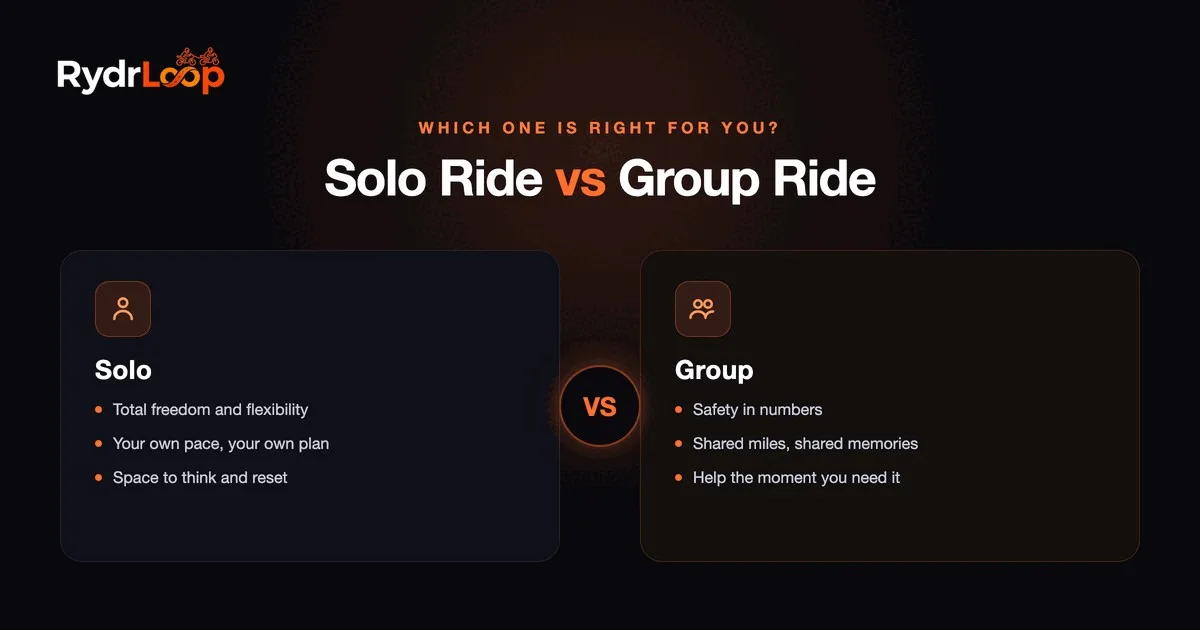
Ask ten riders whether a solo ride or a group ride is better and you'll get ten confident, completely contradictory answers. The rider who swears by solo riding will tell you group rides feel like babysitting someone else's pace. The rider who never rides without their crew will tell you a solo ride is just a ride with nobody to share the good parts with. Both of them are right, about their own riding, and that's really the whole point this debate tends to miss. A solo ride and a group ride aren't competing for the title of correct way to ride a motorcycle. They're two genuinely different experiences that serve different needs, and the actual question worth asking isn't which one wins, it's which one fits what you're looking for from this particular ride.
What Is a Solo Ride, and What Is a Group Ride?
A solo ride means riding on your own: just you and your bike, with no group and no riding partner. You choose the route, set the pace, decide the stops and deal with anything that goes wrong yourself. A group ride means two or more riders heading out together on a shared plan, usually with an agreed meeting point, pace and stops, and often a lead rider at the front and a sweep rider at the back.
The difference sounds obvious, but it changes almost everything about the day, from how you plan to what you carry. If group riding is new to you, our group riding guide explains how a good one runs.
What a Solo Ride Actually Gives You
A solo ride offers something group riding structurally can't: total control over every decision, with nobody else's preferences to factor in. Want to stop for twenty minutes at a viewpoint that wasn't on any plan? A solo ride lets you, instantly, without checking whether anyone else is fine with it. Want to turn back early because the weather's turning or you're just not feeling it? Same answer. There's a particular kind of mental clarity that comes from a solo ride, no conversation to manage, no pace to match, just you, the bike and the road, that riders who love it describe less as a hobby and more as something close to a moving form of quiet.
A solo ride also builds a specific kind of confidence that group riding doesn't, because every problem that comes up, a wrong turn, a change in weather, a mechanical issue, is yours to solve without a group's collective judgment to lean on. Riders who log real solo ride experience tend to develop sharper route-reading instincts and calmer problem-solving under pressure, simply because they've had to.
What a Group Ride Actually Gives You
A group ride offers the thing a solo ride, almost by definition, can't: company, and the specific kind of safety net that comes from not being alone if something goes wrong. A flat tyre, a wrong turn into an unfamiliar area, sudden bad weather, all of these are meaningfully less stressful with three or four other riders there to help than they are on a solo ride with nobody else around.
There's also a social dimension a group ride provides that a solo ride simply doesn't attempt to, the shared conversation at fuel stops, the inside jokes that build over a season of riding together, the specific satisfaction of a group finishing a long, difficult route as a unit rather than as individuals who happened to arrive at the same destination. For a lot of riders, this social layer isn't a bonus on top of the riding, it's the actual reason they keep showing up.
The Honest Downsides of a Solo Ride
A fair comparison means being honest about what a solo ride costs you, not just what it offers. The biggest one is the missing safety net. A breakdown, an injury, even something as ordinary as running low on fuel in an area without an obvious station, is a meaningfully bigger problem alone than it would be with even one other rider present. Solo riders who do serious distance learn to plan around this, but it never fully goes away.
There's also a real, less discussed cost that shows up on longer solo rides: decision fatigue. Every navigation call, every judgment about whether to push on or stop, every read on changing weather, is entirely yours on a solo ride, with no second opinion to share the mental load. Riders who've done long solo trips often describe a specific kind of tiredness by the end of a long day that isn't just physical, it's the accumulated weight of making every single call alone.
The Honest Downsides of a Group Ride
A group ride has its own costs, and they're just as real. The most obvious is the loss of spontaneity. A group ride runs on a plan the group agreed to, which means the sudden impulse to take an unplanned turn just to see where it goes, one of the specific pleasures of a solo ride, mostly isn't available once you're moving with others who are counting on the plan holding.
Pace is the other major cost. A group ride moves at the pace of its group, not any one rider's ideal pace, and that can mean either holding back more than you'd like or pushing harder than you're fully comfortable with, depending on where you land in the group's skill range. And there's a social cost too, even a well-run group ride requires a degree of coordination, communication and compromise that a solo ride simply never asks of you.
If You Value Freedom and Flexibility Above Everything, Choose a Solo Ride
If what actually draws you to riding is the freedom of it, the ability to change the plan mid-ride, stop whenever something catches your eye, turn back the moment you're not feeling it, a solo ride is doing exactly what it's built for. This is also often the right call when your schedule is unpredictable and coordinating with a group feels like more friction than the ride is worth, or when what you're actually craving is quiet, uninterrupted time with your own thoughts rather than conversation.
New riders sometimes assume a solo ride is something to work up to after enough group riding experience, but plenty of confident, experienced riders choose solo riding specifically, not as a stepping stone to anything, but because it's genuinely the riding experience they prefer most weekends.
What a First Solo Ride Should Actually Look Like
If you're leaning toward trying a solo ride for the first time, the version most new riders imagine, a long, ambitious route into unfamiliar territory, is usually the wrong place to start. A first solo ride works best short, on roads you already know reasonably well, with a clear turnaround point decided before you leave rather than a vague sense of "as far as feels good." This isn't about lacking confidence, it's about building the specific skill a solo ride demands, handling every decision alone, in small enough doses that a genuine problem stays manageable if one comes up.
Telling someone your route and rough return time before you leave matters more for a solo ride than it ever does before a group ride, precisely because there's no one else along to notice if something's gone wrong. It costs nothing and it's the single most effective safety habit a solo rider can build. Running through a proper pre-ride checklist matters more here too, a mechanical issue that a group might collectively catch and fix at a fuel stop is entirely yours to handle alone on a solo ride, so catching it before you leave is worth the extra five minutes.
Extend the distance and unfamiliarity gradually from there. A rider who's comfortable with a 40 km solo ride on known roads is in a genuinely different position than one attempting a 300 km solo ride into territory they've never seen, and treating those as the same activity, just longer, undersells how much the decision-making load actually grows with distance and unfamiliarity combined.
If you want somewhere to start, we put together bike trips that suit a first solo ride.
If You Value Safety and Shared Experience, Choose a Group Ride
If the appeal of riding, for you, includes the people as much as the road, a group ride is where that actually lives. This is also the more sensible default for longer, more remote or less familiar routes, where the safety net a group provides matters more than it does on a short, well-known solo ride close to home. New riders building highway or long-distance confidence often find a group ride gives them a far gentler introduction than doing the same distance alone for the first time, there's simply more margin for a mistake to be caught early by someone else.
A group ride also tends to suit riders who genuinely enjoy the planning and social side of riding as much as the riding itself, the anticipation of a ride with friends, the shared photos afterward, the running jokes that build over a season together.
The Riders Who Genuinely Need Both
Most experienced riders, if you push past the loyalty either camp claims to their preferred style, will admit they actually want both, just for different reasons and different moods. A solo ride after a stressful week, when what you need is quiet more than company. A group ride for a long-planned weekend trip, when the safety net and shared experience matter more than flexibility. Neither preference cancels the other out, and treating this as a permanent identity, "I'm a solo rider" or "I only ride in groups", tends to close off exactly the kind of riding that would have suited a specific day better than the default you've settled into.
The riders who get the most out of motorcycling long-term tend to be the ones who ask the question fresh each time, not the ones who've picked a side and stopped reconsidering it.
How to Decide for a Specific Ride, Not Forever
Rather than trying to settle solo versus group riding as a permanent identity, it helps to ask a few honest questions before each specific ride. What do you actually want out of today, quiet and flexibility, or company and safety net? How familiar is the route, and how comfortable are you handling an unexpected problem entirely on your own if the route turns out harder than expected? How much are you craving spontaneity today versus a plan you can relax into without having to make every call yourself?
A short solo ride on a familiar road rarely needs much deliberation. A long, remote or unfamiliar route is where this question is worth genuinely sitting with, because the downsides of getting it wrong scale up with distance and unfamiliarity in a way a quick weekend loop simply doesn't.
Safety Considerations That Actually Differ Between the Two
It's worth being specific about how the real safety profile differs, because the general sense that "group riding is safer" undersells exactly where that safety comes from. A group ride's safety advantage is almost entirely about response to a problem after it happens, more eyes to notice an issue, more hands to help with a breakdown, someone to call for help while another rider stays with you. A solo ride doesn't have this at all, which is exactly why route familiarity, planning and telling someone your route and expected return time matter so much more when riding alone.
What a group ride doesn't inherently fix is rider-level risk, overconfidence, poor gear, fatigue, all the mistakes covered elsewhere on this blog happen just as often in a group as they do solo, sometimes more, when a rider pushes pace to keep up rather than riding within their own limits. A solo ride forces you to ride entirely within your own judgment. A group ride adds a safety net, but only if you're still making sound decisions within it.
The Gear Question: Does It Change Between Solo and Group Rides?
Gear expectations don't drop for a group ride, but what you genuinely need to carry does shift depending on which style you're riding. A solo ride asks more of your self-sufficiency than a group ride does, a basic tool kit, a puncture repair kit, a portable air pump and a charged phone matter more when there's no one else's kit to fall back on if yours is missing something. Riders who do a lot of solo riding tend to carry more than riders who mostly ride in groups, not because the group ride is inherently safer, but because a group naturally pools resources a solo rider has to carry entirely on their own.
Protective gear itself, helmet, jacket, gloves, boots, doesn't really change between the two, the risk from the road and the speed you're riding at is identical whether you're alone or with five other riders. What changes is the margin for a gear gap to go unnoticed. A solo rider who skips proper gear has nobody to notice or say anything before it becomes a problem. A rider doing the same in a group is far more likely to get a pointed comment from someone who's noticed, which, awkward as it can feel in the moment, has genuinely talked more than one rider out of a bad decision before it became a costly one. If you're building or reviewing your kit either way, this breakdown of gear actually worth buying covers what matters most regardless of which style you ride more often.
What Experienced Riders Actually Do
Talk to riders with a decade or more on two wheels and a pattern shows up that the solo-versus-group debate rarely accounts for: most of them do both, deliberately, and treat the choice as situational rather than an identity worth defending. A solo ride on a Tuesday evening after a long day at work, because what they need is quiet, not conversation. A group ride for the annual long weekend trip, because the safety net and shared memories matter more when the stakes and distance are higher. Neither choice is treated as a compromise or a fallback, both are simply the right tool for that particular day.
What experienced riders tend to avoid is exactly the trap newer riders fall into most often, picking one style early and treating the other as somehow lesser or unnecessary. A rider who only ever does group rides often hasn't built the self-sufficient judgment a solo ride teaches. A rider who only ever rides solo often hasn't learned the coordination and trust-building that make a good group ride work. Doing both, even occasionally, tends to make a rider genuinely better at whichever one they prefer most.
How RydrLoop Supports Both Ways of Riding
This isn't really an either-or question RydrLoop expects you to answer once and commit to. You can plan and log a solo ride on your own terms, at your own pace, on routes you choose entirely for yourself, and just as easily browse group rides nearby when what you're after that weekend is company and a shared plan. Seeing a group ride's pace, distance and route before committing removes most of the guesswork about whether it's the right group ride for where you're at, and nothing about using it for one style locks you out of the other next time you're in a different mood.
The Practical Difference in Cost and Logistics
It's a small point compared to everything above, but worth mentioning honestly: a solo ride carries zero coordination overhead. No agreeing on a date that works for six people, no waiting for someone running late, no group decision about where to stop for lunch. If your schedule is unpredictable or you simply don't want the back-and-forth of planning with others, a solo ride removes that friction entirely, you decide, you go.
A group ride flips this. The coordination cost is real, but so is what you get back for it, tolls and fuel on longer routes often get split across the group, making an expensive long-distance trip noticeably cheaper per rider than doing the same route alone. There's also a practical redundancy a group ride provides that's easy to overlook until you need it, one rider's tool kit covers a gap in another's, one rider's local knowledge saves the group a wrong turn nobody else would have caught. None of this changes which style is right for you, but it's worth factoring in honestly rather than deciding purely on the more romantic version of either.
The Same Route Feels Different Depending on Who's With You
Ride the exact same stretch of road twice, once as a solo ride and once as part of a group, and you'll come back with two genuinely different experiences, not just a faster or slower version of the same one. Alone, a good corner or a sudden view tends to become an internal moment, something you notice and hold onto privately, maybe replay in your head for the rest of the ride. With a group, the same corner becomes something shared the second you're off the bike, retold at the next stop, laughed about, remembered collectively rather than individually.
Neither version is better, but they leave genuinely different marks. Riders who've done both consistently describe their most memorable solo ride in almost meditative terms, the quiet, the total absorption in the road with nothing else competing for attention. The same riders describe their most memorable group ride in almost the opposite language, the shared moment, the story that became a running joke, the sense of having gone through something together rather than alone. If you're choosing between a solo ride and a group ride and genuinely can't decide, it's worth asking which of those two feelings you're actually chasing today, the internal or the shared, because that answer usually settles it faster than any practical checklist can.
Final Thoughts: There's No Wrong Answer, Only the Wrong Ride for the Day
A solo ride and a group ride aren't rivals, whatever the more passionate riders on either side might argue. They're two different tools built for two different needs, quiet and total freedom on one side, company and a shared safety net on the other, and the riders who get the most out of motorcycling long-term are usually the ones who stay comfortable reaching for either, depending on what a specific ride actually calls for. Next time you're planning one, skip the identity question entirely and ask the simpler one instead: what do I actually want out of today's ride? The answer will tell you which one to choose far more reliably than any argument about which is objectively better.
Whichever you choose this weekend, plan it on RydrLoop, log a solo ride entirely on your own terms, or browse group rides nearby when what you want is company instead.
Comments (0)
Join the conversation. Your thoughts matter!
Be the first to share your thoughts.